


What Is Answer Engine Optimization AEO and Why Should You Care?
What Is Answer Engine Optimization (AEO) and Why It Matters in 2026
If you have been hearing more about AI answers, zero-click search, and tools like ChatGPT or Perplexity, you are not imagining it. Answer engine optimization helps your brand show up where people are increasingly getting answers, not just where they used to click search results.
Key Takeaways
- AEO helps your content become clear, trusted, and easy for AI answer engines to cite.
- Strong SEO still matters, but rankings alone do not guarantee visibility inside AI-generated answers.
- The best AEO content gives direct answers, uses clear structure, and reinforces your brand as a trusted entity.
- AI visibility is shaped by on-page clarity, technical access, schema, freshness, and trusted third-party mentions.
- AuraSearch helps brands find where they are missing from AI answers and build a practical path toward more citations.
I am Amber Brazda, AI Search Specialist at AuraSearch. I help brands connect traditional search authority with the new world of Generative Engine Optimization (GEO), so their content is not just published, but understood and cited by AI systems. In this guide, we will walk through what answer engine optimization means, why it matters now, and how to start building a strategy that can keep working as search changes.
Answer engine optimization, or AEO, is the practice of structuring content so AI-powered systems like ChatGPT, Perplexity, Google AI Overviews, and Gemini can understand, trust, and cite your brand as a direct answer to user questions.
Here is a quick summary:
| Element | What It Means |
|---|---|
| Goal | Get cited inside AI-generated answers, not just ranked in blue links |
| Target platforms | ChatGPT, Perplexity, Google AI Overviews, Gemini, voice assistants |
| Core tactics | Direct answer blocks, FAQ schema, entity clarity, off-page citations |
| Success metric | Brand mentions and citation share, not only clicks and rankings |
| Relationship to SEO | AEO builds on SEO foundations, it does not replace them |
How Answer Engine Optimization Works
The shift from traditional search results to conversational AI interfaces is a real change in how people discover businesses. Traditional SEO helps your page rank in a list of results. AEO helps your brand earn a place inside the direct answer the user actually reads.
To succeed in this landscape, it helps to understand how generative engines retrieve and present information. Global analysis from PwC on Answer Engine Optimization explains that AI platforms behave less like simple keyword indexes and more like synthesized decision engines. They look for relationships between entities, brands, topics, and user intent.
That matters because buyers are already using AI search to compare vendors, define problems, and build shortlists. If your content is hard to extract, vague about your expertise, or missing corroboration from trusted sources, AI systems may skip it even when the page performs well in traditional search.
AEO is not a replacement for SEO. It is the next layer on top of it. Our guide to Answer Engine Optimization 101 explains how SEO creates the crawlable foundation, while AEO makes that authority easier for AI systems to interpret and cite.
The difference becomes clearer when you compare AEO with broader AI search visibility. Our article on AEO vs GEO shows how AEO focuses on answer retrieval and citations, while GEO covers the wider way a brand is represented across generative engines and model-informed discovery.
For a prospective customer, the business case is simple. If an AI assistant recommends three providers and your brand is not one of them, you may never enter the conversation. If your brand is cited clearly and confidently, you gain visibility at the exact moment a buyer is asking for help.
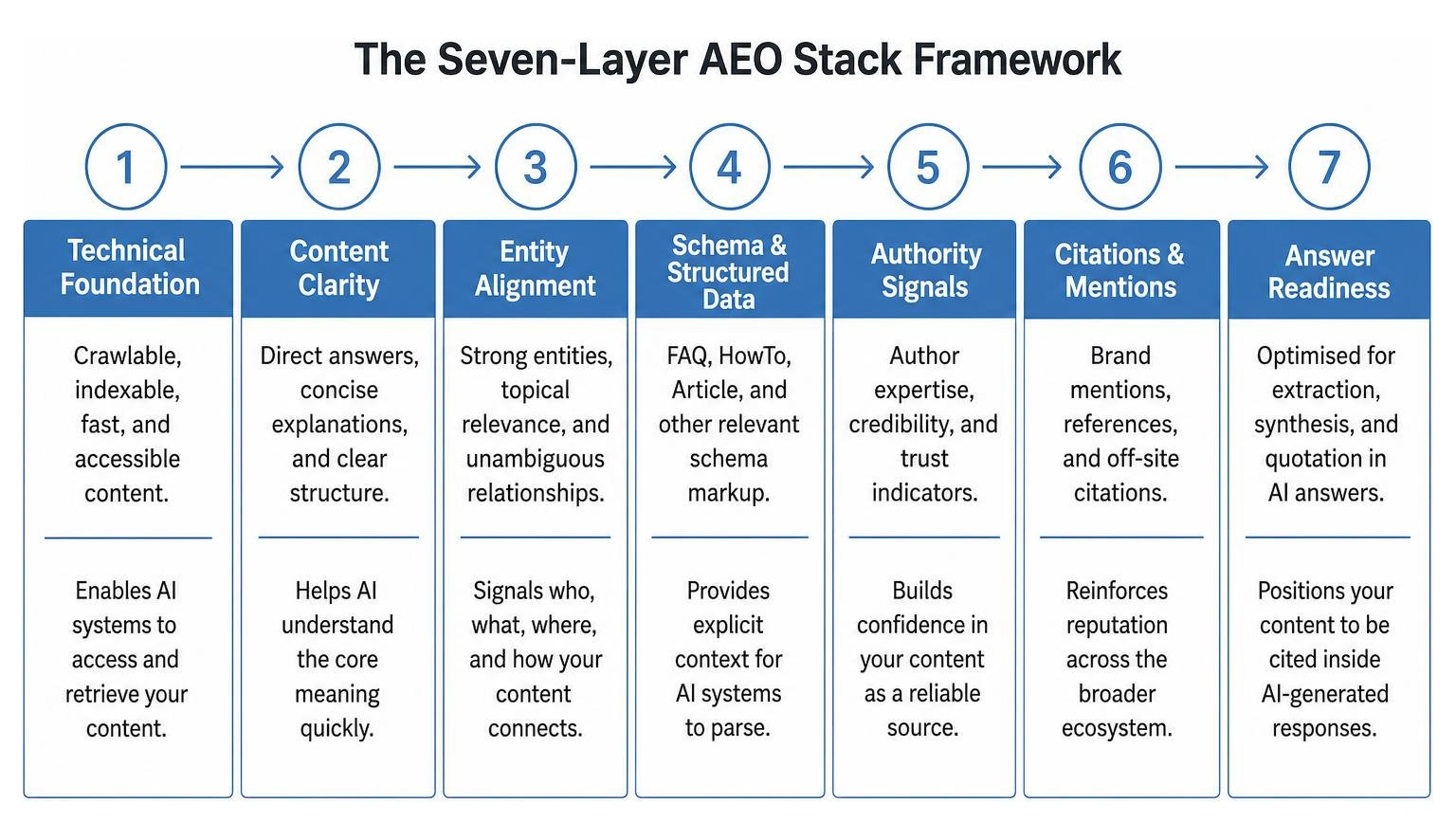
A practical AEO strategy usually includes seven layers:
- Entity clarity : Define clear relationships between your brand, people, products, services, and category.
- Schema markup : Use structured data to help machines interpret page types, authors, FAQs, and organizational details.
- Direct-answer content : Add concise answer blocks near the top of important informational pages.
- Citation surface area : Earn trusted mentions across industry publications, reviews, communities, and relevant third-party sites.
- Technical access : Make sure AI crawlers and search engines can access and render the page.
- Freshness : Keep important content updated so answer engines can trust that it reflects the current market.
- Brand demand : Build real brand awareness, because branded searches and mentions can reinforce how AI systems understand your authority.
When these layers work together, your content becomes easier to retrieve, easier to trust, and easier to cite. AuraSearch’s Generative Engine Optimization services are built to help brands monitor AI visibility, improve entity signals, and structure content for the way answer engines actually read.
How AuraSearch Helps Brands Win in AI Search
As search shifts from links to direct answers, staying visible takes more than publishing another blog post. You need to know where your brand appears, where competitors are being cited instead, and which signals will make your content more useful to AI answer engines.
AuraSearch helps businesses improve visibility across traditional search and emerging AI platforms like ChatGPT, Perplexity, and Google AI Overviews. Our approach connects SEO fundamentals with entity optimization, answer-ready content, and off-page corroboration, so your brand is easier for AI systems to understand and recommend.
Instead of guessing what AI engines might cite, we help you identify gaps, strengthen the pages that matter, and build a clearer presence across the sources answer engines already trust. The goal is straightforward: help your brand become part of the answer when prospects are actively looking for guidance.
FAQs
What is answer engine optimization?
Answer engine optimization is the practice of structuring and formatting content so AI-powered systems can easily extract, trust, and cite it as a direct answer to user questions. It focuses on machine readability, semantic clarity, and entity recognition rather than simple keyword density.
How does answer engine optimization differ from traditional SEO?
Traditional SEO focuses on ranking webpages in search engine results to drive clicks to a website. AEO focuses on getting a brand mentioned and cited directly inside the AI-generated answer itself. The two work together: SEO builds the technical and authority foundation, while AEO makes that information easier for AI systems to use.
Why is AEO important for brands in 2026?
AEO is important because search behavior is moving toward conversational and zero-click experiences. If people ask AI tools for recommendations, comparisons, or definitions, your brand needs to be understandable and trustworthy enough to appear in those answers.
How do AI engines like ChatGPT and Perplexity select sources?
AI engines often use retrieval and synthesis processes that evaluate relevance, trust, clarity, and extractability. They tend to favor pages that answer the question directly, use clear structure, explain entities consistently, and are supported by credible mentions across the web.
What are the best practices for structuring AEO content?
Start each important section with a clear answer, keep paragraphs focused, use question-based headings where natural, and add structured data such as FAQPage schema when appropriate. It also helps to keep pages fresh and make brand, service, and author information easy to understand.
How should brands measure AEO success?
Brands should track citation rate, share of voice, and brand mentions across major AI engines, not just organic rankings and clicks. It is also useful to monitor AI referral traffic, branded search demand, and assisted conversions from visitors who discover the brand through AI platforms.