



How to Improve Agent AI Search Rankings Without Overpromising
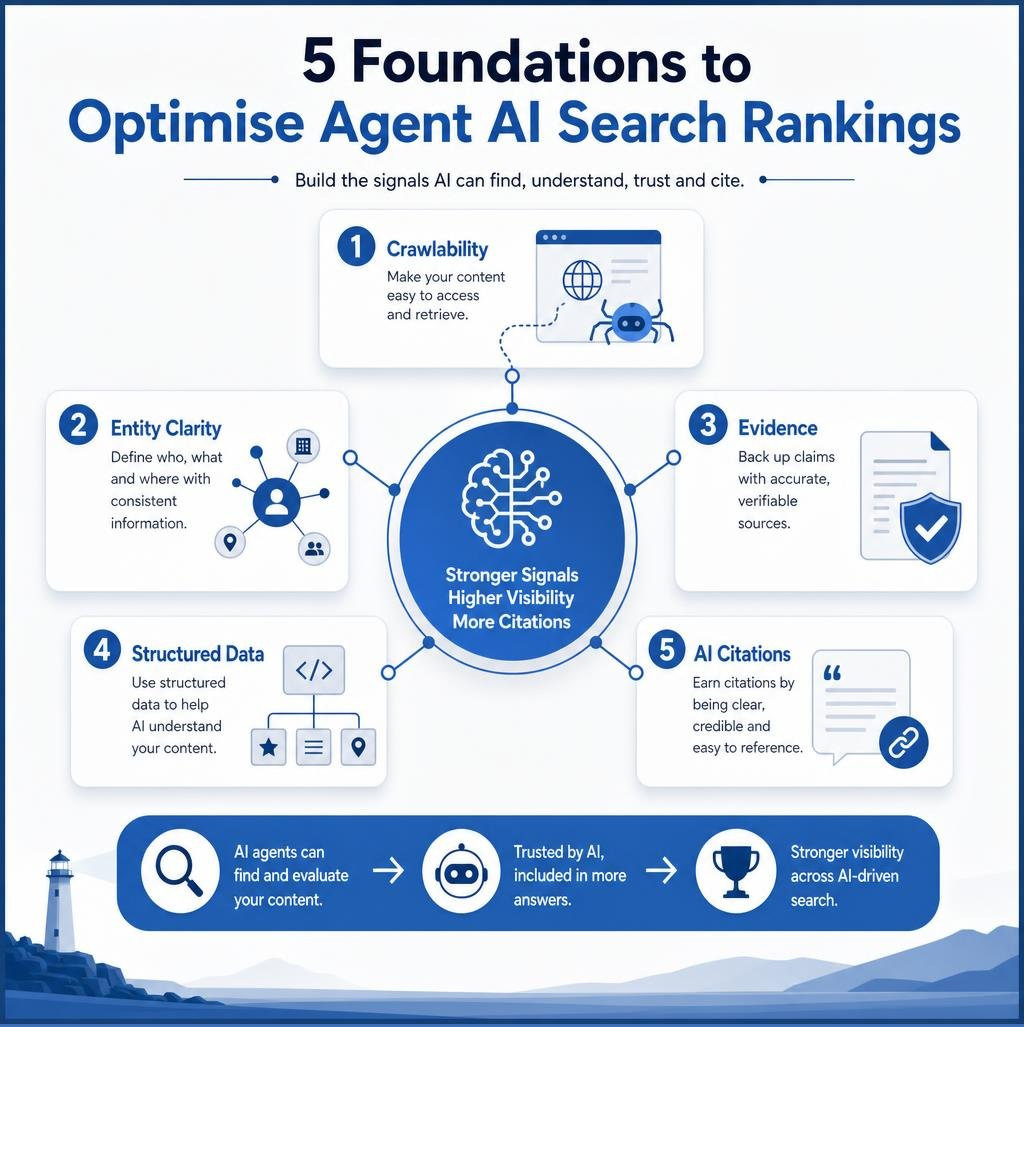
Improving agent AI search rankings starts with pages that AI systems can crawl, understand, verify, and cite. Strong results come from clear technical access, accurate entity signals, helpful answers, and evidence-led content.
Key Takeaways
- AI search visibility depends on crawlable pages, structured content, clear entities, and evidence.
- Generative Engine Optimisation (GEO) builds on Search Engine Optimisation (SEO) by making brands easier for AI systems to retrieve and cite.
- Australian businesses should avoid unsupported claims, non-Australian references, and tactics that imply control over third-party platforms.
- AuraSearch™ helps organisations assess readiness and citation likelihood through Generative Engine Optimisation strategy.
- The right approach improves visibility foundations without promising fixed rankings or guaranteed AI placements.
I am Amber Brazda, an AI Search Specialist at AuraSearch™, with a background in building traditional search authority and applying it to Generative Engine Optimisation (GEO). My work helps organisations improve AI search visibility by strengthening clarity, evidence, technical readiness, and citation likelihood.
Why Agent AI Search Visibility Needs a Stronger SEO Foundation
AI search visibility needs a stronger SEO foundation because AI systems still depend on accessible, well-structured, and trustworthy source material. A page must answer intent early, use semantic headings, and make details easy for crawlers and AI agents to interpret.
This approach supports visibility across Google, Bing, Google AI Overviews, ChatGPT, Perplexity, and Claude. It does not guarantee a citation, recommendation, ranking, traffic increase, or commercial outcome.
Traditional SEO aims to rank a page in search results. GEO also makes a brand and its evidence easier to retrieve, understand, verify, and cite within an AI-generated response.
The practical response is to strengthen technical access, clear answers, authentic expertise, entity consistency, and useful information.
A Practical Framework to Improve Agent AI Search Rankings
A practical framework connects technical access, content clarity, entity authority, and measurement. Businesses that want to improve agent AI search rankings need each layer to work together.
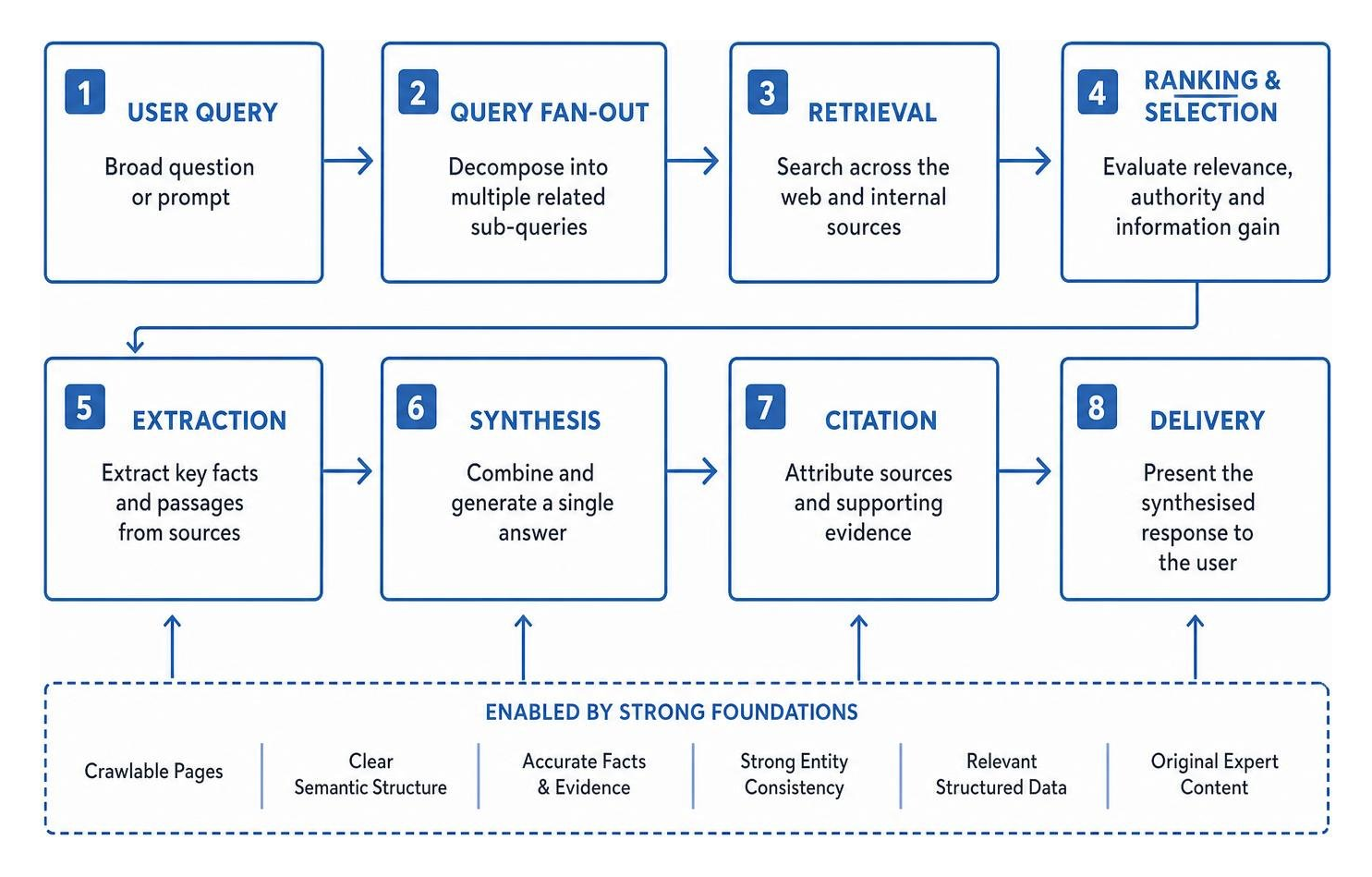
Modern search engines use retrieval systems to evaluate and assemble answers. Generative engines often use Retrieval-Augmented Generation (RAG), which helps a model locate relevant passages and produce a synthesised response.
Query fan-out can break a broad prompt into related sub-queries before the system forms an answer. That makes topic depth, internal links, and consistent entity information more useful than repeating a keyword.
Vector embeddings map words and concepts mathematically, so search systems can assess meaning rather than isolated exact-match phrases. Content should use natural wording around the topic, including phrases such as improving AI search visibility and optimising agent-led discovery.
AuraSearch applies this framework through audits, technical review, content strategy, and transparent reporting. Organisations can explore AI search services for a pathway from technical diagnosis to ongoing optimisation.
Technical Foundations for Agent AI Search Visibility
Technical foundations determine whether AI crawlers and autonomous browser agents can access the page. Clean semantic markup, accessible structure, server-side rendering, and reliable internal links help crawlers process content accurately.
Autonomous browser agents read the accessibility tree, Document Object Model (DOM), and rendered HTML. Clear headings, descriptive image alt text, and logical content order reduce the risk that an agent misreads important information.
Server-side rendering remains important for technical discovery. Client-side JavaScript that delays text rendering can make service descriptions and supporting content harder for crawlers to access.
JSON-LD schema markup gives search systems machine-readable context across commercial and informational assets. Planned schema connects organisations, services, authors, and educational resources without relying on vague page copy alone.
Crawler permissions also need careful governance. Reviewing robots.txt helps prevent accidental blocking of dedicated AI user agents such as GPTBot, ClaudeBot, PerplexityBot, and OAI-SearchBot.
Core Web Vitals support user experience and crawler interaction. AuraSearch reviews these technical signals as part of AI Overview optimisation work, without implying that any single metric controls AI citation outcomes.
Content Structure and Entity Authority
Content structure helps AI systems extract clear statements from a page. Strong pages open with the answer, then add context, evidence, definitions, and commercial relevance in a logical order.
| Traditional SEO Factors | Generative AI Citation Factors |
|---|---|
| Keyword relevance and search intent alignment | Clear answers and verifiable entity relationships |
| Crawlability and internal links | Machine-readable context and structured evidence |
| Metadata and heading quality | Extractable passages and answer-ready formatting |
| Topic clusters and authority signals | Cross-source consistency and useful information gain |
High fact density does not mean overloading the article with unsupported numbers. It means replacing vague claims with clear definitions, primary-source references where available, accurate service descriptions, and examples that match the organisation’s expertise.
Entity authority also depends on consistency. Search systems compare the organisation’s name, services, author information, contact details, and topic coverage before deciding how much confidence to place in a source.
Australian content should follow Australian English and compliance expectations. That includes avoiding non-Australian research references when the brief requires Australian-only sources, and avoiding claims that could mislead under Australian Consumer Law principles.
AuraSearch integrates these controls into topic planning, page briefs, and optimisation reviews. The goal is to improve citation likelihood and search visibility while keeping content accurate.
Workflow for Sustainable AI Search Optimisation
Sustainable AI search optimisation needs an operating rhythm, not a one-off page edit. Search behaviour, platform retrieval patterns, and competitor content can shift, so brands need a repeatable process.
The workflow should cover research, strategy, writing, technical audit, monitoring, and remediation. Each stage has a purpose, from mapping search intent and entities to checking whether published content remains crawlable and useful.
Human review remains essential because AI tools can accelerate analysis without replacing strategic judgement. Editorial governance, brand alignment, source quality, and compliance review should stay with experienced specialists.
Model Context Protocol (MCP) can help agents interface with structured documentation and data stores where suitable. That technical layer should support clarity and access, not replace sound content strategy.
Long-Term Visibility Across AI Engines
Long-term visibility across AI engines depends on consistent management of signals that platforms can verify. Isolated quarterly audits rarely keep pace with changing retrieval patterns, content updates, and shifting brand mentions.
Cross-platform consistency acts as a verification gate for conversational search models. Inconsistent organisation names, service descriptions, locations, and author signals can reduce confidence and make a source less likely to appear in synthesised answers.
AuraSearch approaches long-term visibility as a managed system. Technical crawl access, topic authority, entity clarity, structured data, and performance reporting all need regular review.
Tactics That Do Not Improve AI Search Visibility
Some tactics sound specific to AI search but do not create reliable visibility. Artificial markdown files, excessive micro-chunking, keyword repetition, and hidden prompt instructions can distract from fundamentals that search systems can evaluate.
Major search features continue to rely on standard crawling, indexing, and quality assessment. Clean HTML, accurate content, internal links, schema markup, and reputable source signals remain central.
Unnatural keyword stuffing weakens readability and can reduce trust. The target phrase should become grammatical within the sentence, as in “improve agent AI search rankings” or “optimising agent AI search visibility”, rather than being forced into copy exactly where it does not fit.
Measuring AI Engine Synthesis and Brand Discovery
Measuring AI engine synthesis requires more than standard rank tracking. Brands need to review where they are mentioned, cited, omitted, or misrepresented across ChatGPT, Google AI Overviews, Perplexity, Claude, Google, and Bing.
Traditional analytics can show organic visibility, but AI search reporting needs a broader view of prompts, citations, source attribution, and brand presence. This helps teams understand whether content is being retrieved in the right commercial contexts.
Some informational queries may be answered before the user reaches a website. That does not make website content less important, because AI systems still need reliable source material.
Search Console reporting can support parts of this picture for Google surfaces. Dedicated GEO reporting adds another layer by tracking visibility in AI-generated responses and comparing citation patterns over time.
AuraSearch supports this measurement work through ChatGPT SEO, technical review, and GEO strategy. The purpose is to improve visibility foundations and reporting clarity, not to promise fixed third-party outcomes.
Building Sustainable AI Search Visibility With AuraSearch
AuraSearch fits this AI search challenge because agent-led discovery rewards clear sources, strong technical foundations, and credible information architecture. Businesses need content that search engines can crawl, AI systems can interpret, and human decision-makers can trust.
The approach combines human-led strategy with AI-assisted analysis, technical auditing, entity optimisation, and transparent performance reporting. This gives organisations a practical way to improve citation likelihood without overstating control over third-party systems.
AuraSearch can assess machine readability, identify visibility gaps, and prioritise improvements across content, schema, internal linking, and AI search reporting.
For a focused review of search visibility and citation potential, organisations can contact the team to discuss a practical AI search optimisation pathway.
FAQs
What is the difference between traditional SEO and Generative Engine Optimisation (GEO)?
Traditional SEO focuses on improving visibility within standard search result pages. Generative Engine Optimisation (GEO) focuses on making content easier for AI systems to retrieve, understand, verify, and cite inside synthesised answers.
How can a business improve agent AI search rankings?
A business can improve agent AI search rankings by strengthening crawlability, semantic structure, entity consistency, answer clarity, and evidence quality. These improvements help AI systems interpret the content more confidently, but they do not guarantee a citation or ranking.
Do websites need specialised files like llms.txt to appear in AI search engines?
Specialised files are not mandatory for visibility in major search features. Clean crawl access, indexable pages, structured content, and high-quality source material remain more dependable foundations for AI search visibility.
How do autonomous AI browser agents interact with web pages?
Autonomous agents read page structure through signals such as the accessibility tree, the Document Object Model (DOM), and rendered HTML. Clear headings, accessible markup, descriptive image alt text, and fast rendering help agents understand the page more accurately.
Why does listings accuracy matter for generative search?
Listings accuracy matters because conversational models may compare business details across websites, directories, and other third-party sources. Consistent names, services, locations, and contact details support stronger entity confidence.
Can AuraSearch guarantee placement in AI-generated answers?
AuraSearch cannot guarantee placement in AI-generated answers because third-party platforms control their own retrieval and ranking systems. AuraSearch improves the technical, content, and entity signals that can support visibility and citation likelihood over time.