
How to Rank in ChatGPT Answers Through Stronger AI Search Visibility
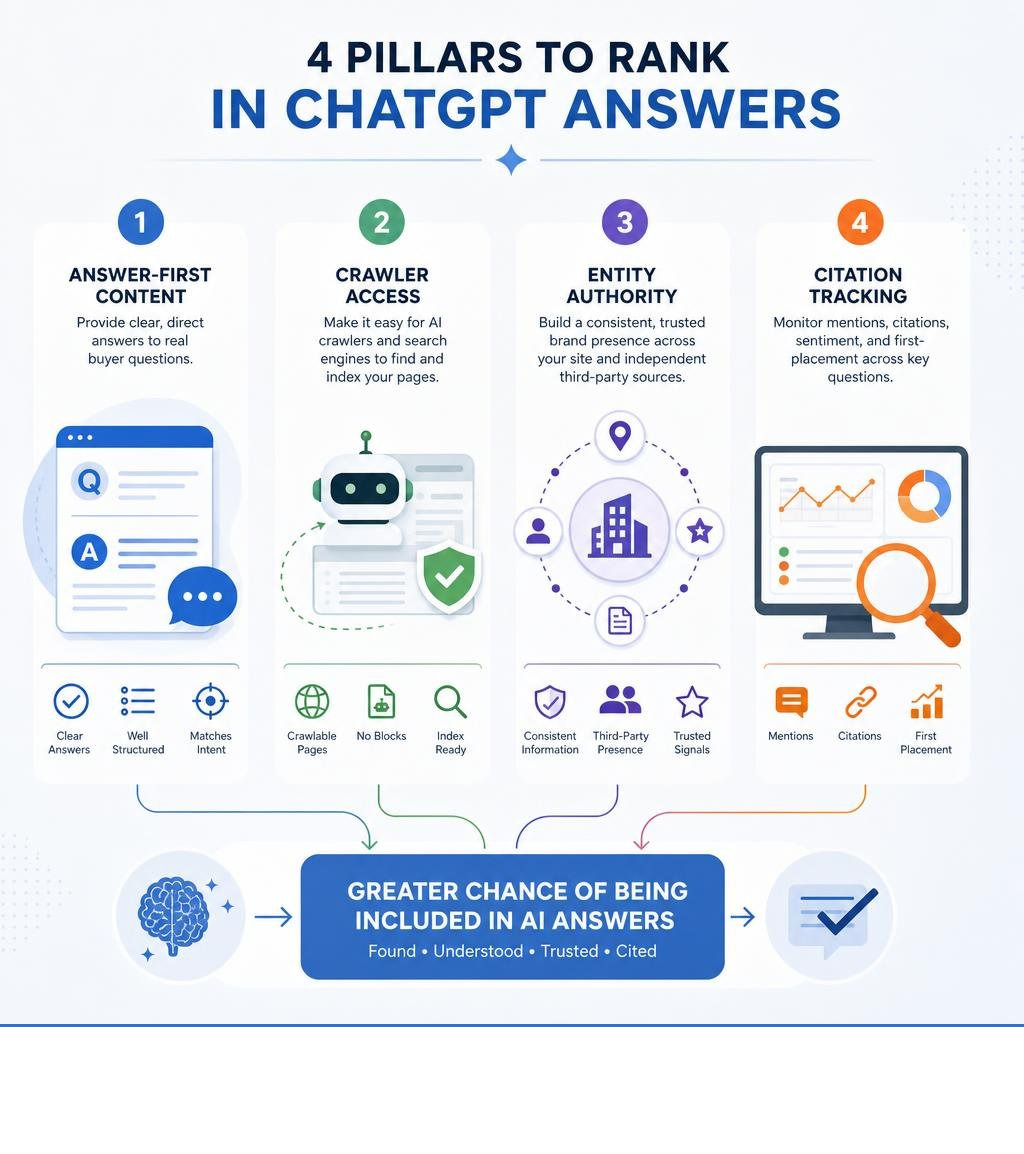
To rank in ChatGPT answers, a brand needs answer-first content, crawlable pages, clear entity signals, and trusted sources that support its claims. The practical goal is to make the business easy for AI systems to understand, verify, and cite when people ask service, product, or provider questions.
Key Takeaways
- Publish clear, self-contained answers to real buyer questions on crawlable web pages.
- Keep core services, products, expertise, and Australian market relevance consistent across owned and third-party sources.
- Ensure Bing can index important pages and OpenAI crawlers are not blocked in robots.txt.
- Track brand mentions, citations, sentiment, and first-placement frequency across a fixed prompt set.
- Use the AuraSearch™ services page to connect technical search engine optimisation (SEO), Generative Engine Optimisation (GEO), and transparent AI search reporting.
I am Amber Brazda, AI Search Specialist at AuraSearch™, with experience connecting traditional search authority to Generative Engine Optimisation (GEO) for specialist and national brands. This guide explains how to rank in ChatGPT answers by strengthening the content, technical, and authority signals that shape AI search visibility.
ChatGPT does not offer a standard list of ranked web pages. It creates a single response by interpreting the question, retrieving relevant sources when search is used, and combining those sources into an answer.
This shift affects visibility across ChatGPT, Google AI Overviews, Perplexity, Claude, Google, and Bing. Strong traditional SEO remains the foundation, but AI search also rewards pages with clear explanations and credible web-wide consensus.
Introduction: Understanding the Shift to AI Search
Conversational artificial intelligence is changing how people discover businesses online. Instead of scanning a page of search results, a prospective customer can ask a detailed question and receive a direct answer that compares options, explains trade-offs, and points to sources.
Australia's policy environment recognises artificial intelligence as a strategic technology area through government guidance on responsible AI adoption. For search teams, that shift makes AI visibility a practical discovery challenge rather than a speculative channel.
Modern AI discovery often uses query fan-out, where one prompt breaks into several background searches. A question about business software may prompt the system to look for features, user sentiment, pricing structures without quoting specific costs, and implementation details before it drafts a response.
Zero-click searches are expanding as conversational interfaces provide structured recommendations inside the chat itself. Prospective customers may not visit a website if the generated answer already satisfies their research intent.
Answer synthesis favours contextual relevance, factual extraction, and category clarity over keyword repetition. The engine extracts discrete claims, comparisons, and brand attributions from authoritative web content, then uses those signals to shape the final response.
Core Framework to Rank in ChatGPT Answers
Retrieval pipelines usually move through query understanding, document retrieval, context grounding, and final answer synthesis. When a prompt needs live information, the model can use web indexes to gather candidate URLs. A brand needs technical access, clear page structure, and external trust signals to pass through those layers.
ChatGPT search visibility often depends on whether important pages can be discovered through major web indexes, including Bing, alongside specialised retrieval systems. If a website blocks key crawlers or leaves important pages out of indexation workflows, those pages are less likely to enter the candidate pool.
AuraSearch™ aligns technical execution with foundational ChatGPT SEO principles to create clearer retrieval pathways. The aim is to improve the quality, consistency, and accessibility of the signals AI systems can evaluate.
| Optimisation Element | Traditional Search Engines | ChatGPT and AI Answer Engines |
|---|---|---|
| Primary Metric | Rank position on a results page | Inclusion, brand citation, and mention tier |
| Index Source | Proprietary web index such as Google | Bing index paired with targeted live crawling |
| Content Evaluation | Page-level topical relevance and backlink volume | Passage-level extractability and semantic factual density |
| Brand Recognition | Anchor text and hyperlink graphs | Digital consensus, unlinked entity mentions, and reviews |
| Output Format | Paginated lists of standalone web URLs | Synthesised prose featuring direct product recommendations |
Technical crawler access governs whether an engine can parse target material during live browsing events. Restrictive web application firewalls or legacy exclusion directives can prevent answer engines from evaluating critical product and service pages.
What It Takes to Rank in ChatGPT Answers
Passage-level clarity influences source selection during real-time grounding. Generative models favour content that names specific services, explains use cases, and connects brand entities with verified attributes in plain language.
A Bottom Line Up Front (BLUF) format helps language models extract conclusions cleanly. A short, direct answer beneath a descriptive heading gives the system a compact unit of meaning.
Early placement also matters. The most definitive explanation should appear near the start of a section, because AI systems often rely on the clearest retrieved passages when assembling an answer.
Mapping content across Category Entry Points (CEPs) helps cover different buying occasions. Strong topic clusters answer related commercial questions in several practical contexts.
Technical and Structural Foundations for LLM Crawling
Server-side rendering remains important for artificial intelligence accessibility. Modern large language model (LLM) crawlers need fast, raw HTML access and may not fully process heavy client-side JavaScript. Product specifications, service definitions, and company credentials should appear in the initial server response.
Robots.txt files require deliberate configuration for artificial intelligence user-agents. OpenAI operates distinct automated crawlers, including GPTBot for model training and OAI-SearchBot for search retrieval. Allowing appropriate access helps preserve discoverability across live search operations.
Comprehensive JSON-LD schema markup creates clearer machine-readable relationships. Organization, Product, Service, and FAQPage schema can clarify business attributes, service categories, and page purpose for automated systems.
Indexation still matters. Submitting XML sitemaps through established webmaster platforms, monitoring crawl status, and resolving technical blockers give AI retrieval systems a stronger base to work from.
Building Off-Page Consensus and Entity Authority
Language models build recommendation confidence by cross-referencing claims across independent sources. If self-published claims lack outside corroboration, the brand may be less likely to appear in commercial recommendations.
Unlinked brand mentions across reputable publications can still serve as contextual anchors. These mentions help associate a business entity with specific services, sectors, and areas of expertise.
Customer reviews across verified platforms provide natural language signals about experience, service quality, and fit. Consistent sentiment, accurate descriptions, and clear service details all help AI systems understand where a brand belongs.
Connecting digital entities to public knowledge bases such as Wikidata can also clarify brand taxonomy. A cohesive entity footprint reduces inaccurate descriptions and supports consistent categorisation across search and conversational interfaces.
Tracking, Measurement, and AI Strategy Execution
Tracking generative engine visibility starts with prompt libraries that reflect real buyer intent. Marketing teams need a consistent set of non-branded questions that mirror how prospective customers compare providers, assess services, and shortlist options.
Conversational responses vary from session to session, so one test prompt rarely tells the full story. A monthly measurement cadence gives teams a better view of persistent patterns, including when a brand is mentioned, cited, recommended early, or omitted.
Share of Model (SoM) is a useful metric for measuring presence across generative platforms. It looks at the share of relevant prompts where a brand appears as a cited or recommended provider. Teams can discuss a structured measurement approach through Contact Us when prompt tracking needs to connect with technical, content, and authority improvements.
How to Track and Rank in ChatGPT Answers Long-Term
Long-term measurement should separate brand mentions, source citations, placement tiers, and sentiment accuracy. A first mention usually carries more visibility than a secondary mention, but the context still matters. A brand needs accurate descriptions, relevant category placement, and credible supporting sources.
Competitor gap analysis shows which third-party publications and comparison pages influence AI answers. If the same external source appears repeatedly in generated responses, earning accurate inclusion on that source can support broader visibility.
Tracking protocols require a structured monthly cadence across a fixed set of commercial prompts:
- Brand Mention Rate: The share of tracked prompts where the brand name appears in synthesised text.
- Citation URL Volume: The frequency with which specific owned domain links appear as footnoted sources.
- Placement Tier Breakdown: The distribution between first mentions, secondary recommendations, and bulleted alternatives.
- Sentiment and Context Accuracy: The alignment between AI-generated capability descriptions and actual operational offerings.
- Competitor Share of Voice: The comparative frequency of competitor appearances across identical query sets.
Turning AI Search Visibility Into a Practical Growth System
Generative search platforms continue to reshape how buyers discover, evaluate, and select service providers. Strong visibility in this landscape comes from technical precision, answer-first content, and consistent third-party corroboration.
The specialist team provides AI search solutions designed to improve organic presence across conversational engines and traditional indexes. The approach combines human-led strategy with AI-supported analysis to help businesses make their services easier to understand, retrieve, and cite.
That work can include crawler configuration, content restructuring, schema implementation, prompt tracking, and authority development. Explore the full capability set through the AuraSearch™ services page.
Building enduring brand prominence across ChatGPT, Google AI Overviews, Perplexity, Claude, Google, and Bing requires an integrated and evidence-based approach. To evaluate current generative search visibility, connect with the strategic team through Contact Us.
FAQs
Does existing website content support AI search visibility or is new content required?
Existing web assets provide the authority base for artificial intelligence discovery. Many older pages still need structural updates to improve extractability. Converting narrative introductions into concise, direct-answer summaries beneath descriptive headings helps generative engines extract factual claims more reliably.
How do conversational engines choose which companies to recommend?
Generative platforms use Retrieval-Augmented Generation (RAG) to query web indexes for relevant real-time sources. The system evaluates candidate pages based on factual clarity, entity density, and content freshness. It also cross-references self-published claims against independent reviews, comparison pages, and broader digital consensus before drafting an answer.
What is the difference between traditional SEO and Generative Engine Optimisation?
Traditional search engine optimisation targets ranked positions within a list of external links on search engine results pages. Generative Engine Optimisation prepares web assets to be parsed, understood, and cited within a single synthesised AI response. Both disciplines rely on crawlability and authority, but Generative Engine Optimisation places more emphasis on passage-level extractability and entity consensus.
How long does it take for content updates to appear in conversational AI answers?
Visibility shifts in conversational platforms generally require several weeks to appear across synthesised outputs. Traditional search engines may re-index updated URLs sooner, but generative systems can take longer to reflect new citations and contextual signals. A regular update schedule helps content remain eligible for real-time retrieval pipelines.
Is AI search optimisation applicable to both B2B and B2C enterprises?
Conversational visibility can influence commercial outcomes across both sectors. B2B buyers often use AI platforms for vendor evaluation, feature comparison, and procurement research. B2C consumers use conversational search for product discovery, reviews, and local service selection.
How can AuraSearch™ help improve AI search visibility?
AuraSearch™ helps businesses improve the signals that conversational engines can discover, understand, and cite. The work combines technical SEO, Generative Engine Optimisation, prompt tracking, content restructuring, and authority development without promising a specific third-party placement.