


Demystifying SEO vs AEO vs GEO for Digital Marketers

If your business is trying to stay visible as search behaviour changes, SEO, AEO and GEO need to work together to help prospective customers find reliable information throughout their search journey.

I am Amber Brazda, AI Search Specialist at AuraSearch™, specialising in multi-platform search architecture, technical crawlability and generative retrieval systems.

Key Takeaways

  • Search Engine Optimisation (SEO) makes pages easy for search engines to crawl, understand and rank in traditional results.
  • Answer Engine Optimisation (AEO) shapes clear, self-contained answers for featured snippets, voice search and AI Overviews (Google).
  • Generative Engine Optimisation (GEO) strengthens the facts, entities and supporting signals that generative search systems use when assessing a source.
  • An integrated approach helps Australian businesses maintain useful visibility across Google, Bing, ChatGPT, Perplexity and Claude.
  • AuraSearch AI SEO Services bring technical SEO, answer-focused content and generative search strategy into one practical programme.

How SEO, AEO and GEO Work Together

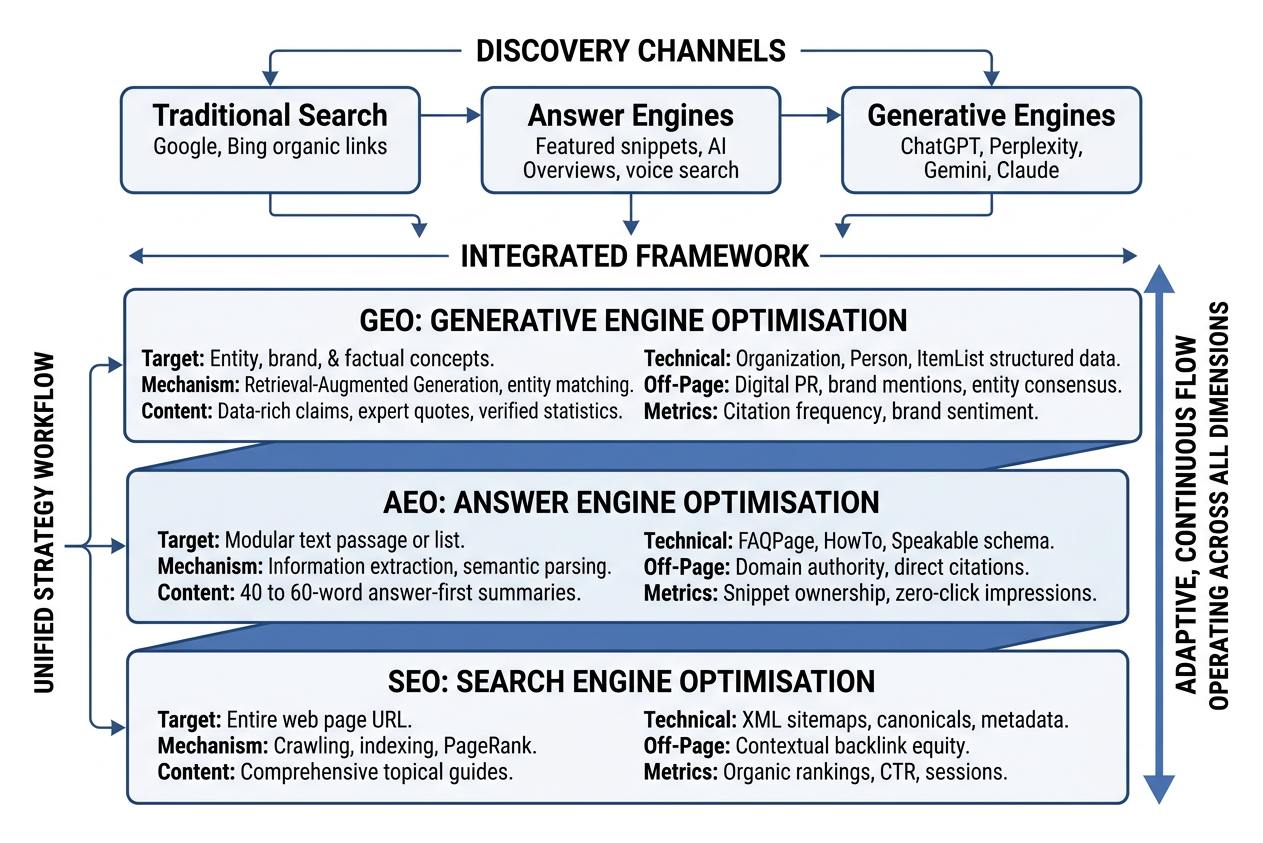
SEO, AEO and GEO solve different parts of the same visibility challenge. SEO supports complete web pages, AEO improves the extractability of useful passages, and GEO helps search systems recognise consistent information about a brand and its expertise.

SEO gives a website its technical base. Search engines need to access, render, index and interpret pages before those pages can appear in conventional results or support other discovery formats. For a prospective client, that means sound site architecture, mobile usability, clear internal pathways and content that answers a genuine search need.

AEO builds on that base by making the best answer easy to find. A direct definition below a question-led heading, a short set of ordered steps or a clearly labelled comparison can help a search interface extract an answer without losing the surrounding context. Good AEO writing still serves the person reading the page, not only the system selecting a passage.

GEO looks more broadly at the signals surrounding an organisation and its content. Generative search systems can assess entity consistency, author expertise, first-party explanations and corroborating references when they assemble a response. Generative Engine Optimisation therefore focuses on giving those systems clear, accurate context rather than attempting to force a citation.

The Difference Between Page Rankings, Answers and Generative Responses

Traditional search engines generally rank whole URLs against a query. Strong topical coverage, useful internal links and dependable technical foundations can help a page compete for a relevant search result.

Answer engines focus on a narrower unit of information. They look for passages, lists and definitions that respond clearly to a specific question. Headings, concise explanations and relevant schema can make the intended answer easier to interpret.

Generative systems can combine information from several sources into a new response. They may consider concepts, entity relationships and the consistency of supporting evidence before presenting a synthesis. Visibility can vary by platform, prompt and the information available at the time of retrieval.

What Each Discipline Prioritises

Optimisation dimension SEO AEO GEO
Primary focus Complete page and URL Answer passage or list Brand, entity and factual context
Discovery environment Google and Bing results Featured snippets, voice search and AI Overviews (Google) ChatGPT, Perplexity, Gemini and Claude
Main mechanism Crawling, indexing and relevance signals Information extraction and semantic interpretation Retrieval, entity matching and generative synthesis
Content approach Comprehensive, useful topic coverage Direct answers with clear structure Accurate claims, visible expertise and corroborating context
Technical support Sitemaps, canonicals and metadata Headings, structured data and readable answer blocks Organisation and person data, consistent entity details
Measurement focus Rankings, impressions and qualified sessions Answer visibility and query coverage Brand mentions and citation patterns where measurable

The practical value comes from joining these disciplines. Your technical foundations make important pages available, answer-focused formatting makes the content easier to use, and clear entity signals support credible representation across generative search environments.

For Australian businesses, the combined approach is especially useful when a single service page needs to do more than rank for a broad term. The page can establish a clear offer, answer the practical questions that arise before an enquiry and give search systems reliable details about who provides the service. That makes the page easier to use for prospective customers as well as easier for search platforms to interpret.

The work should stay specific to the business and the audience it serves. Reusable page templates, duplicated claims and broad AI language can dilute the explanation a prospect needs. A stronger approach connects each key topic to genuine expertise, clear service information and supporting content that addresses the next question naturally.

Build a Connected Search Visibility Strategy

A connected strategy keeps the work practical. Instead of treating traditional search, answer extraction and generative search as separate projects, your team can use the same well-structured content and technical foundation to support each channel.

For prospective clients, the starting point is usually a clear view of what search systems can currently access and understand. Technical SEO checks reveal whether a page can be crawled, rendered, canonicalised and indexed. AEO reviews then show whether the page provides concise answers, useful headings and readable structure. GEO work tests whether the organisation, author expertise, services and supporting claims appear consistently across the wider web.

This approach also improves editorial planning. Service pages can explain the problem, provide direct answers and show the expertise behind the advice. Supporting articles can strengthen related topics through plain language, appropriate internal links and carefully supported claims. Off-site activity can then focus on accurate brand mentions and expert commentary that adds credible context.

AuraSearch combines human-led search strategy with AI-informed analysis for businesses navigating traditional and AI-driven search. The work prioritises useful, technically sound information that can remain resilient as platforms and search behaviours evolve. Outcomes depend on third-party algorithms, available source information and the competitive landscape, so ongoing measurement and refinement remain essential.

That process does not require a separate content stream for every platform. A well-planned page can support conventional rankings, direct answers and generative discovery when it gives each system the information it needs in a format people can understand. Regular reviews then help your team identify where technical access, content clarity or entity consistency needs attention.

AuraSearch works with the existing website, business priorities and customer questions to shape that programme. The focus stays on practical improvements that can be measured, refined and explained clearly to the people responsible for growth.

The strongest starting point is a shared priority list. Focus first on the pages that explain core services, support commercial decisions or answer recurring questions from prospective customers. From there, each improvement can connect technical health, useful information and clear brand context, giving the website a more consistent foundation for search visibility.

This keeps the strategy grounded in the questions that influence real enquiries, rather than chasing isolated platform features. It also gives internal teams a clearer way to review progress, update priority pages and keep brand information aligned as services, evidence and search behaviour change.

To discuss a connected SEO, AEO and GEO approach, Contact AuraSearch.

FAQs

What is the core difference between SEO, AEO and GEO?

SEO helps complete web pages earn visibility in traditional search results. AEO improves the way specific passages answer focused questions in featured snippets, voice interfaces and AI Overviews (Google). GEO supports accurate brand and entity information that generative platforms may use when forming a response.

How can a business build an integrated SEO, AEO and GEO strategy?

Start with a sound technical SEO foundation, then improve key pages with concise answer-led sections and clear supporting context. Your content should use descriptive headings, practical explanations and relevant structured data where appropriate. GEO activity can then reinforce consistent organisational details, author expertise and verifiable claims across owned and third-party sources.

Does answer engine optimisation replace traditional SEO?

No, AEO does not replace traditional SEO. Search engines and AI systems still need accessible, indexable and well-structured pages before they can extract or reference useful content. Technical SEO remains the foundation for answer visibility and generative search discovery.

What makes content more useful for generative search?

Content is more useful for generative search when it presents clear expertise, accurate claims and unambiguous context. Named authors, structured page elements and consistent organisational details can help systems interpret the source. Strong content also explains a topic directly rather than relying on vague promotional language.

How do performance measures differ across SEO, AEO and GEO?

SEO commonly tracks rankings, impressions and qualified website sessions. AEO can assess answer visibility and the coverage of high-value questions. GEO can monitor brand mentions and observable citation patterns across selected generative platforms, recognising that platform results can change over time.

What are sensible first steps for future-ready search visibility?

Begin by reviewing whether key pages are accessible, useful and aligned with the questions prospective customers ask. Next, turn important service and informational content into clear answer-led sections, then strengthen the supporting evidence and brand context around those pages. A connected programme can help your business respond as traditional and AI-driven search continue to develop.

Recent Posts

By Amber Brazda • October 26, 2026
Learn how AI brand reputation management works across generative search engines, with actionable strategies for entity authority and sentiment control.

By Amber Brazda • October 26, 2026
Learn how to use Recruitment AI SEO tools to optimize career content for generative search and candidate discovery.

By Amber Brazda • October 22, 2026
AI SEO helps Australian businesses improve search visibility with clear, useful content that AI search systems can interpret accurately.

By Amber Brazda • October 21, 2026
Learn how Australian enterprises can optimise business AI search with answer-first content, structured data, trusted evidence, and a practical GEO strategy.

By Amber Brazda • October 20, 2026
This guide explains how Australian law firms can improve AI visibility through structured data, clear legal content, and consistent entity information.

By Amber Brazda • October 16, 2026
This guide explains how Australian dental practices can improve visibility in AI-driven search with clear content, schema, and consistent practice information.

By Amber Brazda • October 15, 2026
SEO for Melbourne helps businesses improve local visibility through technical SEO, local search strategy, and AI-driven search readiness.

By Amber Brazda • October 13, 2026
Learn how to track AI Overview traffic using GA4, Search Console and server logs for clearer AI search reporting.

By Amber Brazda • October 7, 2026
An AI recruitment strategy can improve sourcing, screening and hiring workflows while supporting human oversight, privacy and fair decision-making.

By Amber Brazda • October 6, 2026
Optimise your law firm AI answer visibility with a practical daily routine covering Australian content, schema, and citation strategy.
Show More