


A Practical Guide to Recruitment AI SEO Tools

Recruitment AI SEO is the practice of structuring career sites, job listings, and hiring data so generative search engines like ChatGPT, AI Overviews (Google), Perplexity, and Claude can extract, verify, and cite them accurately. It combines technical schema markup, server-side rendering, and verified entity authority to help talent platforms appear within conversational AI answers, rather than relying solely on keyword rankings. Recruitment agencies and hiring platforms that adopt this approach position their vacancies and workplace insights as trusted, machine-readable data sources across both traditional and AI-driven search.

Key Takeaways

  • Generative search engines extract career information through structured data, rendering traditional keyword matching secondary.
  • Server-side rendering ensures AI crawlers index dynamic job listings and career portals without JavaScript execution barriers.
  • Entity authority and verified recruiter attribution establish the trust signals required for conversational citation inclusion.
  • Structured salary transparency and detailed role criteria align with modern Australian employment standards to capture high-intent candidate queries.
  • Partnering with AuraSearch™ enables hiring platforms to deploy technical Generative Engine Optimisation (GEO) strategies that support consistent search visibility.

I am Amber Brazda, an AI search specialist at AuraSearch™ dedicated to helping talent acquisition platforms and recruitment agencies engineer machine-readable discovery frameworks across generative search engines.

Comprehensive Framework for Recruitment AI SEO Execution

Recruitment AI SEO requires an integrated approach that connects technical machine-readability with high-intent content creation. Hiring platforms and agencies achieve sustained visibility by structuring career assets so generative systems can extract, verify, and cite their hiring data. Implementing a structured recruitment framework ensures that careers sites function as talent data sources rather than static online job boards.

Candidate Intent Modelling and Query Clustering

Generative search engines process complex natural language queries rather than simple keyword combinations. Candidates use conversational prompts to compare workplace cultures, evaluate remote policies, and benchmark compensation packages across specific industries. Mapping career content to distinct search intents allows hiring platforms to appear within AI-generated overviews.

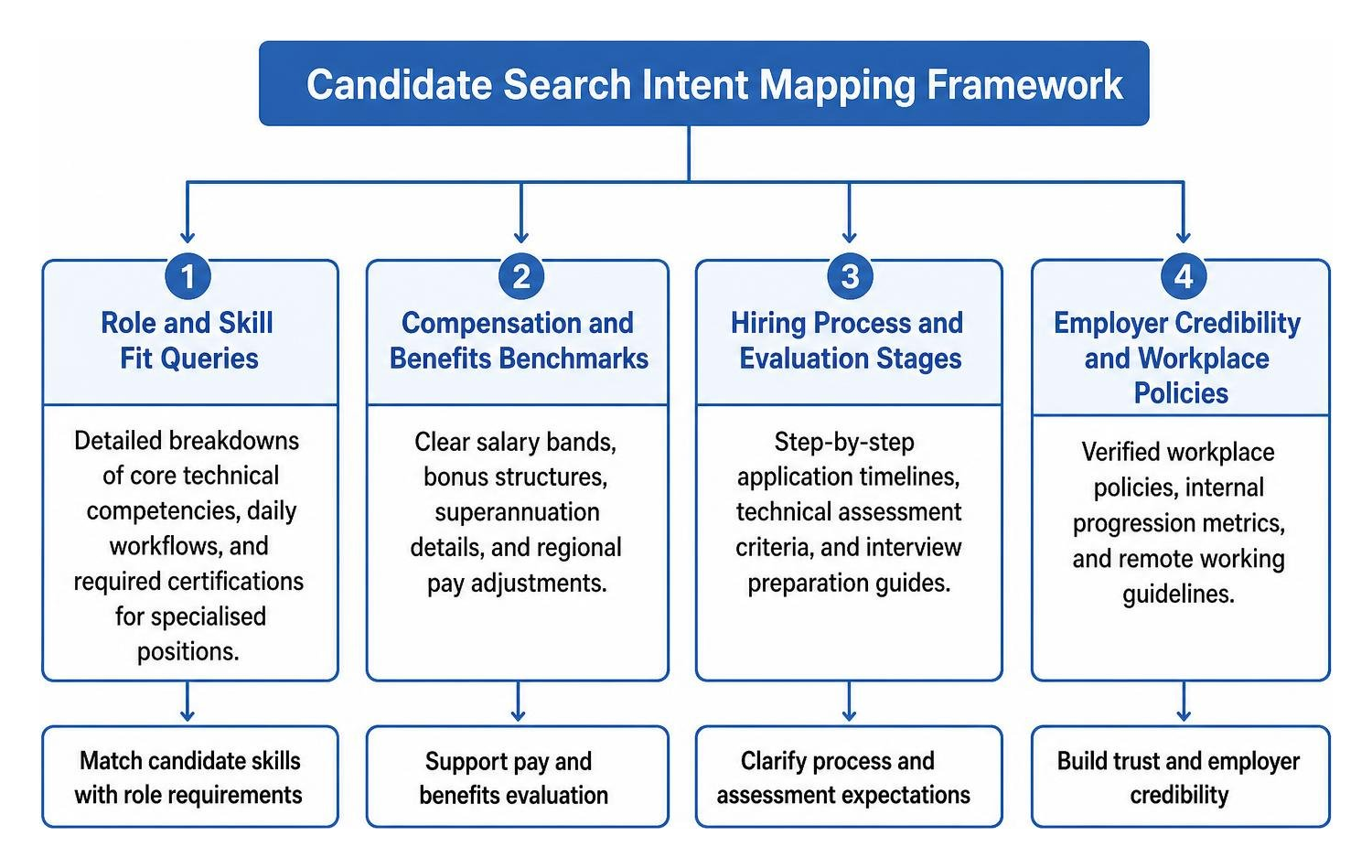
Hiring teams must map content across specific candidate decision stages:

  • Role and Skill Fit Queries: Detailed breakdowns of core technical competencies, daily workflows, and required certifications for specialised positions.
  • Compensation and Benefits Benchmarks: Clear salary bands, bonus structures, superannuation details, and regional pay adjustments.
  • Hiring Process and Evaluation Stages: Application timelines, technical assessment criteria, and interview preparation guides.
  • Employer Credibility and Workplace Policies: Verified workplace policies, internal progression metrics, and remote working guidelines.

Tracking targeted search queries allows recruitment organisations to identify gaps in their existing career assets. Integrating these topics into structured content hubs ensures that answer engines find verifiable data points when candidates research prospective employers.

Technical Foundation, Schema Markup, and Crawler Accessibility

Machine-readable infrastructure forms the backbone of generative search visibility. AI retrieval systems rely on structured code to extract job details, organisational hierarchy, and geographic parameters without parsing ambiguities.

Implementing complete schema markup ensures that search crawlers accurately index vacancy details:

  1. JobPosting Schema: Embed explicit properties for title , description , datePosted , validThrough , employmentType , hiringOrganization , jobLocation , and baseSalary .
  2. Organization Markup: Define corporate identity, official domain properties, verified social profiles, and industry classifications.
  3. Entity Association: Link official entities to authoritative databases such as Wikidata to reinforce domain authority across knowledge graphs.

Server-side rendering is necessary for dynamic job listings and career portals. Client-side JavaScript execution often prevents AI search crawlers from accessing vacancy copy and metadata. Platform administrators must configure robots.txt files to grant explicit access permissions to modern AI crawler user-agents, including GPTBot, ClaudeBot, and PerplexityBot.

Strategic Domain Architecture and High-Intent Naming

Domain naming conventions and URL taxonomy directly influence search system relevance scoring. Clear naming patterns establish immediate contextual relevance for retrieval algorithms and prospective applicants.

Effective domain prefixes and suffixes communicate specialised industry focus:

  • Functional Prefixes: Utilising prefixes such as talent- , careers- , work- , or hire- establishes topical category relevance.
  • Descriptive Suffixes: Suffixes including -jobs , -search , -insights , or -ai clarify platform utility and service scope.
  • Semantic URL Slugs: Clean hierarchical directory structures, such as /jobs/engineering/senior-systems-engineer-melbourne , provide explicit contextual signals to retrieval algorithms.

Precise taxonomy prevents orphan URLs and assists search systems in crawling related job families efficiently.

Content Asset Development and Passive Talent Engagement

High-value recruitment content targets passive job seekers who conduct exploratory research rather than direct application submissions. Informational assets build search authority while answering the detailed questions candidates ask during career transitions.

AuraSearch™ develops actionable recruitment content strategies through specialised generative engine optimisation frameworks, focusing on comprehensive guides that address core industry challenges. Organisations can master artificial intelligence SEO by structuring articles with clear factual definitions, subheadings, and data tables.

Valuable content formats include:

  • Day-in-the-Life Role Overviews: Practical descriptions of daily responsibilities, reporting lines, and team collaboration frameworks.
  • Sector Salary Guides: Transparent remuneration reports based on placement data and market analysis.
  • Technical Interview Preparation Guides: Detailed explanations of technical evaluation criteria, sample project briefs, and assessment expectations.

Strategy Component Traditional Recruitment SEO Generative Engine Optimisation (GEO)
Primary Objective Rank high on search engine results pages for specific keywords Secure direct citations and recommendations inside AI responses
Content Focus Keyword density, metadata length, and search volume matching Factual precision, statistical density, and direct question answering
Technical Priority Basic XML sitemaps and standard indexing Server-rendered HTML, JobPosting schema, and AI bot crawler access
Trust Validation Standard backlink counts and domain age Entity consistency, named expert attribution, and external citations
Performance Metric Organic impressions and blue-link click-through rates AI model citation share, zero-click brand presence, and application intent

Entity Authority, Digital PR, and Human-Led Governance

AI search engines prioritise content verified by external sources across the wider web. Generative models evaluate third-party mentions, directory profiles, industry commentary, and official publications to assess recruitment platform credibility.

Establishing Experience, Expertise, Authoritativeness, and Trustworthiness (E-E-A-T) requires visible, human-led verification:

  • Named Recruiter Attribution: Publish comprehensive author biographies for recruitment consultants, detailing their specific industry focus, sector experience, and verified credentials.
  • Digital PR and Industry Commentary: Secure earned editorial mentions in authoritative trade journals and national business publications.
  • Hybrid Editorial Production: Maintain strict human editorial oversight over all AI-assisted drafting processes to eliminate generic phrasing, prevent factual inaccuracies, and protect compliance standards.

Applying structured entity clustering across industries we serve ensures that search engines recognise recruitment agencies as primary authorities in niche commercial sectors. For tailored support, contact AuraSearch™ or review the full range of services.

The Strategic Advantage of AuraSearch™

Generative search engines have changed the talent acquisition landscape from a keyword-matching ecosystem to a citation-driven discovery model. Recruitment agencies and hiring platforms require sophisticated infrastructure to ensure their job vacancies, market insights, and workplace data remain retrievable across conversational search models. AuraSearch™ provides the technical precision and strategic governance needed to establish measurable search visibility.

AuraSearch™ provides end-to-end strategy, technical schema deployment, and evidence-based content development through its specialised generative engine optimisation services. The agency helps organisations build machine-readable assets that capture high-intent candidates across traditional search engines and emerging generative platforms.

  • Explore the full range of AI visibility capabilities on the Services page.
  • Schedule a consultation with the search team via the Contact Us page.
  • Discover specialised enterprise frameworks on the Professional Services AI SEO solutions page.

FAQs

What is Recruitment AI SEO and how does it work?

Recruitment AI SEO is the strategic practice of optimising career portals, job advertisements, and recruitment content so conversational search systems and traditional search engines can easily extract and cite the information. Generative search engines use natural language processing and retrieval-augmented generation to scan indexed web pages for direct answers to candidate inquiries. Structuring vacancy listings with precise schema markup and factual content ensures that AI models retrieve and recommend these employment opportunities.

How does Recruitment AI SEO differ from traditional recruitment marketing?

Recruitment AI SEO focuses on earning structured citations within conversational AI summaries rather than competing exclusively for blue-link click-through positions on traditional search engine results pages. Traditional recruitment marketing relies heavily on paid job boards, pay-per-click ads, and exact-match keyword targeting. Generative search strategies prioritise deep entity authority, comprehensive salary benchmarks, and transparent hiring details that answer complex candidate decision queries.

Which technical SEO elements matter most for AI-driven careers pages?

Structured data implementation and server-side content rendering are the most critical technical elements for AI-driven careers pages. Comprehensive JobPosting schema tells search engine algorithms exactly what a vacancy entails, including remuneration parameters, required qualifications, and employment locations. Rendering job pages server-side ensures that AI web scrapers can read dynamic listings immediately without encountering JavaScript execution roadblocks.

How can recruitment platforms leverage local SEO for regional hiring?

Recruitment platforms can capture localized hiring demand by creating dedicated, geographic-specific landing pages supported by localized schema markup properties. Incorporating regional salary distributions, local commuting insights, and verified office coordinates establishes clear geographic entity signals for search engines. This structured approach helps platforms appear in localized AI Overviews (Google) when candidates search for opportunities within specific metropolitan areas.

What are the most common SEO mistakes made by hiring platforms?

The most frequent SEO mistakes include publishing thin job descriptions without salary context, relying on client-side JavaScript rendering, and blocking AI crawlers within robots.txt files. Many hiring websites also create duplicate listings that generate broken orphan links once vacancies close, diluting domain crawl efficiency. Ensuring every listing provides comprehensive role expectations, structured compensation ranges, and stable taxonomy prevents search visibility decay.

How do hiring teams safely integrate AI-generated content into their search strategy?

Hiring teams must implement a hybrid human-AI production workflow where qualified recruitment specialists review, fact-check, and enrich every piece of generated content. Generative tools can draft initial topic outlines or expand keyword research clusters, but human industry experts must supply primary placement data, proprietary market observations, and legal compliance reviews. This collaborative editorial approach protects employer brand credibility and satisfies search engine quality standards.

Recent Posts

By Amber Brazda • October 22, 2026
AI SEO helps Australian businesses improve search visibility with clear, useful content that AI search systems can interpret accurately.

By Amber Brazda • October 21, 2026
Learn how Australian enterprises can optimise business AI search with answer-first content, structured data, trusted evidence, and a practical GEO strategy.

By Amber Brazda • October 20, 2026
This guide explains how Australian law firms can improve AI visibility through structured data, clear legal content, and consistent entity information.

By Amber Brazda • October 16, 2026
This guide explains how Australian dental practices can improve visibility in AI-driven search with clear content, schema, and consistent practice information.

By Amber Brazda • October 15, 2026
SEO for Melbourne helps businesses improve local visibility through technical SEO, local search strategy, and AI-driven search readiness.

By Amber Brazda • October 13, 2026
Learn how to track AI Overview traffic using GA4, Search Console and server logs for clearer AI search reporting.

By Amber Brazda • October 7, 2026
An AI recruitment strategy can improve sourcing, screening and hiring workflows while supporting human oversight, privacy and fair decision-making.

By Amber Brazda • October 6, 2026
Optimise your law firm AI answer visibility with a practical daily routine covering Australian content, schema, and citation strategy.

By Amber Brazda • October 6, 2026
Master geo search engine optimization with this practical guide to boosting your content's visibility in AI-driven search results and generative engines.

By Amber Brazda • October 6, 2026
Compare top SEO companies in Melbourne with a practical checklist covering technical SEO, AI search visibility, and local strategy for stronger brand discovery.
Show More