



How to Optimise Law Firm AI Answers in Less Than an Hour a Day
How Australian Law Firms Can Optimise AI Answers
Australian law firms can improve AI answer visibility by making practice-area content clear, structured, and easy for answer engines to interpret. A practical daily routine helps legal teams keep their website, directory profiles, and AI search presence aligned without relying on guaranteed third-party outcomes.
Key Takeaways
- Law firm AI answer optimisation works best when each practice-area page answers one clear client question before adding detail.
- Australian legal content should use plain language, verified practitioner details, and locally relevant compliance framing.
- Schema markup, directory consistency, and author credentials help search systems connect a firm with reliable legal information.
- AuraSearch™ supports legal practices through AI search visibility services that combine human-led strategy, technical review, and transparent reporting.
A Simple Daily Workflow for Law Firm AI Answer Optimisation
I am Amber Brazda, leading AI search visibility research and Generative Engine Optimisation (GEO) strategies at AuraSearch™. Law firm AI answer optimisation gives Australian legal practices a practical way to improve citation likelihood across ChatGPT, Google AI Overviews, Perplexity, Claude, Google, and Bing by making their expertise easier for search systems to read, verify, and reuse.
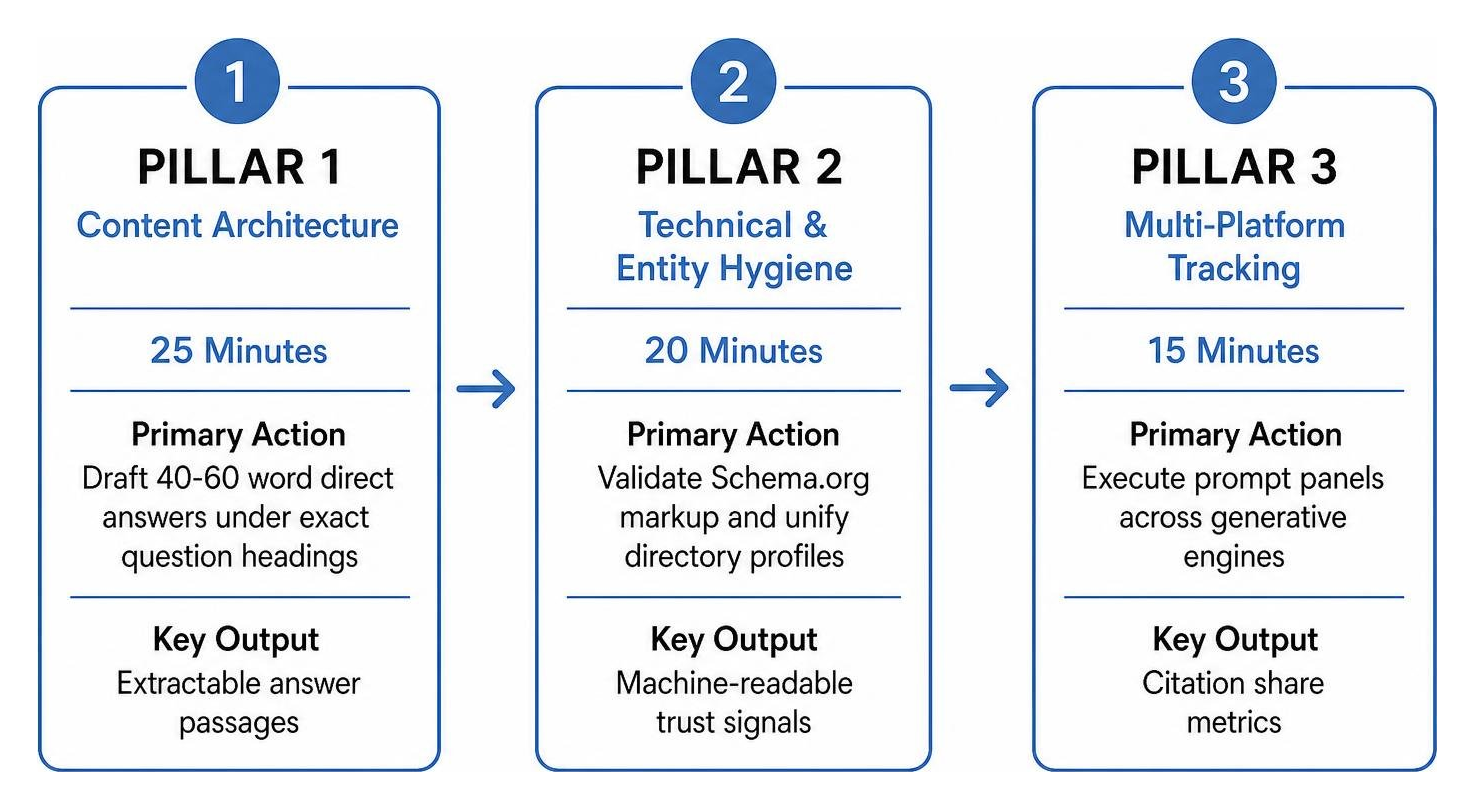
Law firms can treat AI answer optimisation as a focused daily routine rather than a large one-off project. The work comes down to three habits: making content easier to quote, keeping entity data accurate, and checking how AI-driven platforms describe the firm.
Start with the question a prospective client is likely to ask. A family law page might answer a specific question about separation, parenting arrangements, or property settlement before expanding into process and eligibility details.
The primary keyword also needs to read naturally. A sentence such as “law firm AI answer optimisation improves how legal expertise is understood by AI-driven search systems” fits the topic without sounding forced.
This Generative Engine Optimisation approach supports editorial structure by pairing technical review with human judgement. The goal is not to control what an independent AI platform says. The goal is to make reliable firm information easier to find, interpret, and cite.
Structure Content So Answer Engines Can Read It Quickly
Answer-first content helps AI systems understand what a legal page explains. Each major section should open with a direct answer, then add context, limits, and Australian compliance considerations.
Clear headings matter because they help search systems match a passage to a user’s question. Use headings that describe the legal issue and practical outcome.
Short paragraphs also improve readability for people and machines. A concise paragraph that explains one idea is easier to extract than a dense block covering process, eligibility, and firm credentials at once.
Australian legal practices should avoid language that implies a guaranteed result. Content can explain how a firm handles matters, what information clients usually need, and when formal legal advice is required. It should not promise a case outcome, ranking position, or AI answer placement.
Keep Australian Entity Signals Consistent
Entity consistency helps AI-driven and traditional search platforms recognise the same law firm across different sources. A firm’s website, Google Business Profile, legal directory listings, professional registers, and author bios should use consistent names, locations, practitioner details, and service descriptions.
Structured data supports that consistency. LegalService
schema can clarify office locations, practice areas, opening hours, and service regions. Person
schema can connect individual solicitors with author pages, credentials, and professional profiles. FAQPage
schema can reinforce visible question-and-answer content.
Legal practices also need consistent Australian terminology. Terms such as solicitor, barrister, legal practitioner, practice area, and professional conduct should replace overseas wording that does not fit the local context.
AI Overview Optimisation work helps identify where structured content, entity data, and search visibility signals need attention. That process supports stronger citation likelihood, but outcomes still depend on independent platform behaviour.
Add One Reliable External Reference
An external reference helps the article meet publishing quality checks and gives readers a trustworthy Australian source. For legal content, the safest references are official Australian government pages rather than overseas legal directories or commercial commentary.
A practical reference point is the Federal Register of Legislation in force collection, which helps legal content teams confirm current Commonwealth legislation before publishing explanatory material.
Measure Visibility Across AI and Traditional Search
Measurement shows whether law firm content is being understood consistently across AI-driven and traditional search platforms. A useful review looks at whether the firm is cited, how services are described, and whether the answer reflects the correct Australian legal context.
Testing should include ChatGPT, Google AI Overviews, Perplexity, Claude, Google, and Bing. Each platform may interpret prompts differently, so the same practice-area page can perform well in one environment and need refinement in another.
The best prompt checks use natural client language. Examples include questions about choosing a family lawyer, understanding conveyancing steps, or finding a commercial solicitor for a business issue.
Prompt testing, technical review, and reporting through AI SEO services give legal teams a clearer view of which pages need clearer answers, stronger schema, or better internal linking.
Prioritise the Most Useful Link Anchors
Link anchors should be clear, concise, and properly capitalised only when they refer to official page names. Sentence-style anchors work best in most article copy because they read naturally and avoid unnecessary emphasis.
This article keeps anchor text focused on the most important destinations: service pages, relevant AI search capability pages, one official Australian reference, and one closing contact pathway. It avoids excessive blog linking so the article stays easy to read.
Good anchors explain what the linked page provides. Phrases such as “AI search visibility services” and “AI SEO services” describe the destination without sounding promotional.
Build a Routine Legal Teams Can Maintain
A sustainable routine gives each person a clear role. Solicitors can review legal accuracy, marketers can improve headings and internal links, and developers can validate schema and technical crawlability.
Content reviews should focus on passages that answer high-intent legal questions. Technical checks should confirm that schema, canonical tags, indexability, and internal links support the page.
The work should stay grounded in Australian context. References to overseas legal directories, overseas advertising rules, or foreign professional terminology can confuse the article’s relevance unless the page compares jurisdictions.
Law firms do not need to treat AI answer optimisation as separate from search engine optimisation. The strongest approach aligns content quality, technical clarity, entity trust, and measurement across AI-driven and traditional search surfaces.
Practical AI Search Visibility for Australian Law Firms
Australian law firms need search visibility work that respects legal accuracy, professional context, and the limits of third-party AI platforms. The right approach combines human-led strategy, entity optimisation, technical review, and AI search measurement across ChatGPT, Google AI Overviews, Perplexity, Claude, Google, and Bing.
The commercial value sits in making reliable legal expertise easier to discover and interpret. The services page helps legal practices assess content structure, internal links, schema signals, and AI answer visibility without promising rankings or fixed placements.
Legal practices can also contact the team to review how their current pages appear across AI-driven and traditional search platforms. That pathway gives firms a practical next step for improving citation likelihood, entity clarity, and search visibility in an Australian legal context.
FAQs
What is Answer Engine Optimisation (AEO) for law firms?
Answer Engine Optimisation (AEO) structures legal content so AI-driven platforms can understand and cite direct answers. For law firms, that means clear question headings, concise explanations, accurate practitioner information, and Australian legal terminology.
AEO does not replace search engine optimisation. It extends search work by making legal content easier for answer engines, AI Overviews, and conversational platforms to interpret.
How does law firm AI answer optimisation support Australian legal marketing?
Law firm AI answer optimisation supports Australian legal marketing by improving how legal expertise appears in AI-driven and traditional search environments. It helps firms present practice-area information in a clearer, more verifiable format.
The process should stay compliant and measured. Legal content should explain services and processes without guaranteeing outcomes, rankings, traffic, or AI answer placements.
Which Australian signals matter most for AI answer visibility?
The most useful Australian signals include consistent firm details, accurate solicitor profiles, relevant practice-area content, and visible author credentials. Search systems compare these signals across a firm’s website, directories, professional profiles, and structured data.
Australian terminology also matters. Content should use local legal language such as solicitor, barrister, legal practitioner, practice area, and professional conduct where relevant.
How often should a law firm review AI answer visibility?
A law firm should review AI answer visibility on a regular operational schedule that its team can maintain. The exact frequency depends on publishing activity, practice-area priorities, and the market.
A consistent routine works better than irregular large reviews. Teams can check important prompts, refine unclear passages, and update entity details as services or practitioners change.
Can schema markup help law firms appear in AI answers?
Schema markup can help search systems interpret a law firm’s services, people, locations, and article content. It gives machines structured context that supports the visible information on the page.
Schema does not guarantee AI answer inclusion. It works best when paired with accurate content, consistent directory information, and technically accessible pages.
Why should law firms avoid overseas legal references in Australian AI search content?
Law firms should avoid overseas legal references because they can weaken local relevance and confuse the legal context. Australian legal content should reflect local terminology, compliance expectations, and client search intent.
Overseas references only belong when the article clearly compares jurisdictions. For most Australian law firm content, local context provides a cleaner signal for both readers and search systems.