

Technical Strategies to Optimise for AI Overviews: An Actionable Guide
AI Overviews (Google) reward pages that answer real questions clearly, load reliably and provide information that search systems can verify.
I am Amber Brazda, an AI Search Specialist at AuraSearch, specialising in generative retrieval systems, technical indexing architecture, and enterprise digital visibility across algorithmic discovery networks.
Key Takeaways
- AI Overviews (Google) combine information from several sources to address complex search intent directly in the results page.
- Query fan-out breaks a broad search into related subtopics, so clear answers to each subtopic can strengthen retrieval.
- Concise definitions, logical headings and well-described entities make content easier for generative search systems to interpret.
- Strong organic visibility still matters because AI search systems draw on crawlable, relevant and trusted pages.
- AuraSearch™’s Generative Engine Optimisation (GEO) service helps organisations build a practical AI search visibility strategy.
Understanding AI Overviews (Google) and the Changing Search Landscape
To optimise for AI Overviews (Google), build pages around concise answers, reliable crawlability and structured information that search systems can verify. Generative search interfaces pull together self-contained passages from indexable pages, so clear headings and direct explanations make useful context easier to retrieve.
AI Overviews (Google) change how information appears in search results by presenting direct summaries near the top of the page. These summaries can draw on several sources, which makes clear, dependable content more valuable for businesses competing for visibility in AI-driven search.
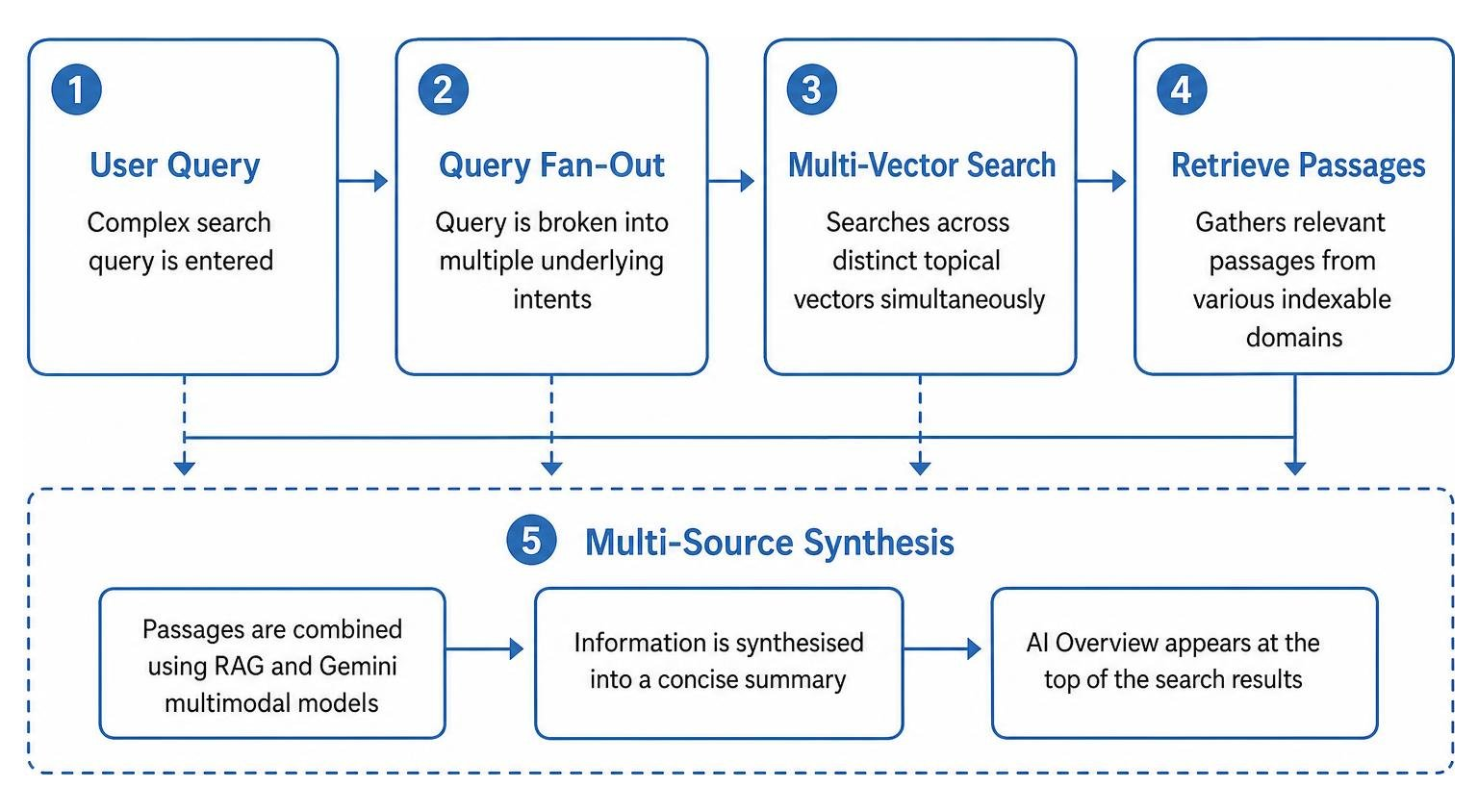
Google deploys its Gemini multimodal models alongside advanced Retrieval-Augmented Generation frameworks to construct these dynamic summaries. The retrieval system breaks complex search queries into multiple underlying topical vectors. This mechanism, known as query fan-out, searches across distinct topical vectors simultaneously to gather relevant passages from various indexable domains.
As AI search develops, straightforward informational queries can receive an answer before a person visits a website. Site owners therefore need to focus on earning visibility as a trusted source within the AI summary as well as in traditional organic results.
A practical approach connects traditional indexing with generative answer engines. Businesses can strengthen that foundation by aligning content, technical SEO and entity information around the questions their prospective customers search for.
How to Optimise for AI Overviews (Google): Technical Execution and Content Structure
AI Overviews (Google) favour content that gives a clear answer first and then explains it with useful detail. Each section should address one search intent plainly, using language that business decision-makers can understand without decoding technical jargon.
A practical AI Overview optimisation plan brings content structure, technical SEO and entity information together. The goal is not to chase a single search feature. It is to make every important page easier for Google and other AI search systems to crawl, interpret and cite when relevant.
Give each section a direct answer
Start each major section with the answer a prospective customer is looking for. Follow that answer with supporting explanation, examples and details that confirm the claim. This approach gives AI search systems a self-contained passage they can assess without relying on surrounding copy.
Clear H2 and H3 headings also help. Headings should describe the question or topic being answered, then the paragraph below should resolve it directly. Avoid vague labels that force a search system to infer what the section means.
Keep technical foundations reliable
Technical crawlability remains essential. Googlebot needs access to clean, server-rendered HTML without conflicting robots directives or avoidable JavaScript rendering barriers. A logical heading hierarchy also helps crawlers understand how a page’s topics relate to each other.
Structured data can add helpful context when it matches the visible page content. Schema.org types such as Article, FAQPage and Organisation can clarify the people, services and subjects discussed on a page. Markup does not replace strong copy, but it can reduce ambiguity around important entities.
| Factor | Traditional organic search | AI Overviews (Google) extraction |
|---|---|---|
| Primary goal | Ranking for target search terms | Citing a useful passage for a combined intent |
| Content structure | Comprehensive topic pages | Clear, modular answer blocks |
| Retrieval focus | Page relevance, authority and links | Passage relevance, factual clarity and context |
| Markup role | Supports rich results | Clarifies entities and relationships |
Build content that is easy to retrieve
Definition passages, short step sequences, comparison tables and concise takeaway lists can make complex topics easier to navigate. Each format should earn its place by helping explain the subject, rather than adding structure for its own sake.
Content also needs depth. A useful page covers the related questions that sit around the main topic, including definitions, practical implications and common technical barriers. This helps build topical relevance while giving search systems more complete context for related queries.
Original observations, first-party experience and clearly explained processes can add information that similar pages do not provide. Businesses should make those contributions specific and verifiable rather than repeating generic claims already common across search results.
Measure visibility in more than one place
AI search visibility should be monitored alongside traditional organic performance. Review whether important pages are crawled and indexed, whether the brand appears for relevant topics, and whether visits lead to meaningful enquiries or other business outcomes.
The strongest approach is consistent rather than speculative. Well-organised content, dependable technical foundations and accurate entity details give AI search systems a better basis for understanding a business and its expertise.
Build Stronger AI Search Visibility with AuraSearch
AI search has changed the way prospective customers discover and assess businesses. Strong visibility now depends on more than a single ranking position. It depends on whether search systems can crawl a site, understand its services and retrieve useful answers when a relevant question is asked.
AuraSearch combines human-led AI workflows with practical technical SEO, content architecture and entity strategy. The team works across AI-driven and traditional search platforms, including ChatGPT, AI Overviews (Google), Perplexity, Claude, Google and Bing, so businesses can build a more consistent search presence without relying on unsupported promises.
That work can suit enterprise teams, eCommerce businesses, professional services, healthcare providers, fintech organisations and service businesses. Each strategy focuses on the content, technical foundations and search signals most relevant to the organisation’s market and goals.
A useful programme starts with the pages that already influence key commercial and informational searches. AuraSearch reviews whether those pages answer the right questions, connect related topics clearly and give search systems enough reliable context to understand the organisation behind them. The work can then prioritise practical improvements, such as clearer service explanations, stronger internal pathways, structured data that reflects visible copy and content that addresses recurring customer questions. This approach keeps the focus on durable search visibility rather than short-lived tactics, and it gives internal marketing teams a clearer basis for measuring progress across both organic and AI-driven search over time.
For businesses ready to strengthen their AI search visibility, the next steps are straightforward:
FAQs
How can a business optimise informational content for AI Overviews (Google)?
A business can optimise informational content by answering the main query in the opening sentence of each section. Supporting context, practical examples and clear subheadings then help AI search systems understand how each passage relates to the wider topic.
What technical requirements support visibility in AI Overviews (Google)?
Reliable crawlability and indexability provide the foundation for visibility. Server-rendered HTML, sensible robots directives, valid structured data and strong Core Web Vitals help search systems access and interpret important content.
How does Google choose websites for AI Overviews (Google)?
Google can assess topical relevance, factual consistency, page quality and the clarity of individual passages when selecting supporting sources. Pages with direct answers, useful expertise and content that fits the query are better positioned to be considered when relevant.
Does organic ranking still matter for AI Overviews (Google)?
Organic rankings still matter because they reflect whether a page is crawlable, relevant and useful for a search query. Strong traditional SEO does not guarantee inclusion in an AI Overview, but it supports the underlying visibility signals that generative search can draw on.
How do AI Overviews (Google) affect eCommerce businesses?
AI Overviews (Google) can surface product comparisons and related information before a shopper reaches a website. Accurate product data, availability details, review markup and clear comparison content can help eCommerce businesses present consistent information across search experiences.
Can a publisher limit content from appearing in AI Overviews (Google)?
A publisher can use standard search directives, such as nosnippet or max-snippet, to limit the text Google may show in search features. These settings should be considered carefully because they may also affect how content appears in regular organic results.
How does structured data support generative search retrieval?
Structured data gives search systems machine-readable context about the entities and relationships on a page. When the markup matches visible content, it can reduce ambiguity and help systems interpret published information more accurately.
What is the difference between traditional SEO and Generative Engine Optimisation (GEO)?
Traditional SEO focuses on improving a page’s visibility in organic search results. Generative Engine Optimisation (GEO) adds a focus on direct-answer passages, entity clarity and content that can support multi-source AI search responses.