

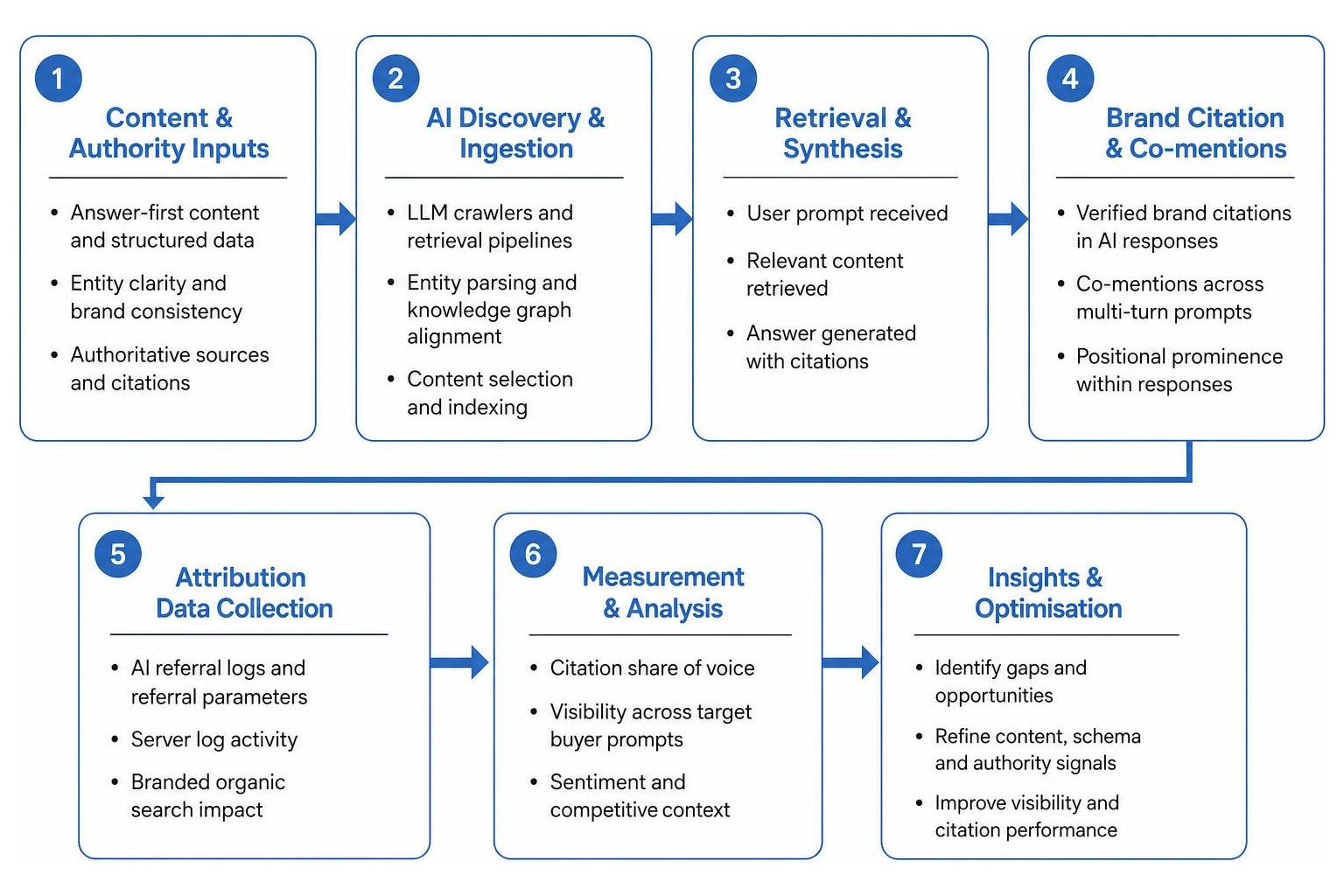

Are Answer Engine Optimization Services Worth It?
How to Choose an Answer Engine Optimization Agency
Choosing an answer engine optimization agency is about finding a partner that can make a brand easier for AI search platforms to understand, trust, and cite. For Australian organisations, that means combining strong search fundamentals with clear facts, structured content, and careful visibility monitoring across traditional and AI-driven search.
Key Takeaways
- An answer engine optimization agency helps improve citation likelihood across ChatGPT, Google AI Overviews, Perplexity, Claude, Google, and Bing.
- Strong agency evaluation looks at technical schema, entity consistency, prompt research, content structure, and transparent reporting.
- Generative Engine Optimisation (GEO) works best when it builds on reliable SEO foundations rather than replacing them.
- AuraSearch™ combines expert strategy with AI tools to support Australian organisations that want clearer visibility across modern search.
- Businesses can review Services to understand how search visibility support can be structured.
I am Amber Brazda… an AI Search Specialist at AuraSearch™ focused on helping organisations select and apply the capabilities of an expert answer engine optimization agency to reduce attribution gaps and build durable AI search visibility.
An answer engine optimization agency helps a brand improve its likelihood of appearing as a cited, accurate source in AI-generated answers. The right partner combines SEO foundations with clear content, structured data, entity authority, and ongoing visibility monitoring across ChatGPT, Google AI Overviews, Perplexity, Claude, Google, and Bing.
When evaluating agencies, look for evidence that they can:
- Audit where a brand is cited, omitted, or misrepresented in AI answers
- Map real customer questions and high-intent prompts
- Improve technical crawlability, schema, and semantic page structure
- Build consistent brand and expert signals across trusted sources
- Report on citations, share of voice, AI referral traffic, and business outcomes
Traditional SEO helps a page earn visibility and a click. Answer Engine Optimisation (AEO), within the wider field of Generative Engine Optimisation (GEO), also focuses on how AI systems interpret, summarise, and attribute a brand when they generate a direct answer.
AuraSearch™ applies expert strategy and AI tools to strengthen search visibility across both traditional and AI-driven search. The goal is not to control what an external platform says, but to make the brand's facts, expertise, and sources easier for those platforms to understand and cite.
Core Criteria for Evaluating an Answer Engine Optimization Agency
Selecting a partner starts with technical expertise, strategic entity management, and clear reporting. A qualified provider should show how it audits large language model responses, improves machine-readable site architecture, and turns customer questions into useful search assets.
Traditional search discovery relies on keywords, indexed pages, and ranking signals. Answer engines work differently because they retrieve, synthesise, and cite sources directly inside conversational outputs.
| Evaluation Metric | Traditional SEO Agency | Answer Engine Optimization Agency |
|---|---|---|
| Primary Goal | Page-one search visibility and organic click capture | Verified brand citations inside AI-generated syntheses |
| Content Structure | Keyword-targeted long-form articles | Modular, answer-first responses and structured data |
| Discovery Mechanism | Web crawlers indexing HTML documents | Large Language Model (LLM) ingestions and live retrieval pipelines |
| Authority Signals | Backlink quality and topical relevance | Entity salience, brand consistency, and knowledge graph validation |
| Measurement Focus | Search impressions, link clicks, and rank tracking | Citation share of voice, co-mentions, and AI referral attribution |
An agency needs practical familiarity with generative AI architecture. It should understand how systems parse entities, process natural language questions, and select references during retrieval-augmented generation.
Core Capabilities of an Answer Engine Optimization Agency
A specialised partner structures website content using answer-first architecture. This approach places clear definitions and direct answers near the start of each section so search and AI systems can extract the main point without ambiguity.
Agencies build prompt mapping models rather than relying only on standard keyword lists. These maps reflect conversational queries across different intent stages and help connect service pages, articles, FAQs, and supporting sources.
Technical teams configure server environments and robots protocols for AI crawler optimisation. They verify access for bots such as GPTBot, ClaudeBot, and PerplexityBot while maintaining site performance and responsible data governance.
How an Answer Engine Optimization Agency Measures Success and Citations
Measuring success in AI discovery requires tracking brand co-mentions and citation frequencies across major answer platforms. Traditional position tracking still matters, but it does not show whether AI systems are selecting the brand as a trusted source.
Agencies establish baseline visibility scores to measure how often target buyer prompts generate verified brand references. They monitor sentiment, prominence within generated summaries, and competitive citation share of voice across multi-turn prompts.
Attribution modelling connects server log activity, referral parameters, and branded organic search growth. Organisations seeking a visibility audit can use Contact Us to discuss current baseline measurement.
Multi-Platform Optimisation Across Search and Generative Engines
Optimising for conversational discovery requires multi-platform coverage across ChatGPT, Google AI Overviews, Perplexity, Claude, Google, and Bing. Each system uses different ingestion patterns and citation logic, so the work needs a tailored approach.
Strategic Generative Engine Optimisation accounts for these differences by aligning schema, citation networks, and editorial authority to specific retrieval pipelines. Perplexity often rewards fresh, well-sourced content, while Google AI Overviews draws heavily on established search infrastructure and Knowledge Graph alignment.
Agencies test brand queries across multiple model architectures. This validation helps keep entity facts consistent across standalone chatbots, enterprise search tools, and traditional hybrid interfaces.
Building Durable AI Search Visibility in Australia
A strong implementation plan connects company knowledge to the sources AI systems use for retrieval and citation. The work combines technical schema, digital PR, content restructuring, and verified entity data.
Agencies adapt these frameworks for Australian commercial and regulated sectors. B2B, healthcare, fintech, eCommerce, professional services, and trades need content that reflects buyer questions and local trust signals.
Structured Data, Entity Authority, and Knowledge Graph Integration
Structured schema markup gives answer engines a machine-readable foundation. Detailed JSON-LD for organisations, services, FAQs, people, and technical entities helps reduce ambiguity when AI systems extract facts.
Consistent entity validation also matters. Search and AI retrieval systems need to recognise brand names, key people, service categories, and proprietary methods as stable subjects across the website and trusted references.
Digital PR supports entity authority by securing high-quality citations across publications that AI retrieval systems may reference. Credible Australian sources can reinforce trust when brand information is accurate and consistent.
Responsible AI governance also influences how organisations publish facts for machine interpretation. The Australian Government's Voluntary AI Safety Standard provides useful principles for AI-related risk, accountability, and transparency.
Industry Readiness Across B2B, Healthcare, and Professional Services
Regulated and high-consideration industries need strict factual accuracy in AI search outputs. Clear author credentials, review processes, and source-backed explanations help reduce inaccurate or incomplete AI summaries.
B2B technology enterprises benefit when their platforms are clearly positioned within comparison prompts and vendor evaluation queries. Product documentation, service pages, and feature schema can improve citation likelihood during research cycles.
Healthcare, legal, and financial services need careful Experience, Expertise, Authoritativeness, and Trustworthiness (E-E-A-T) signals. Australian organisations also need content that reflects local terminology, compliance expectations, and customer context.
Expected Timelines, Reporting, and Partnering for Long-Term Growth
Implementing an answer engine strategy follows a progression of technical remediation, entity alignment, and ongoing refinement. Initial work often focuses on crawlability, schema, content structure, and prompt baselines before broader authority signals compound.
Citation share of voice and multi-platform visibility usually improve over subsequent months as entity signals consolidate across search systems. Ongoing iteration helps maintain visibility as AI platforms and search engines adjust their retrieval behaviour.
Partnering with AuraSearch for AI Search Visibility
AuraSearch™ supports search visibility across traditional and AI-driven platforms. Its human-led AI approach combines experienced strategy, structured content, technical optimisation, and visibility reporting for brands that want to be easier for search and answer engines to understand.
The team develops content architectures, schema recommendations, and entity authority frameworks that clarify brand messaging for machine synthesis. Organisations can review Services to understand the available support across AI search and traditional SEO.
Establishing durable visibility across evolving search interfaces requires a proactive and technically sound approach. Organisations ready to audit their search footprint and improve citation likelihood can Contact Us to discuss the next step.
FAQs
What does an answer engine optimization agency do?
An answer engine optimization agency audits, structures, and optimises website content, technical schema, and external entity authority. This work helps brand data become easier for conversational AI engines like ChatGPT, Google AI Overviews, and Perplexity to extract and cite.
How does AEO differ from traditional SEO?
Traditional SEO focuses on improving the visibility of website links on search engine results pages. AEO structures content so it can support direct, synthesised answers and cited sources inside AI-generated responses.
Which AI platforms do agencies optimise for?
Agencies optimise content for primary generative and traditional search platforms. These include ChatGPT, Google AI Overviews, Perplexity, Claude, Microsoft Copilot, Google Search, and Bing.
How do agencies measure AEO success without standard keyword rankings?
Success is measured through AI citation frequency, prompt share of voice, sentiment, brand co-mentions, and referral traffic from generative platforms. Strong reporting connects these indicators to broader search visibility rather than treating them as isolated metrics.
How long does it take to see results from an AEO engagement?
Initial crawlability improvements and schema ingestion can begin within the first phase of work. Meaningful gains in entity authority, citation share, and multi-platform visibility usually compound over subsequent months.
Why does Australian context matter for AEO?
Australian context helps content reflect local terminology, compliance expectations, and source quality. It also supports clearer brand interpretation when AI systems compare organisations, services, and industry expertise within a specific market.