



Smart Schooling: What Is the Best AI SEO Strategy for Higher Education?
What Is the Best AI SEO Strategy for Higher Education?
The best AI SEO strategy for higher education is a practical mix of clear course information, technical search engine optimisation, Generative Engine Optimisation (GEO), and evidence that proves institutional authority.
It gives prospective students and education decision-makers the answers they need before they compare providers across ChatGPT, Google AI Overviews, Perplexity, Claude, Google, and Bing.
Key Takeaways
- Higher education search now depends on answer-ready pages that AI search platforms can interpret, retrieve, and cite accurately.
- Course pages need clear schema, current enrolment details, faculty authority signals, and plain-language answers to student questions.
- The strongest strategy connects traditional SEO with GEO so universities can support both organic rankings and AI citation likelihood.
- Australian institutions should keep course, accreditation, scholarship, and application information consistent across every official page.
- AuraSearch™ supports this work through human-led strategy, technical GEO execution, and transparent search visibility reporting through Generative Engine Optimisation.
I am Amber Brazda, AI Search Specialist at AuraSearch™, and previously led an SEO business, building experience in traditional search authority and AI-driven discovery. My work on the best AI SEO strategy for higher education focuses on human-led, citation-ready content, sound technical foundations, and transparent visibility reporting.
The best AI SEO strategy for higher education combines technical SEO with GEO: clear and accurate course information, structured pages that AI systems can interpret, visible academic authority, and measurement across both search traffic and AI citations.
Prospective students now ask detailed questions about entry requirements, study modes, scholarships, enrolment pathways, and career outcomes. AI search platforms often summarise those answers before a student reaches a university website.
Higher education search visibility now depends on more than blue-link rankings. Institutions need citable source material that gives direct answers, supports important claims with credible institutional evidence, and stays current as course details change.
1. Understanding the AI Search Landscape in Australian Higher Education
Prospective students increasingly discover academic options through conversational search. Instead of typing short keyword phrases, they ask layered questions about entry requirements, scholarship eligibility, flexible study, recognition of prior learning, and graduate pathways.
Generative platforms such as ChatGPT, Google AI Overviews, Perplexity, Claude, and Bing read institutional pages for clear answers. They favour content that explains courses plainly, uses consistent terminology, and makes important details easy to extract.
This shift matters for Australian universities, TAFEs, and private higher education providers. Students compare official provider pages with government, accreditation, and third-party information before they decide which institution to trust.
Zero-click search environments push institutions to become the clearest primary source. A course page should answer the student’s next question without forcing them to open several PDFs or navigate confusing faculty pages.
Australian context also matters. Search content should reflect local education terminology, Australian enrolment language, domestic and international student pathways where relevant, and verified Australian sources such as the Australian Government Department of Education.
AuraSearch™ helps higher education marketing teams adapt to this search landscape by refining site architecture, entity signals, and answer-ready content. The goal is not to control third-party platforms, but to improve how clearly institutional information can be understood and cited.
2. Core Pillars of Higher Education Generative Engine Optimisation
Generative Engine Optimisation (GEO) works best when technical, content, and trust signals support the same message. Higher education providers need pages that answer student questions directly and give search systems a reliable structure to interpret.
Technical Schema and Entity Optimisation
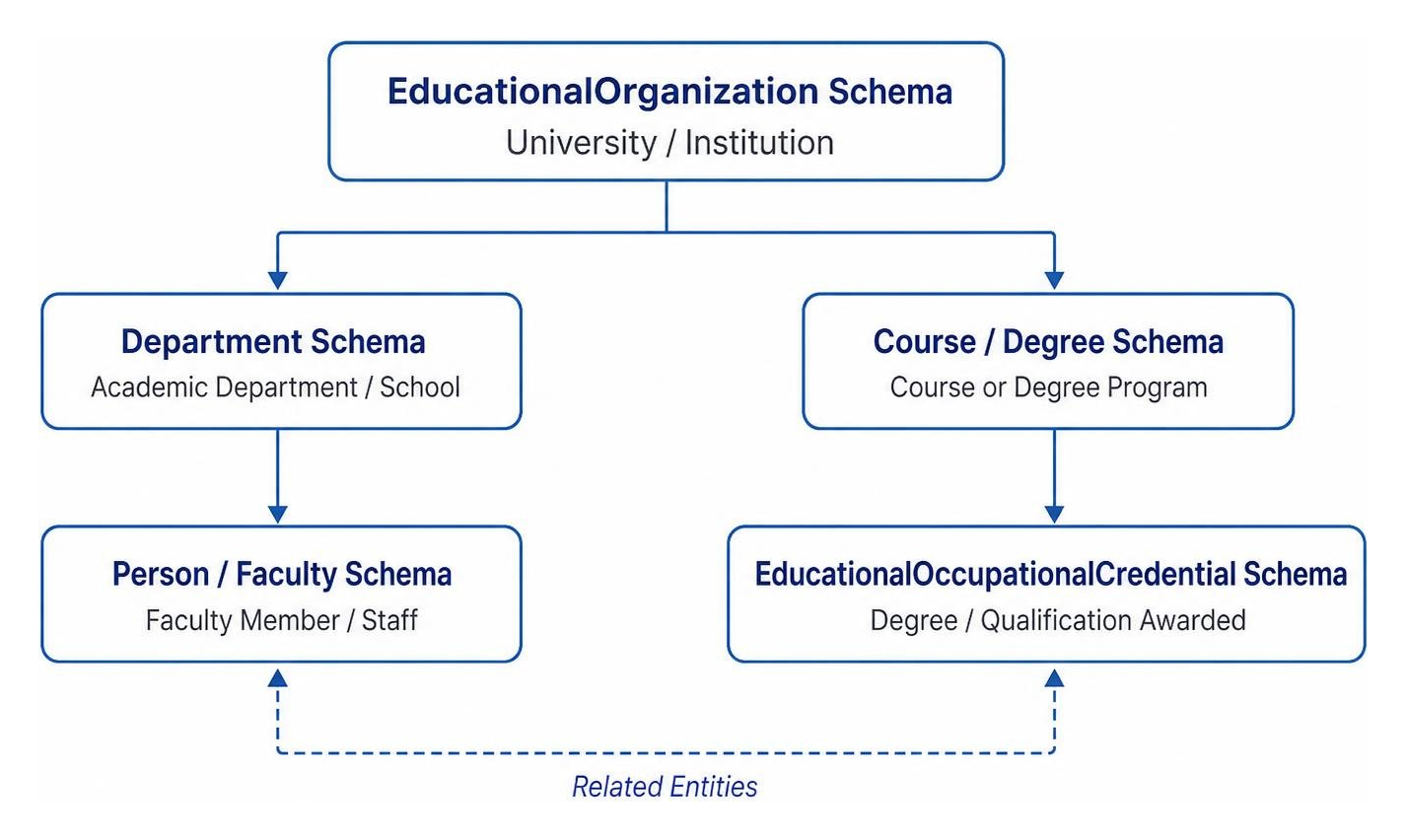
Machine-readable data helps search systems understand the relationship between qualifications, schools, faculties, campuses, study areas, and academic leaders. EducationalOrganization, Course, Department, Person, and FAQ schema can support clearer entity relationships when implemented accurately.
Clear entity relationships reduce confusion when AI systems compare similar course names or campus options. They also help search platforms distinguish current course information from archived or outdated pages.
Answer Architecture and Degree Hubs
Degree hubs should make the most important information easy to scan. Strong pages open with direct answers about study mode, entry pathways, accreditation, learning outcomes, and career relevance.
Clean tables, concise lists, plain subheadings, and contextual internal links help both students and search systems. These formats support extraction because the page does not bury key details deep in long blocks of copy.
Conversational and Long-Tail Query Targeting
Students ask specific questions in natural language. A strong content strategy answers those questions directly, including questions about part-time study, online delivery, postgraduate pathways, credit transfer, and professional recognition.
Program pages should include scenario-based answers that reflect real applicant needs. This helps generative systems understand when a course is relevant to a student’s situation without relying on keyword repetition.
Content Freshness and Data Consistency
Course details must stay consistent across degree pages, faculty pages, PDFs, scholarship pages, and application portals. Conflicting entry requirements, closing dates, or scholarship descriptions can weaken trust and reduce citation likelihood.
Regular audits help remove outdated course guides, broken links, duplicate pages, and inconsistent terminology. AuraSearch™ supports this process by aligning technical infrastructure with modern answer engine requirements through Services and direct strategy support through Contact Us.
3. Strengthening E-E-A-T Through Faculty and Institutional Authority
Generative search systems look for sources that show Experience, Expertise, Authoritativeness, and Trustworthiness (E-E-A-T). Higher education providers already hold strong authority through accredited qualifications, research activity, teaching expertise, and academic governance.
Faculty profiles should connect clearly to relevant course pages. Academic qualifications, research interests, publications, professional memberships, and teaching responsibilities give search systems stronger evidence about subject-matter expertise.
Graduate outcome information also needs careful handling. Institutions should publish accurate, current, and compliant information without overstating results or implying guaranteed employment outcomes.
Accreditation, professional recognition, research grants, partnerships, and learning facilities can all strengthen trust when they appear on relevant pages. These signals work best when they connect naturally to the course or study area being discussed.
Search systems can misread fragmented information when academic profiles, course pages, research repositories, and qualification details sit in separate silos. Strong internal linking and schema alignment help connect those entities into a clearer institutional knowledge graph.
AuraSearch™ helps institutions turn existing academic strength into search-ready authority signals. This includes content mapping, entity optimisation, technical recommendations, and transparent reporting that shows where visibility opportunities exist.
4. CAMPUS Framework for Higher Education AI SEO
The CAMPUS Framework gives Australian higher education teams a practical way to improve AI search visibility. It turns the best AI SEO strategy for higher education into a repeatable process across course pages, faculty hubs, and institutional content.
Phase 1: Entity and Schema Foundation
The first phase audits URL structures, duplicate course entries, archived pages, redirects, and faculty subdomains. Technical teams can then apply consistent Course, EducationalOrganization, Department, Person, and campus-related schema where it accurately reflects the page content.
Canonical links also matter. They help search systems recognise the preferred version of a course page when similar information appears across handbooks, faculty pages, and campaign landing pages.
Phase 2: Content Re-Architecture
Marketing, admissions, and academic teams should reshape degree pages into direct-answer hubs. Each page should answer the practical questions students ask about entry, study modes, application steps, recognition, scholarships, and outcomes.
FAQ modules, comparison-friendly sections, and short explanatory paragraphs improve readability. They also give AI search platforms clearer passages to retrieve when answering conversational student queries.
Phase 3: E-E-A-T Integration
The third phase links faculty expertise, research output, and academic credentials to relevant course content. Person schema and well-structured academic profiles can help search systems understand who teaches, leads, or contributes to each subject area.
Accreditation references, professional recognition, and verified institutional information should appear close to the course claims they support. This keeps the content useful for students and more reliable for retrieval systems.
Phase 4: Citation Tracking and Conversion Optimisation
The fourth phase monitors visibility across generative platforms, including ChatGPT, Google AI Overviews, Perplexity, Claude, and Bing. Search teams should look at branded query growth, citation patterns, referral quality, and enquiry behaviour rather than relying only on ranking reports.
Citation tracking reveals gaps in content coverage and emerging student questions. Continuous optimisation keeps course information current, improves answer clarity, and supports qualified enrolment enquiries without promising fixed third-party outcomes.
AuraSearch™ supports universities throughout the CAMPUS Framework with entity auditing, citation tracking, GEO execution, and human-led strategic review. This helps institutions build a search framework that can adapt as AI search systems continue to evolve.
Strategic AI Search Visibility for Higher Education
Sustainable student recruitment depends on clear, trustworthy, and searchable course information. Higher education providers need technical schema, answer-focused program hubs, verified academic credentials, and ongoing AI citation tracking.
AuraSearch™ provides generative AI SEO services that help institutions strengthen visibility across ChatGPT, Google AI Overviews, Perplexity, Claude, Google, and Bing. Its human-led AI approach combines expert search strategy, technical optimisation, and transparent reporting without implying guaranteed rankings or platform control.
Higher education institutions can explore strategic support through Services, review specialist AI Overview Optimisation, or contact the team through Contact Us.
FAQs
What is the best AI SEO strategy for higher education institutions?
The best AI SEO strategy for higher education combines traditional SEO, Generative Engine Optimisation (GEO), technical schema, answer-ready content, and strong academic trust signals. It helps institutions make course information easier for students and AI search systems to understand. The strategy works best when every important course claim is clear, current, and supported by official institutional evidence.
How do universities implement the best AI SEO strategy for higher education?
Universities implement the best AI SEO strategy for higher education by auditing technical foundations, improving course page structure, and aligning content with natural student questions. Teams should connect course pages with faculty profiles, accreditation information, research evidence, and application pathways. Regular reviews help keep information consistent across handbooks, faculty pages, scholarship pages, and enrolment portals.
What is the difference between GEO and traditional SEO for universities?
Traditional SEO helps university pages rank in standard search results, and GEO helps those pages become clearer sources for AI-generated answers. GEO focuses on direct answers, entity relationships, schema, citation likelihood, and conversational search intent. The strongest higher education strategy uses both approaches because students move between search engines and AI assistants during research.
How do Google AI Overviews affect university website traffic?
Google AI Overviews can summarise course requirements, study options, and admission details directly on the search results page. This changes how students interact with search because they may read a generated answer before visiting an institution’s website. Universities improve their chances of being understood and cited by publishing clear, accurate, and well-structured official information.
Why is E-E-A-T critical for higher education AI search visibility?
E-E-A-T is critical because higher education decisions require trust, accuracy, and subject-matter expertise. AI search systems need clear signals that course information comes from qualified academic and institutional sources. Faculty profiles, research activity, accreditation details, and transparent course information all help strengthen that trust.
How can institutions measure success in AI search engines?
Institutions can measure success by monitoring AI citation patterns, brand visibility across generative platforms, referral quality, and enquiry behaviour. These indicators sit alongside traditional SEO metrics such as organic traffic, rankings, and indexed page performance. AuraSearch™ helps institutions build transparent reporting systems that track visibility trends while recognising that third-party search outcomes can vary.