

The Ultimate Guide to AI SEO for Trades
AI SEO for trades is how your business gets found when homeowners ask AI tools like Google AI Overviews, ChatGPT, or Perplexity who to call. If your plumbing, HVAC, electrical, or other trade business is not easy for AI systems to understand and trust, you can miss the lead before the customer ever visits a website.
Key Takeaways
- AI SEO for trade businesses helps you appear inside AI-generated answers, not just traditional search results.
- Homeowners are asking more conversational, urgent questions such as “Who can fix a leaking pipe near me today?”
- AI systems look for structured proof, including schema, reviews, service pages, Google Business Profile data, and trusted third-party mentions.
- Strong AI visibility does not always require a number-one organic ranking, because AI citations can come from pages outside the top 10 results.
- AuraSearch helps trades businesses measure AI Share of Voice, fix visibility gaps, and become easier for AI search tools to recommend.
I am Amber Brazda, AI Search Specialist at AuraSearch. I help trade and home service businesses turn strong real-world reputations into stronger visibility across AI search. In this guide, I will walk you through what AI SEO for trades means, why traditional SEO is no longer enough on its own, and what your business can do to stay visible as customers move from blue links to AI-generated recommendations.
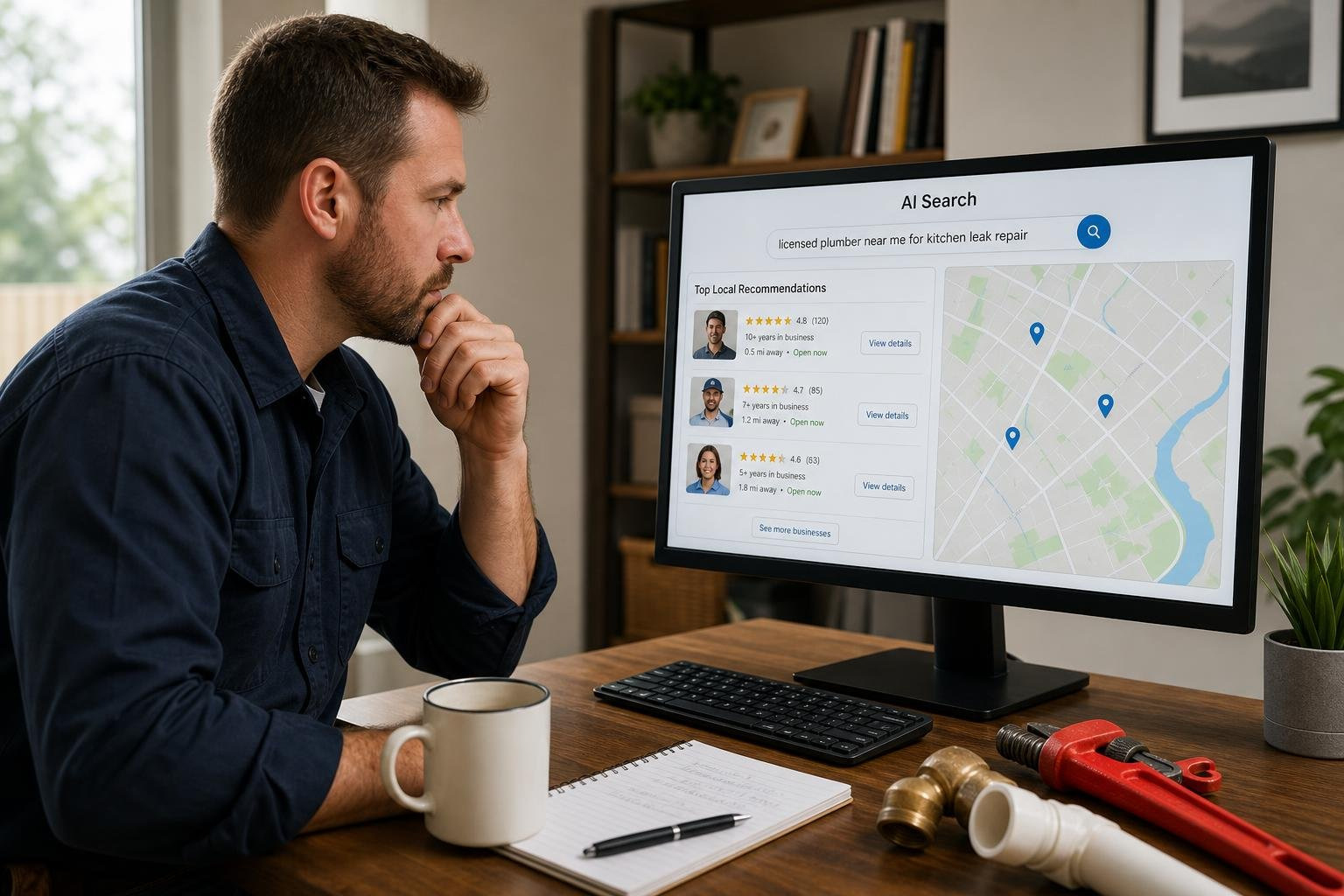
The shift is already affecting how homeowners choose local service providers. Someone searching for “emergency HVAC repair near me” may now see an AI-generated summary with a recommended business before they see a traditional list of websites. If your business is not included in that answer, the lead may go elsewhere without a click, call, or quote request.
That is why AI search visibility matters. It is not about chasing every algorithm update. It is about making your business clear, credible, and easy for AI systems to recommend when a homeowner needs help now.
The Shift to AI SEO for Trades
Traditional SEO still matters, but it is no longer the whole picture. Search engines used to send people to a list of websites and let them compare options themselves. Generative search tools now try to answer the question directly. For trades businesses, that changes the goal from simply ranking to being cited, trusted, and recommended.
| Metric / Feature | Traditional SEO | AI SEO |
|---|---|---|
| Primary Goal | Rank in the top 10 blue links | Secure citations in AI-generated answers |
| Search Intent | Keyword-based, such as “plumber near me” | Conversational, such as “who can fix a leaking copper pipe today?” |
| User Experience | Customer clicks through to compare websites | Customer gets a direct answer or shortlist on the results page |
| Data Sources | On-page content and backlinks | Schema, reviews, directory networks, service data, and brand mentions |
| Measurement | Organic traffic and keyword positions | AI Share of Voice and citation volume |
Local service searches are highly transactional. Homeowners usually want a fast, reliable answer from someone nearby. AI search tools are designed for exactly that type of decision. They can compare service areas, reviews, availability signals, and business information before a customer ever reaches your site.
Our team monitors these shifts so contractors can adapt before they lose visibility. We design strategies around the way each trade is searched, compared, and booked. If you want to see how demand varies across trades, the Local SEO and AI Search Services by Trade directory gives a useful industry breakdown.
Why Traditional Search Is Giving Way to AI SEO for Trades
Zero-click search is one of the clearest signs of this change. More searches now end without a website visit because users get enough information directly from the search results page. In local services, that can mean a business name, phone number, review summary, or booking option appears before the customer clicks anything.
AI agents are also changing consumer habits. A Salesforce study found that 33% of consumers prefer using an AI agent over speaking to a person, while 24% already allow AI assistants to make purchasing decisions on their behalf.
This shift toward automated decision-making is often called agentic commerce. In a home services context, that could eventually mean a smart system detects a hot water failure, searches for a local plumber, compares trusted options, and helps schedule the visit. To earn those jobs, your business needs a digital footprint that AI crawlers can read and verify.
Relying only on paid lead portals can become expensive because you are often competing for shared leads. AI SEO gives trades businesses a more durable asset: a structured, trusted online presence that can support visibility across Google, ChatGPT, Perplexity, and future AI assistants. AuraSearch explains this shift in more detail in its guide to Trades and Services AI SEO.
Key Strategies to Optimise for AI SEO for Trades
Winning recommendations in AI search starts with clarity. AI models do not simply guess which business is best. They look for consistent, verifiable signals that prove what you do, where you work, and why customers trust you.
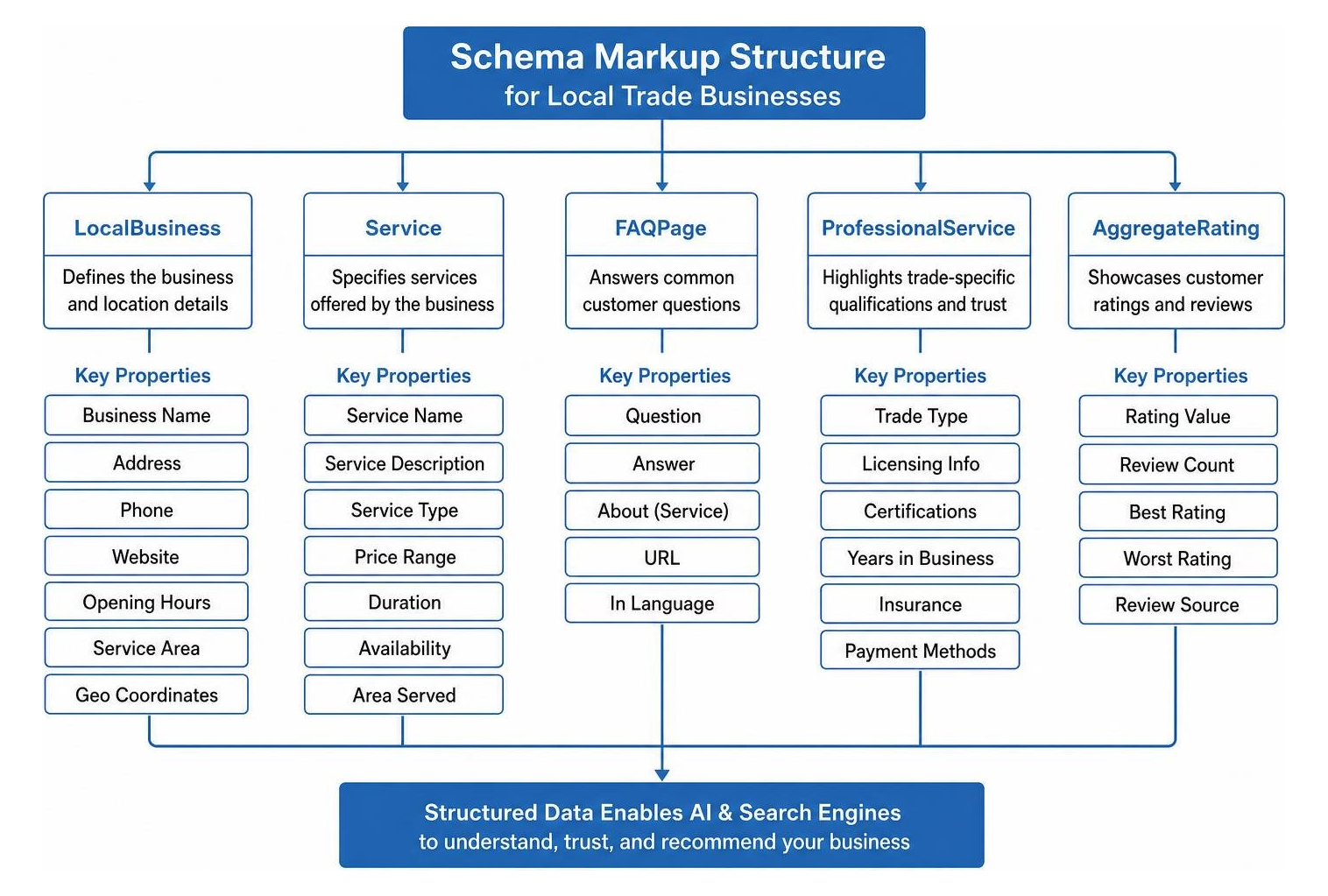
Schema markup is one of the most important pieces. LocalBusiness, Service, and FAQPage schema help AI crawlers understand your service areas, licensing details, opening hours, pricing information, and common customer questions.
Your content also needs to be more direct. Instead of writing vague blog posts around repeated keywords, answer the customer’s question clearly at the start of each page. Then support that answer with practical details, examples, service information, and proof that your business is qualified to help.
E-E-A-T stands for Experience, Expertise, Authoritativeness, and Trustworthiness. For trade businesses, that means showing real completed work, customer reviews, licensing credentials, team expertise, and local reputation. AI systems can cross-check these signals across your website, Google Business Profile, directories, review platforms, and other trusted sources.
Consistency matters too. Your Name, Address, and Phone details should match across your site, business listings, and third-party profiles. Even small inconsistencies can make AI systems less confident about recommending you. For practical steps, read AuraSearch’s guide on How to Make Your Trade Business the Top Answer for AI.
How AuraSearch Helps Trades Businesses Win AI Visibility
AuraSearch gives trade businesses the strategy and technical structure needed to compete in generative search. Instead of focusing only on traditional ranking reports, we look at whether AI systems understand, trust, and recommend your business for high-intent local searches.
Our platform analyses how AI models perceive your business entity. We identify visibility gaps, optimise schema deployment, strengthen citation profiles, and help build the structured authority needed to secure AI recommendations.
We also help trades businesses move beyond traditional keyword tracking and start measuring AI Share of Voice. That way, you can see how often your brand is recommended when local customers use conversational search tools. If you want your business to become the obvious answer when someone asks AI who to call, our Trades and Services AI SEO services are built for that next step.
FAQs
What is AI SEO for trades, and how is it different from traditional SEO?
AI SEO for trades is the process of optimising your online presence so AI engines can cite and recommend your business. Traditional SEO focuses on ranking your website in standard search results. AI SEO focuses on structured data, entity clarity, reviews, service information, and conversational content that helps your business appear inside AI-generated answers.
How do AI agents and AI Overviews change how customers hire tradespeople?
AI tools make the hiring process faster by summarising local options and presenting recommended contractors directly on the screen. Instead of opening several websites, a homeowner can ask a conversational question and receive a short list or single recommendation based on reviews, proximity, service information, and trust signals. Businesses that do not appear in those answers risk becoming invisible to customers who rely on AI search.
Will AI agents replace the need for a trade business website?
No. AI agents make your website more important, not less important. Your website is the source AI systems use to verify your services, locations, schema markup, licensing information, FAQs, and proof of expertise. If your site is thin, unclear, or technically weak, AI tools have less reason to trust and recommend your business.
What is E-E-A-T, and why does it matter for trades in AI search?
E-E-A-T stands for Experience, Expertise, Authoritativeness, and Trustworthiness. For trades businesses, it means showing proof that real customers trust you and that qualified people do the work. Reviews, project photos, licenses, certifications, team experience, and local associations all help AI systems judge whether your business is credible enough to recommend.
Can a trade business appear in AI Overviews without ranking first in organic search?
Yes. A trade business can appear in AI-generated answers even if it is not the number-one organic result. AI systems often prioritise the source that gives the clearest, most relevant, and most structured answer. That creates an opportunity for local trade businesses that build strong service pages, schema, reviews, and third-party credibility.
How do we measure success in an AI-driven search environment?
Success is measured by AI Share of Voice, citation volume, and the quality of inbound leads. Traditional metrics like organic traffic still matter, but they do not tell the whole story when more searches end without a click. The better question is whether AI tools recommend your business when customers ask high-intent local questions.
What is the difference between Google AI Overviews and ChatGPT search?
Google AI Overviews appear inside Google search results and give users quick summaries for certain queries. ChatGPT search is more conversational and can answer multi-step questions using web information. Both rely on structured, trustworthy data, so your business needs clear service pages, strong local signals, and credible third-party mentions to compete across both.