
The Definitive Guide to AI Overview Traffic
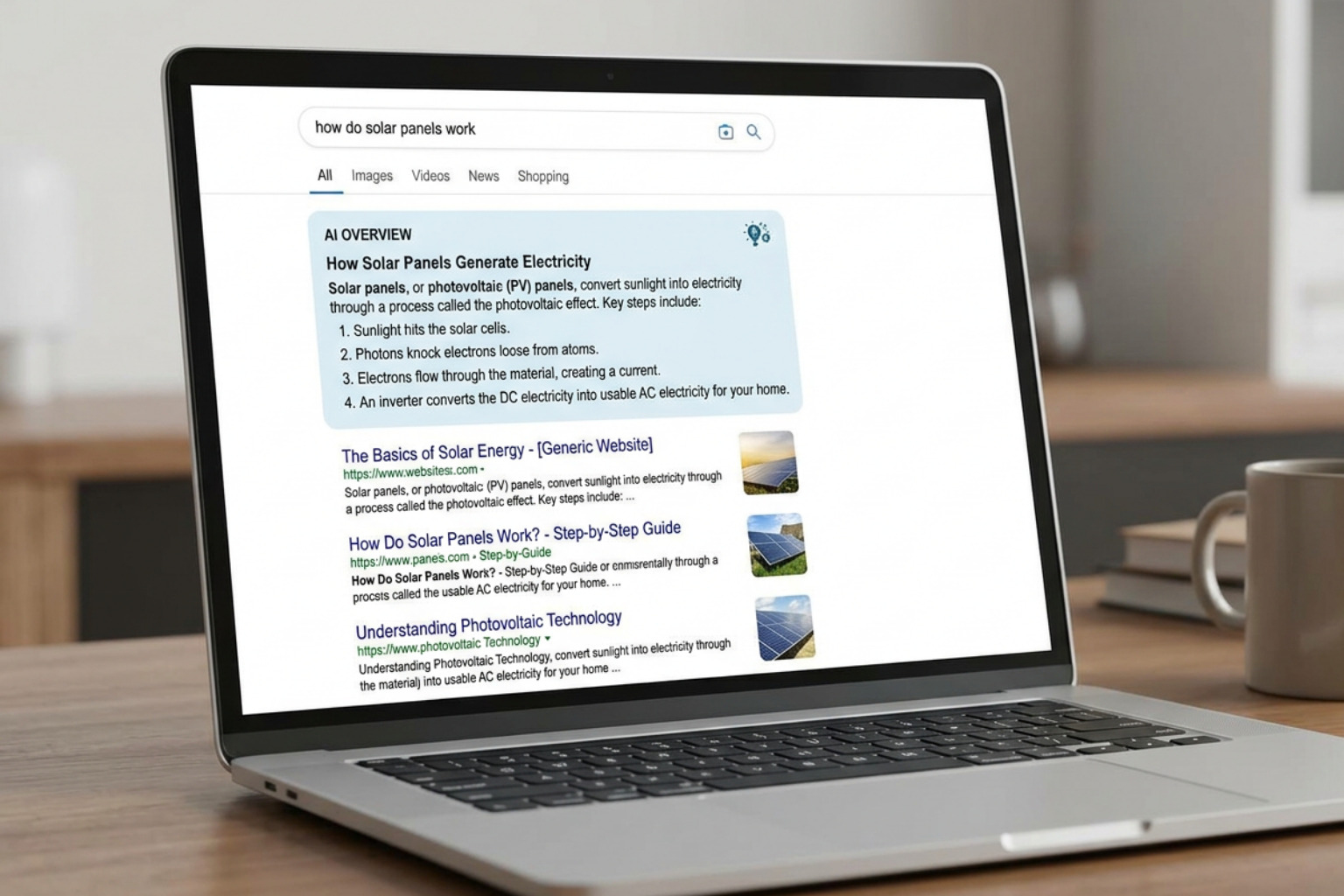
AI Overview traffic is declining for most websites, even those holding strong organic rankings. Google's AI-generated summaries now answer queries directly on the search results page, reducing the need for users to click through to any source.
Key Takeaways
- When an AI Overview appears, organic click-through rates can drop sharply, with Seer Interactive reporting a fall from 1.76% to 0.61% across 25.1 million impressions.
- AI Overviews now appear in a significant share of Google searches, with longer and more complex queries driving the highest trigger rates.
- Brands cited inside AI Overviews can earn more organic clicks than those not cited, making citation strategy a critical visibility priority.
- Zero-click behaviour is rising, with more users ending their browsing session after viewing an AI Overview.
- AuraSearch's AI Visibility Diagnostics show where your brand stands in the AI citation layer and map a path to becoming a cited source for high-value queries.
Search behaviour has shifted faster than most marketing teams have adapted. Google users now receive synthesised answers before they see a single organic result, and the data confirms they are clicking far less as a result. For marketers and business owners watching traffic fall despite stable rankings, the cause is no longer a mystery. The question is what to do about it.
I am Amber Brazda, AI Search Specialist at AuraSearch, where I have spent years building the strategic frameworks that help national brands move from invisible to cited inside AI-generated answers, including directly measurable work on AI Overview traffic recovery for high-value commercial queries. The sections ahead break down exactly how AI Overviews are reshaping search behaviour, which signals drive citation inclusion, and how to build a content strategy that performs in the answer layer.
Assessing the Impact of AI Overview Traffic on CTR
Google's integration of Gemini-based answers changes traditional organic pathways. Our analysis of search engine results pages shows that when an AI Overview triggers, organic click-through rates drop by up to 61%. Ahrefs' research confirms this pattern, showing that AI summaries reduce the organic CTR for position-one content by 58%. Paid search performance suffers an even greater blow, with paid CTR falling 68% from 19.7% to 6.34%.
| Metric | Without AI Overview | With AI Overview |
|---|---|---|
| Organic CTR | 15% | 8% |
| Paid CTR | 19.7% | 6.34% |
| Session end rate | 16% | 26% |
| Clicks on cited sources | N/A | 1% |
This decline stems from a fundamental shift in user behaviour. Users find immediate answers on the search page and feel no need to visit external sites. Pew Research Center data indicates that users click a traditional search link in only 8% of visits where an AI summary appears, compared to 15% of visits without one. Clicks on the sources cited within the summaries are rare, occurring in just 1% of visits. Business owners can read Why Your Traffic Just Took a Nosedive: The AI Overview Effect to understand how this zero-click environment impacts their bottom line.
AuraSearch helps brands measure and mitigate this loss. Standard analytics tools struggle to isolate these interactions because Google aggregates AI Overview data within general web search metrics. Marketers can learn How to Track the AI Overview Impact on Your Business using our advanced tracking frameworks. Understanding the mechanics of this shift is the first step toward reclaiming your search visibility. For further reading, industry experts discuss these changes in What Is Google AI Overview and How Does It Affect Website Traffic?.
How Search Queries Trigger AI Overview Traffic
Query length and search intent directly dictate whether Google generates an AI summary. Longer, complex queries drive the highest trigger rates. Data shows that 53% of searches containing 10 or more words produce an AI summary, whereas only 8% of short, 1-to-2-word searches trigger one. Informational and question-based queries are highly vulnerable, with 60% of question-word searches and 36% of full-sentence searches triggering an AI Overview.
Prevalence also varies dramatically by industry. Healthcare and education queries trigger AI Overviews at an 87% rate. B2B tech sits at 70%, and insurance queries show a 63% trigger rate. E-commerce queries trigger AI summaries only 4% of the time, largely because Google prefers product grid formats for transactional searches.
Marketers must align their target keywords with these triggering patterns to protect their traffic. We recommend reviewing Lost Traffic to AI Overviews: Get Your Clicks Back to map your current keyword footprint against AI-vulnerable search terms. You can also explore technical measurement tactics in How to Measure the Impact of AI Overviews on Site Traffic to see how search volume translates to actual impressions.
Optimising Content to Capture AI Overview Traffic
Securing a citation within the AI Overview is the single best way to recover lost organic traffic. Brands that get cited inside these summaries earn 35% more organic clicks than those that do not. To achieve this, you must structure your content for easy machine extraction.
Traditional SEO ranking remains the foundation for AI visibility. Google's AI pulls 97% of its cited sources from the top 20 organic search results, and 92.36% come from the top 10. A page in position one is 161% more likely to be cited. Roughly 75% of links in AI Overviews actually come from position 12 or lower, which opens major opportunities for lower-ranking pages to leapfrog to the top.
We recommend organising your content into modular, self-contained sections. Lead each H2 or H3 section with a direct, standalone answer of 40 to 60 words. Implement schema markup in JSON-LD format to help Google's crawlers verify your facts. Google's AI also shows a 26% freshness bias, meaning you must regularly update your core pages with recent data.
Turning AI Overview Visibility Into a Strategic Advantage
AuraSearch provides the expert generative AI SEO services required to adapt and win in this changing search landscape. We are the only platform offering dedicated optimization and tracking built specifically for Google's AI Overview and conversational search engines. Our proprietary technology models how large language models retrieve, synthesise, and cite web content.
We help your business move from standard keyword tracking to comprehensive entity and citation monitoring. Our platform measures your exact share of voice within AI summaries, tracks citation changes, and identifies content gaps before your competitors do. We configure custom GA4 channels and Google Search Console filters to isolate your AI-driven clicks and prove the tangible value of your campaign.
FAQs
How do AI Overviews affect click-through rates and overall website traffic?
AI Overviews cause a significant decline in traditional organic click-through rates. When Google displays an AI summary, organic CTR drops by up to 61% because users get their answers directly on the search results page. This zero-click behaviour reduces overall website traffic, especially for informational queries that no longer require a click to resolve.
What percentage of Google searches now trigger AI Overviews?
AI Overviews appear in approximately 11% to 18% of all Google searches, representing a steady year-over-year increase. The exact trigger rate depends heavily on the complexity and length of the search query. Longer, conversational queries trigger summaries at much higher rates than short, transactional keywords.
Which types of queries are most likely to generate AI Overviews?
Long-tail queries and question-based searches are the most likely to trigger AI Overviews. Studies show that 60% of question-based searches and 53% of queries containing 10 or more words generate AI summaries. Industries such as healthcare, education, and B2B tech experience the highest trigger rates.
How frequently do users click on sources cited within AI Overviews?
Users rarely click on the sources cited directly within AI Overviews, with clicks occurring in only 1% of visits. The majority of searchers read the synthesised summary and end their search session immediately. Getting cited remains critical because it establishes brand authority and yields 35% more clicks than being excluded from the summary.
What are the most commonly cited sources in AI Overviews?
Wikipedia, YouTube, and Reddit are the most frequently cited sources in Google's AI summaries, mirroring their dominance in standard organic results. Government websites also appear frequently, accounting for 6% of citations compared to just 2% in traditional search results. The vast majority of AI summaries cite three or more sources to build their responses.
Do AI Overviews lead to higher-quality or more qualified traffic?
Yes, the clicks generated from AI Overviews are often highly qualified and closer to conversion. Users who click through from an AI summary have already been pre-educated by the synthesised text. These visitors spend more time on site and convert at higher rates than average organic search visitors.