How to Track the AI Overview Impact On Your Business
How is AI affecting your business?
Key Takeaways
- Organic click-through rates for queries featuring AI summaries fell from 1.41% to 0.64% by early 2025.
- Major news publishers report referral traffic declines between 30% and 40% following the feature rollout.
- Users engage with traditional search links in only 8% of visits when an AI summary is present.
- Cited brands in AI Overviews earn 35% more organic clicks than non-cited competitors.
Introduction and the AI Overview Traffic Impact
Google AI Overviews represent a fundamental shift in how users consume information on search results pages. This integration prioritises immediate answers over external link clicks. Data from 2025 and 2026 confirms a significant reduction in referral traffic for informational queries.
The AI Overview Traffic Impact Is Already Reshaping Organic Search
Traffic impact is measurable, significant, and accelerating across almost every content category in 2025 and 2026. Here is what the data shows at a glance:
| Metric | Without AI Overview | With AI Overview |
|---|---|---|
| Organic CTR (top result) | ~1.76% | 0.61% (down 61%) |
| User link click rate | 15% of sessions | 8% of sessions |
| Cited link clicks (within AIO) | - | 1% of sessions |
| Session endings after SERP | 16% | 26% |
| Publisher referral traffic loss | Baseline | 30-40% YoY decline |
Zero-click searches now account for roughly 60% of all queries globally. When an AI summary appears, users get their answer directly on the results page and simply stop browsing.
The impact is not evenly distributed. Informational content - how-to guides, health questions, news articles - faces the steepest declines. Retailers, news publications, and marketing agencies reported organic traffic drops of 20-40% in 2025. Some smaller publishers saw losses of 80% or more, despite their rankings remaining unchanged.
Impressions stay stable. Clicks collapse. That gap is the AI Overview effect in action.
The search landscape has not broken - it has restructured. Brands that earn citations inside AI Overviews gain a measurable advantage, with 35% more organic clicks than non-cited competitors. The new competition is not for the top blue link. It is for the answer layer above it.
Identifying the AI Overview Traffic Impact Across Industry Verticals
The impact manifests as a structural decline in organic click-through rates (CTR) for high-volume informational queries. Analysis from January 2025 indicates that organic CTR plummeted from 1.41% to 0.64% for queries where AI Overviews appear. This represents a 61% collapse in performance for the top-ranking results. By the third quarter of 2025, the year-over-year decline reached 65.2% for sites that failed to earn a citation within the AI summary.
News publishers experience some of the most severe disruptions to their business models. Referral traffic to major outlets like CNN dropped approximately 30% compared to the previous year. Other major publishers, including Business Insider and HuffPost, recorded plunges of 40%. These declines stem from the 38% drop in Google referral traffic observed across the media industry. Smaller independent sites report even more catastrophic outcomes, with some travel blogs losing 90% of their organic traffic immediately following the rollout.
The health and retail sectors also face significant pressure from generative search summaries. Health niche sites recorded a 10% to 30% decrease in clicks even for pages that maintained a number one ranking. Retailers and marketing agencies saw broader traffic losses ranging from 20% to 40%. These figures correlate with the rise of zero-click searches, which now characterise 60% of global queries. Users encountering an AI summary click a traditional link in only 8% of visits, which is nearly half the 15% rate seen on pages without AI summaries.
Strategic Metrics for Measuring AI Overview Traffic Impact
Standard analytics platforms often fail to capture the full scope of the traffic impact due to an ongoing attribution crisis. Research suggests that 70.6% of traffic originating from AI platforms is misclassified as direct traffic in GA4. This dark traffic phenomenon occurs because many AI agents do not pass referrer headers or identify themselves properly. Consequently, a spike in direct traffic often masks a shift in how users discover a brand through generative summaries rather than traditional search links.
Monitoring AI crawler activity provides a more accurate picture of how generative engines interact with a website. Reports show that 80% of AI agents do not properly identify themselves , making server-side logging essential for visibility. While referral volume from AI platforms remains low compared to organic search, the quality of this traffic is exceptionally high. AI-referred visitors convert at 10.21%, which is 4.1 times higher than the rate for non-AI direct traffic.
| Metric Type | Traditional SEO Focus | AI-Driven Search Focus |
|---|---|---|
| Primary Goal | Rank #1 in Blue Links | Earn Citation in AI Summary |
| Success Indicator | Raw Click Volume | Share of Voice (SOV) |
| Attribution | Referral Source Tracking | Direct Traffic Growth Analysis |
| Content Value | Keyword Density | Semantic Completeness |
| Conversion | 0.15% (Organic Average) | 1.66% (AI Referral Average) |
Earning a citation within an AI Overview provides a distinct competitive moat. Brands featured in these summaries earn 35% more organic clicks and 91% more paid clicks than those that are excluded. This citation advantage proves that visibility within the AI layer is the new benchmark for search success. Measuring successes now requires tracking brand mentions and citation rates rather than relying solely on traditional position tracking.
Positioning Brands for AI Search Leadership with AuraSearch
The evolution of search requires a transition from traditional keyword targeting to entity-based optimisation. AuraSearch defines the future of Generative Engine Optimisation (GEO) by mapping brand visibility across AI platforms. Technical capability and data modelling allow brands to capture generative answers effectively. AuraSearch ensures that businesses remain visible as search engines move toward a zero-click model. Strategic adaptation through AuraSearch services secures a competitive advantage in the new search landscape.
AuraSearch provides the only expert generative AI SEO services designed to adapt and win in this changing environment. By focusing on semantic completeness and multi-modal integration, AuraSearch helps brands secure the citations that drive high-intent traffic. Our technical framework addresses the attribution crisis, providing clear visibility into how AI Overviews affect your bottom line.
To protect your organic reach and lead in the era of generative search, explore the AuraSearch AI Overview Optimisation services today.
FAQs
How do AI Overviews change click-through rates?
AI Overviews significantly reduce click-through rates by providing direct answers that satisfy user intent without requiring a site visit. Statistics show that organic CTR for top results can drop by over 50% when a summary appears. Users click on traditional links in only 8% of sessions compared to 15% on pages without AI summaries. This shift is most pronounced on mobile devices where AI summaries and featured snippets occupy over 75% of the initial screen space.
Which publishers face the highest risk from AI search?
Informational publishers and news outlets face the highest risk because their content is easily summarised by generative models. Major publications like CNN and Business Insider have observed traffic plunges between 30% and 40%. Smaller independent sites relying on organic search traffic report even more dramatic declines, sometimes losing 90% of their volume. The risk is highest for queries starting with "who," "what," "when," or "why," as these trigger AI summaries in 60% of cases.
Can being cited in an AI summary recover lost traffic?
Being cited within an AI Overview offers a significant visibility advantage that can partially mitigate organic traffic losses. Research indicates that cited brands earn 35% more organic clicks than those excluded from the summary. While the overall volume of clicks on the search results page decreases, the traffic directed to cited sources is often of higher quality and intent. This makes earning a citation a primary goal for any modern search strategy aiming to maintain brand authority.
What is the difference between an AI Overview and a Featured Snippet?
A Featured Snippet extracts a verbatim passage from a single website to answer a query. An AI Overview synthesises information from multiple sources - typically 6 to 14 different URLs - to create an entirely new summary. AI Overviews are more disruptive to traffic because they provide a comprehensive answer that often removes the need for the user to visit any external website. Featured Snippets are still common, but AI Overviews now appear in roughly 20% of all Google searches.
How can businesses track traffic from AI Overviews?
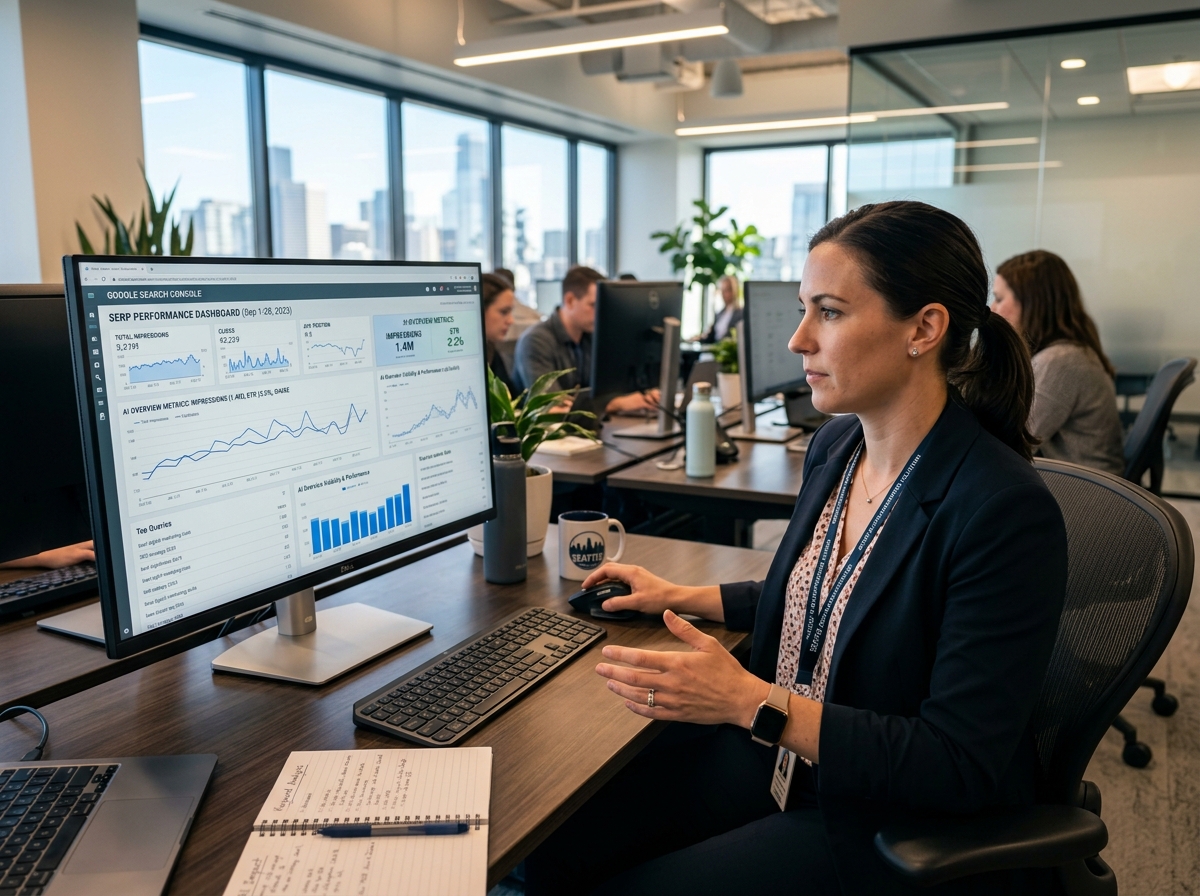
Businesses can track the impact by monitoring direct traffic spikes in GA4 that correlate with declines in organic search referrals. Because 70.6% of AI traffic is misclassified as direct, marketers must look for high-converting traffic with no apparent source. Specialized tools that monitor AI visibility and share of voice are also necessary to see when and where a brand is being cited. Traditional Search Console data will show stable impressions but declining clicks for queries where an AI summary is present.