
How to Build a Concrete AI SEO Strategy for Your Construction Company
Why Construction Companies Can No Longer Afford to Ignore AI Search
AI SEO for construction helps your business show up when people ask AI tools for contractor recommendations, cost guidance, service comparisons, and local building expertise. If your website is clear, structured, and trustworthy, AI search engines have a much better reason to cite you instead of a competitor.
Key Takeaways
- AI search platforms are changing how homeowners, builders, and commercial clients discover construction companies.
- Your website needs clear service information, structured data, and consistent local signals so AI systems can understand and recommend your business.
- Publishing practical cost guides, project details, and location-specific content helps reduce inaccurate AI answers about your services or pricing.
- Strong third-party citations, reviews, and directory profiles make your company easier for AI tools to verify.
- AuraSearch™ helps construction and trade businesses build visibility across traditional search and generative AI platforms.
I am Amber Brazda, AI Search Specialist at AuraSearch™, and I help trade and construction businesses build the kind of structured, citation-ready digital presence that AI search systems can trust. This guide explains how AI SEO for construction works, why it matters, and what your company can do now to stay visible as search keeps changing.
AI SEO for construction is the practice of optimising your digital presence so AI-powered search platforms, such as ChatGPT, Perplexity, and Google AI Overviews, can find, understand, and recommend your business when prospective clients search for contractors, builders, or trade services.
Here is the short version:
What is AI SEO for construction, and why does it matter?
- AI search platforms now influence how homeowners and commercial clients discover contractors, often before they reach a traditional Google results page.
- Traditional SEO helps you rank in search results. AI SEO helps your business get cited inside AI-generated answers.
- The main ingredients are structured data, helpful content that answers real buyer questions, and consistent third-party citations across trusted directories and industry sources.
- Construction companies that act early can build a visibility advantage that gets harder for competitors to close over time.
- AuraSearch™ helps construction and trade businesses diagnose their current AI search visibility and close the gaps.
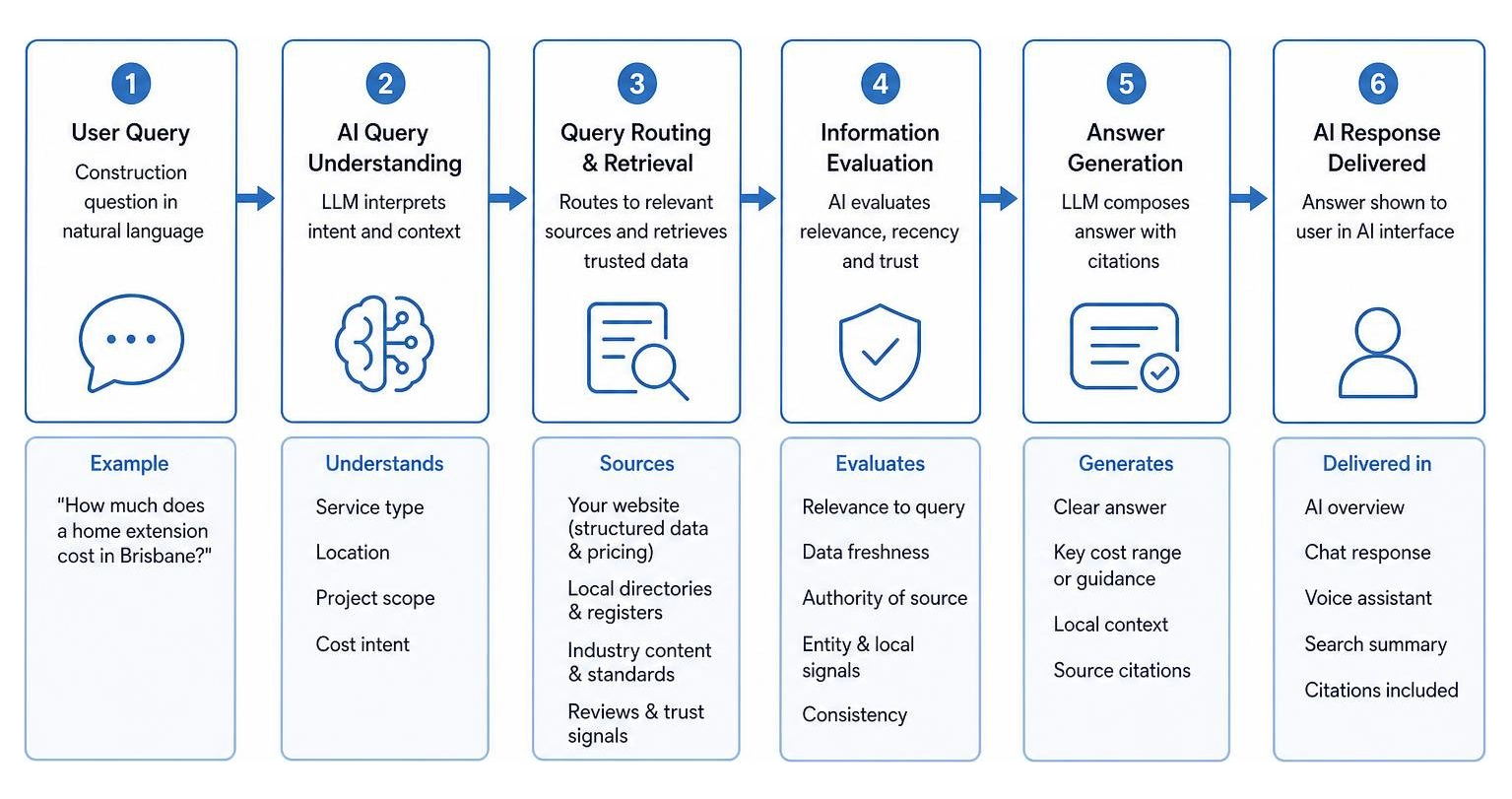
Search behaviour has shifted. Homeowners researching a renovation, builders comparing subcontractors, and project managers vetting suppliers are no longer just typing short queries into Google. They are asking AI assistants detailed questions about costs, materials, timelines, and local providers. The AI then gives a synthesized answer and cites a small group of trusted sources. If your business is not one of those sources, you may not appear in the answer at all.
That is the challenge for construction companies in 2026. Strong traditional rankings still matter, but they no longer guarantee discovery. Your company can rank well on a Google results page and still be missing from the AI-generated answers that shape a buyer's shortlist before they ever click through to a website.
For high-ticket construction projects, such as new home builds, commercial fit-outs, and major renovations, the research phase can last weeks or months. Buyers ask AI tools comparison questions, request cost guides, and look for local specialists long before they contact a contractor. When your business earns a citation in those early AI interactions, you start the sales conversation with more trust already built in.
AI SEO for Construction: Building Visibility in the Era of Generative Search
Generative Engine Optimisation (GEO) is the next phase of digital marketing for the building sector. Traditional search engine optimisation focuses on helping a website appear in standard search results. GEO focuses on helping your business get cited inside the conversational answers generated by large language models.
The Shift from Keywords to Machine-Readable Structure
AI search engines do not read websites in the same way people do. These systems crawl the web to collect facts, relationships, and entities, then use that information to build a clearer picture of industries, businesses, locations, and services. If you want your construction company to appear in AI-generated recommendations, your website needs to present information in a format machines can understand.
That means moving away from awkward keyword repetition and focusing on clear, data-rich content. Your site should explain what you do, where you work, who you serve, what projects you handle, and what makes your experience credible. When your digital assets send clear signals to generative models, your business becomes easier to verify and recommend.
Correcting AI Model Hallucinations About Construction Costs
AI tools can sometimes rely on outdated or incomplete information, which may lead to poor estimates for construction materials, labour rates, project timelines, or local requirements. For example, an AI assistant might suggest a home extension budget based on broad historical data instead of current local supply and permitting realities.
Construction companies can help correct these gaps by publishing dated cost ranges, project examples, and practical pricing explainers on their own websites. Break down the variables that affect price, such as material grades, site access, council requirements, project complexity, and labour availability. This gives AI engines a more reliable source to retrieve when users ask cost-related questions. For more guidance, see our article on how to make your trade business the top answer for AI.
The Critical Role of Local Entity Signals for Regional Builders
Most construction and trade businesses serve specific regions. AI search engines need to understand where you operate before they can recommend you for local projects. That makes regional optimisation a major part of any modern search strategy.
Keep your business name, address, phone number, service areas, licence details, and trade categories consistent everywhere your company appears online. AI models can cross-check directories, business profiles, licensing sources, review platforms, and trade listings to confirm that your business is active and legitimate. Recent customer reviews also help because they give AI systems fresh proof that real people trust your work. For deeper regional tactics, read local SEO in the AI era.
Schema Engineering and Structured Data for Construction Sites
Schema markup is code added to your website that helps search engines understand the meaning behind your content. For construction firms, it can clarify your business type, services, locations, project examples, reviews, offers, and service boundaries.
Basic contact schema is a useful start, but construction websites often need more detail. Depending on the business, relevant schema may include trade-specific business types, service area markup, offer information, project portfolio details, and FAQ schema. The goal is simple: make it easy for search engines and AI systems to understand exactly what you do and where you do it. A plumbing company, for example, would apply similar principles in a trade-specific way, as shown in our step-by-step guide to plumbing business AI visibility.
Timeline for AI Visibility and Compounding Growth
AI visibility does not usually change overnight. Some businesses may see early citation movement within several weeks after improving structured data, content quality, and third-party consistency. Stronger, more reliable gains usually take longer because AI systems need repeated evidence that your business is a trusted source.
Think of AI SEO as compounding visibility. Each helpful guide, directory correction, review, schema update, and local project page gives search systems more confidence in your business. Over time, that creates a digital footprint competitors cannot easily copy with ads alone.
Can AI SEO Systems Replace Traditional Digital Marketing Agencies?
AI tools can speed up research, content production, reporting, and technical checks, so it makes sense that some contractors wonder whether they still need marketing support. The issue is that automation alone often misses the nuance behind high-value construction decisions.
Construction buyers care about trust, risk, timelines, proof of past work, compliance, cost clarity, and local experience. A strong AI SEO strategy needs both smart systems and human judgment. AI can help with speed and scale, but experienced strategists are still needed to shape the message, validate the facts, engineer the structure, and connect the strategy to real project leads.
Build a Search Strategy That Helps Construction Buyers Find You
Search is moving from blue links to instant, synthesized answers, and construction companies need to be visible in both places. AuraSearch™ helps trade and construction businesses make that shift with a practical strategy that connects traditional SEO, GEO, content quality, structured data, and local authority.
Our expert-led team diagnoses your current search footprint, identifies visibility gaps, and improves the signals AI platforms use to understand and cite your business. That includes clearer content, stronger entity signals, better schema, and a measurement framework that shows where your business is gaining visibility across ChatGPT, Perplexity, Claude, and Google AI Overviews.
If you want your construction company to be easier for AI search platforms and real buyers to find, our team can help you build the right foundation.
- Contact us to schedule a strategic visibility consultation.
- Learn more about our trades and services AI SEO solutions.
FAQs
How does AI SEO for construction differ from traditional search engine optimisation?
Traditional search engine optimisation focuses on helping individual pages rank in standard search results. AI SEO focuses on helping your business get cited and recommended inside AI-generated answers. Traditional methods often target specific search phrases to drive website clicks, while AI SEO structures your content and business data so large language models can retrieve and reference your company as a trusted source.
What are the key elements of a successful AI SEO for construction strategy?
A successful strategy combines structured data, useful content, and verified third-party trust signals. Construction companies should use clear local business schema, define service areas, publish helpful project and pricing content, and maintain consistent business details across important directories. These signals make it easier for AI systems to understand, verify, and recommend the business.
How long does it take to see results from generative search optimisation?
Some early citation improvements may appear within several weeks, especially after technical and content issues are fixed. Stronger gains usually take three to six months of consistent optimisation because AI platforms need time to verify your business credentials, collect third-party signals, and recognise your local project history.
Can a local contractor compete with national firms in AI search?
Yes. Local contractors can compete by giving AI systems clearer local proof than larger generic competitors. Precise service areas, consistent directory listings, strong local reviews, project pages, and trade-specific schema can help a regional builder appear in relevant local recommendations.
What is Generative Engine Optimisation for builders?
Generative Engine Optimisation is the practice of structuring your website and online presence so generative AI search engines can cite your business in their answers. For builders, that means making project portfolios, services, technical details, locations, and proof points clear enough for machines to parse and trustworthy enough for buyers to believe.
Why are structured data and schema markup critical for AI visibility?
Structured data and schema markup help translate your website for search engines and AI crawlers. They define your business type, services, locations, trade classifications, project details, and service boundaries in a standardized format. Without this structure, AI systems may struggle to understand what your company does, which makes them less likely to recommend you.