

How to Optimize Your Site for AI Search Engines (A 2026 Checklist)

Why Every Marketer Needs an AI SEO Checklist in 2026

If you want your brand to show up in AI answers, traditional SEO is only part of the job now. This AI SEO checklist walks you through the technical, content, and authority signals that help tools like Google AI Overviews, ChatGPT, Gemini, and Perplexity understand and cite your site.

Key Takeaways

  • Roughly 7 in 10 Google searches now end without a click, so rankings alone no longer guarantee traffic.
  • Google AI Overviews are creating a new visibility layer that standard SEO does not fully address.
  • Clear citations, statistics, and expert-backed claims make your content easier for AI systems to quote.
  • Brand pages can earn AI traffic without becoming trusted citation sources, which creates a gap between clicks and authority.
  • AuraSearch's AI Visibility Diagnostics show where your brand appears in AI answers and what to improve next.

I am Amber Brazda, AI Search Specialist at AuraSearch. I help brands move from being absent in AI-generated answers to becoming trusted sources that AI systems can recognise, extract, and recommend.

Search did not die. It split.

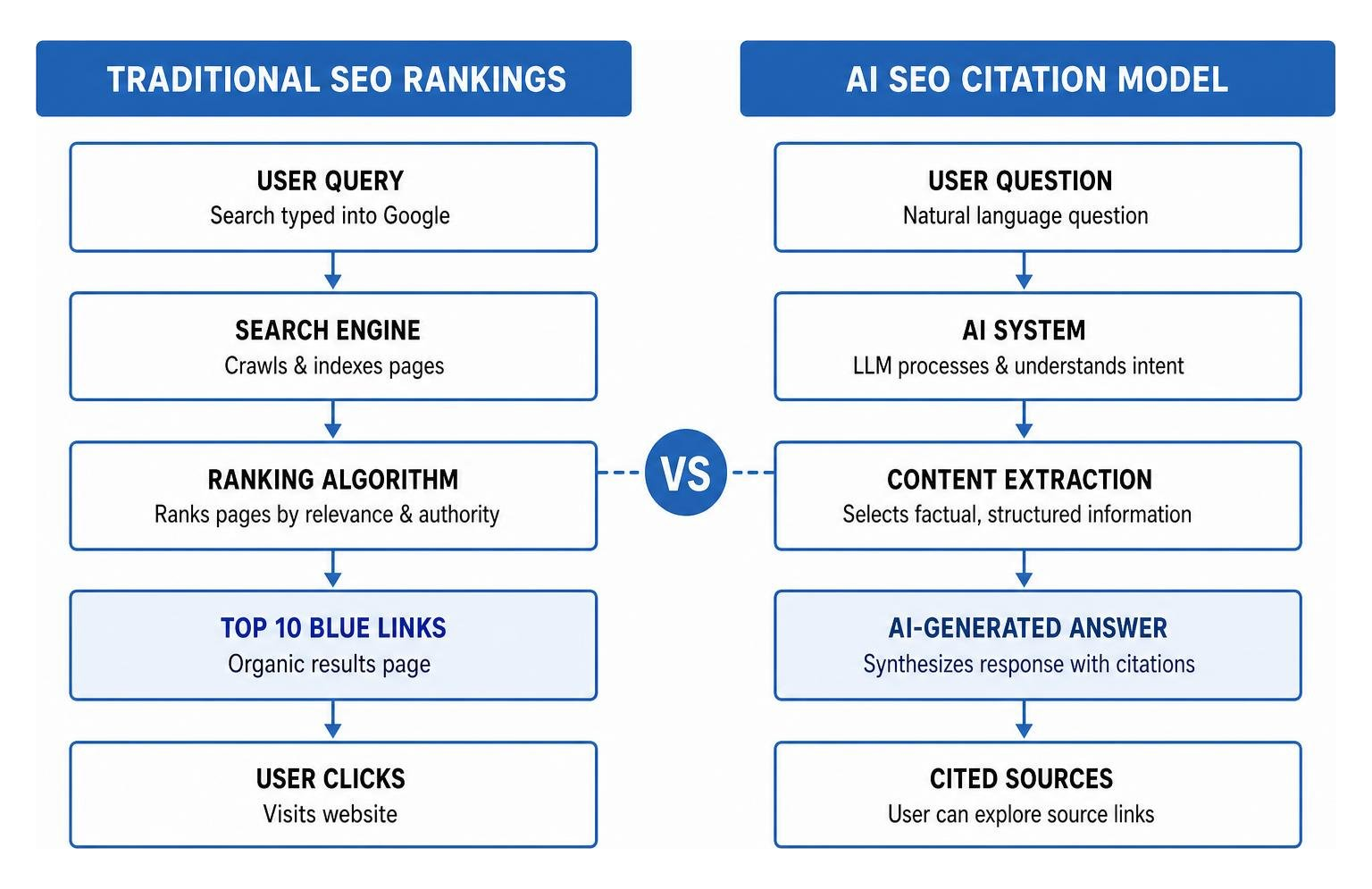
On one side, Google's traditional results still exist. On the other, AI systems like Gemini, ChatGPT, and Perplexity now synthesise answers directly, pulling from sources they deem credible and well structured. If your brand is not optimised for that second layer, you may be missing from the conversation even when your website is useful.

That is the problem an AI SEO checklist solves. It gives you a practical way to review the technical setup, page structure, and authority signals that influence whether AI systems can understand and cite your content.

The shift is already measurable. AI-generated results can reduce clicks to traditional organic listings, while AI referral traffic often arrives with stronger intent because users have already narrowed their options before they click.

Optimising for AI search is now a practical necessity for brands that depend on organic discovery.

The Essential AI SEO Checklist for Beginners

Moving from traditional keyword targeting to generative search optimisation takes a shift in mindset. Large language models do not simply look for keyword repetition. They extract clear facts, recognise entities, and look for content that is easy to understand, verify, and cite.

Optimisation Element Traditional Search Engine Optimisation Generative Engine Optimisation (GEO)
Primary Goal Rank in the top 10 blue links Earn citations in AI-generated answers
Content Structure Long-form, keyword-optimised articles Answer-first, modular, high-fact-density sections
Technical Focus Crawlability, indexability, XML sitemaps AI crawler access, schema stacking, clean HTML
Authority Signal Backlink volume and anchor text Entity consistency, expert quotes, trusted references

Technical Foundations and AI Crawler Access

Crawlability is the gatekeeper of generative search visibility. If AI crawlers cannot access your pages, they cannot read, learn from, or cite your content.

Start by reviewing your robots.txt file and firewall rules. Make sure you understand how major AI agents, including GPTBot, ClaudeBot, PerplexityBot, and GoogleOther, are treated by your site setup.

You should also check how your website renders important content. AI crawlers often fetch raw HTML and may not consistently process complex JavaScript. Server-side rendering or clean static HTML can make your most important information easier to access.

For a deeper technical walkthrough, the AI search optimization checklist is a useful reference for reviewing crawler access, indexing, and content accessibility.

Content Structure and Information Extractability

AI search engines tend to cite content that is structured, specific, and easy to extract. That means your page should answer important questions directly instead of burying the point in long introductions.

A strong approach is to open each priority section with a clear answer in plain language. Then support that answer with statistics, expert commentary, examples, and source links that make the claim easy to verify.

Lists, tables, definitions, and step-by-step guidance all help because they turn your page into smaller factual units. AI systems can lift those units into answer panels more easily than dense, unstructured prose.

You can also strengthen topical authority by grouping related articles into semantic clusters around central pillar pages. If you are building that roadmap, AuraSearch's AI search content strategy guide explains how to connect topics, entities, and search intent in a way AI systems can follow.

Schema Markup and Entity Authority

Structured data helps search engines connect your brand, authors, products, and services to broader entity networks. When schema markup is accurate, it gives machines a clearer explanation of who created the content and what the page is about.

For informational pages, Article, Person, and FAQPage schema can validate authorship and page structure. For commercial pages, Product, Offer, and AggregateRating schema can make product and pricing details easier for AI shopping and recommendation systems to understand.

Entity consistency matters too. Use sameAs markup in Organisation schema to connect your website with official profiles, trusted databases, and social channels where appropriate.

For ecommerce teams, structured product data is especially important. The ecommerce AI-readiness SEO checklist gives a practical breakdown of product feeds, identifiers, and machine-readable commerce data.

How AuraSearch Helps You Win in AI Search

Generative search has changed how people find information, compare providers, and choose what to buy. Traditional SEO still matters, but the brands that win now also make their expertise easy for AI systems to find, verify, and recommend.

AuraSearch helps you make that transition with specialist generative AI SEO services. We audit your technical architecture, content structure, and entity signals so you can see where your brand is visible and where competitors are being cited instead.

Our methodology focuses on machine readability, answer-ready content, and stronger authority signals across ChatGPT, Gemini, Perplexity, and Google AI Overviews. Instead of guessing what to fix, you get a clear plan for improving your presence in AI-generated answers.

If you want to protect your organic search footprint and compete for AI citations, explore our professional AI SEO services.

FAQs

What is an AI SEO checklist and why is it necessary?

An AI SEO checklist is a structured list of technical, content, and authority improvements that make your website easier for AI engines to discover, understand, and cite. It is necessary because traditional SEO focuses mostly on ranking in search results, while AI search systems need clear formatting, trusted signals, and factual precision to include your brand in direct answers. For a practical starting point, follow AuraSearch's AI search content optimization checklist.

How do I implement an AI SEO checklist for ecommerce?

For ecommerce, start with clean product schema and structured product feeds. Add Product, Offer, and AggregateRating schema to product pages, include identifiers such as GTIN, MPN, and SKU where available, and keep pricing consistent across your site and marketplace listings. Product descriptions should answer real pre-purchase questions in natural language.

How do Google AI Overviews impact click-through rates?

Google AI Overviews can reduce click-through rates for traditional organic listings because they answer some queries directly on the results page. That creates a zero-click environment where users may get what they need without visiting a website. The best response is to optimise for inclusion and citation inside the AI Overview itself, not just for a traditional blue-link ranking.

What is the difference between GEO and traditional SEO?

Generative Engine Optimisation focuses on earning citations and recommendations inside AI-generated answers, while traditional SEO focuses on ranking web pages in standard search results. Traditional SEO relies on keyword targeting, technical health, backlinks, and page relevance. GEO adds another layer by improving information extractability, entity recognition, and factual clarity.

How do AI crawlers interact with robots.txt files?

AI crawlers read robots.txt user-agent directives to determine whether they have permission to access your URLs. Crawlers such as GPTBot, ClaudeBot, and PerplexityBot look for rules that allow or block them before gathering page information. If your robots.txt file or firewall blocks these agents, the related AI systems may not be able to read or cite your pages.

How do brands measure visibility in generative search?

Brands measure visibility in generative search by tracking presence, citation share, and referral traffic across major AI platforms. That includes monitoring how often your brand appears in conversational answers, which competitors are cited for priority prompts, and whether traffic from tools like ChatGPT and Perplexity is growing over time.

Recent Posts

By Amber Brazda • September 25, 2026
Australian accounting practices can improve AI search visibility by combining responsible AI adoption with clear expertise, structured data, and compliant local content.

By Amber Brazda • September 24, 2026
AI SEO for medical clinics in Australia helps healthcare providers improve search visibility with clear content, structured data, and compliant local strategy.
By Amber Brazda • September 24, 2026
Learn how to improve agent AI search rankings with Australian-focused guidance on technical SEO, content authority, and sustainable AI search visibility.
By Amber Brazda • September 23, 2026
Learn how Accounting AI SEO helps your firm get cited in generative engines like ChatGPT and Google AI Overviews with expert optimization strategies.
By Amber Brazda • September 18, 2026
Learn how to rank in ChatGPT answers with practical AI visibility, entity authority, and citation tracking strategies for generative search.
By Amber Brazda • September 17, 2026
Learn how to choose the best AI SEO agency for manufacturing industry searches, with practical criteria for Australian suppliers.

By Amber Brazda • September 11, 2026
Find an expert answer engine optimization agency to boost your AI search visibility with structured data, citation tracking, and multi-platform strategies.

By Amber Brazda • September 10, 2026
Learn how AI traffic affects chiropractic practices and how AuraSearch™ helps improve visibility across AI search platforms and traditional search.

By Amber Brazda • September 10, 2026
Discover what is the best AI SEO strategy for higher education to boost student recruitment through generative engine optimization.
By Amber Brazda • September 8, 2026
Discover how ai seo audit report tools evaluate visibility, citability and LLM accessibility to boost your generative search performance.
Show More