

How to Optimize Your Content for AI Search Engines Without Losing Your Mind
AI Search Is Changing What Visibility Actually Means
The best strategy to optimise content for AI search engines is to make each page easy for people to read and easy for AI systems to extract, verify, and cite. AuraSearch™ helps brands connect traditional search foundations with Generative Engine Optimisation (GEO), so content can earn stronger visibility across AI-driven and standard search platforms.
Key Takeaways
- Generative Engine Optimisation (GEO) builds on traditional SEO by helping content become clear, credible, and citation-ready for AI search systems.
- Direct answer blocks under descriptive headings make it easier for ChatGPT, Google AI Overviews, Perplexity, and Claude to interpret page content.
- Clear entity definitions, structured data, and strong internal links help AI systems understand brand expertise and topic relationships.
- Australian sources, visible updates, and verifiable claims support trust for readers and retrieval systems.
- AuraSearch Services can help organisations assess AI search visibility and build a practical optimisation framework.
I am Amber Brazda, AI Search Specialist at AuraSearch™, where I lead the strategic bridge between traditional search authority and Generative Engine Optimisation (GEO), helping national brands optimise content for AI search engines across generative platforms. The practical framework below draws on that work across B2B, eCommerce, Healthcare, Fintech, Professional Services, and Trades to give content teams a clear, actionable path forward.
AI search has changed the way visibility works. Instead of asking whether a page ranks for one keyword, content teams now need to ask whether a page gives AI systems a clear, trustworthy answer worth citing.
Traditional organic rankings still matter. Search indexes, crawlability, content quality, and authority signals remain the foundation, but AI search adds another layer. Pages need concise answers, strong source signals, and a clear relationship between the brand, the topic, and the reader’s problem.
Practical Framework for AI Search Content Optimisation
Generative Engine Optimisation (GEO) adapts web publishing for large language models and Retrieval-Augmented Generation (RAG) systems. These systems retrieve relevant information and turn it into direct answers, so the page must make the answer easy to find, trust, and reuse.
AuraSearch™ guides organisations in refining their digital footprint so AI-driven search systems can recognise their authority across important informational queries. The strongest approach combines helpful writing, accessible technical foundations, and consistent brand signals across the wider web.
Structure Direct Answers Clearly
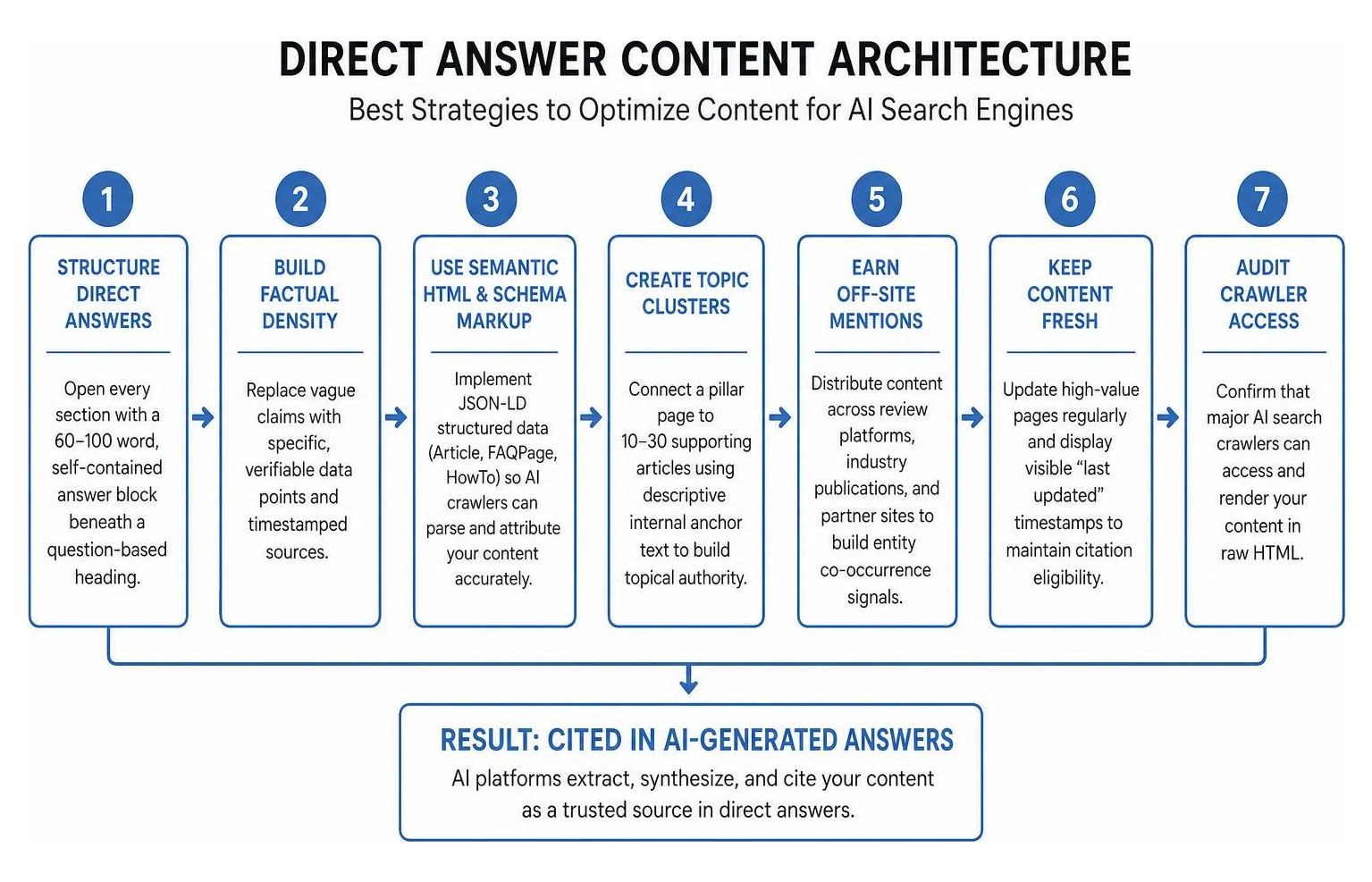
AI search systems work best with content that answers a question quickly and then expands with useful detail. A strong section starts with a plain-language answer, then supports it with definitions, examples, evidence, or next steps.
This does not mean writing for robots. It means giving prospective customers a better experience. When the first sentence under a heading explains the point clearly, both readers and retrieval systems can understand the page faster.
Server-side rendering also matters because the raw HTML should expose important text without relying on client-side JavaScript. Guidance from the Australian Government Digital Service Standard supports accessible, user-centred digital services, which aligns with clear content structure and readable page delivery.
Build Citation-Ready Factual Density and Entity Clarity
Factual density means replacing vague marketing copy with statements that can be checked, explained, and attributed. AI search systems need clear facts, dates where relevant, defined entities, and consistent terminology to understand what a page is about.
| Content Element | Traditional SEO Focus | Citation-Ready AI Content Focus |
|---|---|---|
| Headline Structure | Keyword-focused target phrases | Natural-language headings that explain the query |
| Opening Statements | Narrative introductions | Concise answer blocks that stand alone |
| Data Presentation | General claims | Verifiable facts with approved Australian sources |
| Entity Referencing | Broad category terms | Clear brand, product, platform, and industry entities |
| Content Updates | General refreshes | Visible revisions that keep information current |
Clear entity writing helps AI systems connect AuraSearch™ with AI search visibility, SEO, Generative Engine Optimisation (GEO), and the platforms customers care about. It also helps readers understand why the advice is relevant to their business, not just to a generic search checklist.
Use RAG Mechanics, Schema Markup, and Topic Clusters
Retrieval-Augmented Generation (RAG) connects search retrieval with generative language output. That makes structured pages, clear headings, and machine-readable context especially valuable.
JSON-LD schema markup can help search engines understand articles, services, FAQs, organisations, and authors. Topic clusters also matter because they show depth across connected subjects rather than treating each page as a standalone asset.
A practical cluster might include a central AI search service page, supporting articles on Google AI Overviews, guidance on content structure, and explainers for prompt visibility. AuraSearch Services can help map those relationships and identify gaps that limit search visibility.
Strengthen Brand Co-Occurrence Across Trusted Surfaces
Brand co-occurrence is the relationship between a brand name and the topics it is regularly associated with online. For AI search, this matters because retrieval systems look for repeated, credible signals across the web.
AuraSearch™ should appear consistently beside terms such as AI search visibility, Generative Engine Optimisation (GEO), ChatGPT, Google AI Overviews, Perplexity, Claude, Google, and Bing. Those associations support clearer entity recognition across both traditional search and AI-driven discovery.
Strong co-occurrence does not come from repeating the brand name without purpose. It comes from useful content, relevant citations, accurate service descriptions, and a consistent presence across trustworthy industry surfaces.
Keep Technical Foundations Clean
Speculative optimisation tactics, such as standalone llms.txt files or artificial content chunking, do not replace normal crawlability, visible on-page content, XML sitemaps, and clear information architecture. Search systems still need to access, parse, and trust the page.
Teams should monitor crawl behaviour, indexation, internal links, schema validity, and content freshness. Clear writing, active voice, accessible formatting, and concise answers improve the experience for readers while making the page easier for AI systems to interpret.
AuraSearch™ pairs expert strategy with AI tools to help identify where content structure, schema, entity signals, and technical search foundations need attention.
AI Search Visibility With AuraSearch
AuraSearch™ provides a strategic bridge between traditional search optimisation and generative engine visibility. The team helps organisations diagnose current positioning, identify content gaps, and implement structured frameworks that improve citation likelihood without promising control over third-party platforms.
AuraSearch™ combines human-led strategy, data modelling, and transparent reporting across ChatGPT, Google AI Overviews, Perplexity, Claude, Google, and Bing. That approach helps brands keep content crawlable, useful, and aligned with the way search behaviour is evolving.
For organisations that want a clearer path into AI search, the next step is to review AuraSearch Services and Contact Us to discuss the right visibility framework.
FAQs
How does ChatGPT select source content for web citations?
ChatGPT can retrieve web content for real-time queries when search access is available. Clear entity definitions, crawlable HTML, and concise summaries help a page become easier to interpret as a possible citation source.
How does Perplexity discover and cite web pages?
Perplexity uses search and retrieval systems to surface direct citations from web pages. Pages with clear question-and-answer formatting, updated information, and verifiable claims are easier for readers and retrieval systems to understand.
What determines brand inclusion in Google AI Overviews?
Google AI Overviews draw on search indexing and ranking systems to build generative summaries. Strong technical SEO, helpful content, entity clarity, and structured data all support eligibility for visibility in AI-generated search experiences.
How should robots.txt files be configured for AI search crawlers?
Robots.txt files should preserve access for search retrieval crawlers that may support discovery and citation. Organisations can still manage different crawler types carefully, but blocking important search crawlers can reduce visibility opportunities.
Does FAQ schema markup help content appear in generative answers?
FAQPage schema can help search systems understand question-and-answer relationships when it matches visible page content. The visible text remains the main source, while clean JSON-LD markup reinforces structure and intent.
How can organisations measure brand share of voice in AI search?
Brand share of voice in AI search can be measured by reviewing citation frequency, brand mention rates, prompt visibility, and crawler activity across important query sets. AuraSearch™ uses transparent reporting to help organisations understand presence across AI-driven and traditional search platforms.