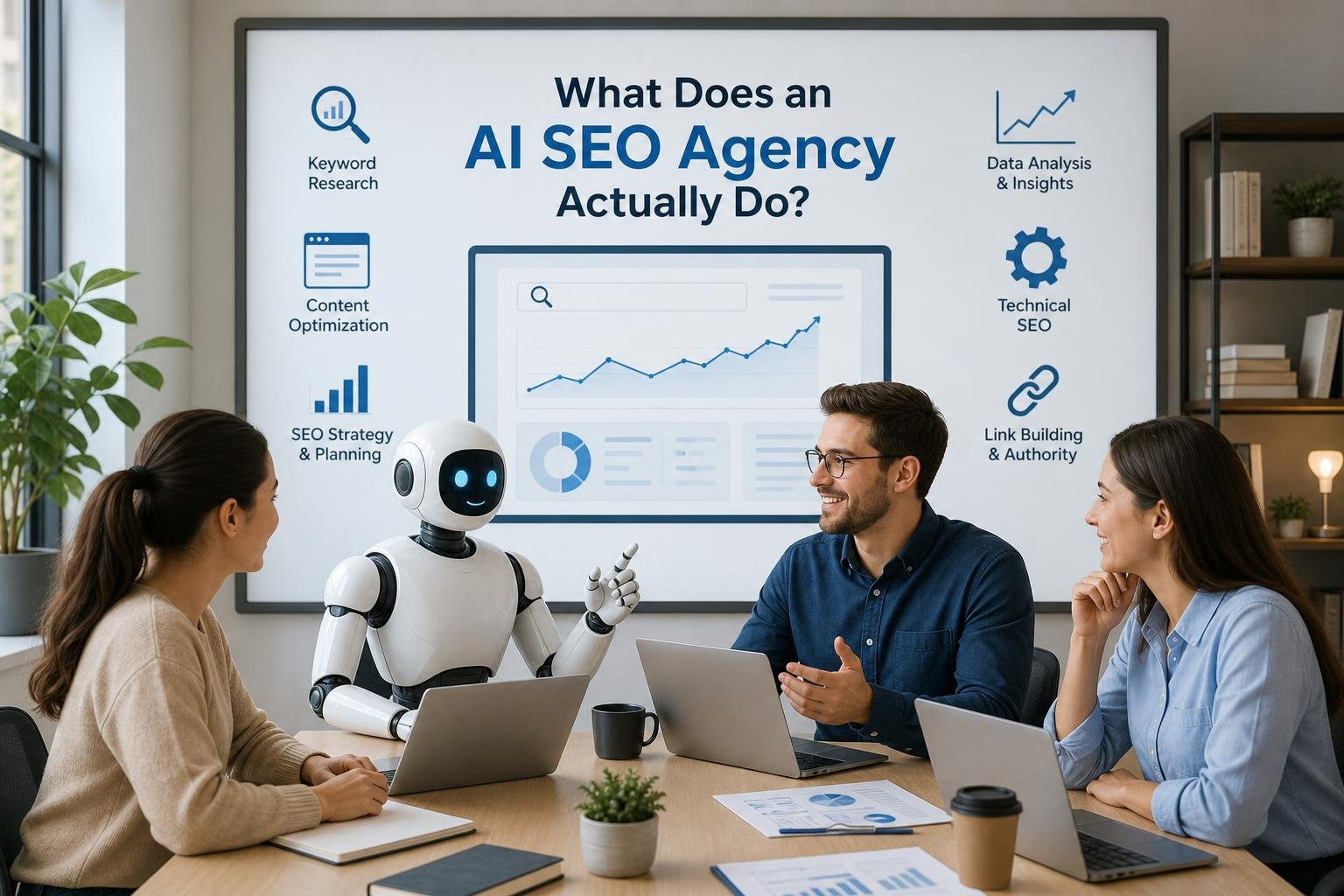

Detailed Guide to AI Content SEO Strategies

Why Every Marketer Needs an AI Content SEO Guide in 2026

This AI content SEO guide explains how brands can earn visibility in AI-generated answers across ChatGPT, Perplexity, Google AI Overviews, and Gemini. It shows why AI SEO now depends on crawlability, structured data, factual density, topical authority, and third-party credibility rather than keyword matching alone.

Key Takeaways

  • AI search visibility depends on citations in generated answers, not just rankings in traditional blue-link results.
  • AI crawlers need accessible robots.txt rules, clean HTML, and structured data to extract content reliably.
  • Strong AI content SEO uses direct answers, factual detail, schema, and interlinked topic clusters.
  • Third-party credibility matters because AI systems often cite external sources alongside brand-owned pages.
  • AuraSearch helps brands build generative engine optimization strategies that improve citation opportunities across major AI platforms.

I am Amber Brazda, AI Search Specialist at AuraSearch, where I lead research into generative search algorithms, crawler behaviour, and the strategic frameworks brands need to earn citations in AI-generated responses. My background spans over a decade in technical SEO and the application of E-E-A-T principles to AI-first visibility, and every strategy in this AI content SEO guide is grounded in crawler data, citation analysis, and generative engine optimisation practice. The sections ahead move from foundational concepts through to platform-specific tactics and measurement frameworks, giving teams a clear path from invisible to cited.

Quick Answer: How to Optimise Content for AI Search in 2026

  1. Allow AI crawlers, including GPTBot, OAI-SearchBot, and PerplexityBot, access in your robots.txt.
  2. Implement structured data, including FAQ, Article, Organisation, and HowTo schema.
  3. Write direct-answer content with high factual density.
  4. Build topical authority through interlinked content clusters.
  5. Establish third-party credibility on review platforms, Reddit, and industry publications.
  6. Track AI citation rates across platforms, not just Google rankings.

Search behaviour has shifted dramatically. AI referrals to top websites spiked 357% year-over-year in June 2025, reaching 1.13 billion visits. That is not a trend to monitor. It is a structural change already affecting how buyers discover brands.

The core problem is this: ranking on page one no longer guarantees visibility. AI platforms synthesise answers from multiple sources and cite the most credible, structured, and factually dense content. A competitor with weaker Google rankings but better-structured content can appear in every AI-generated answer while a top-ranked site is completely absent.

Traditional SEO optimises for clicks. AI SEO optimises for citations. These are two different problems requiring two different strategies.

Optimising Visibility with an AI Content SEO Guide

Generative search engines do not merely list URLs. They synthesise answers from multiple source documents, creating a direct response for the user. This extraction process relies heavily on a mechanism called query fan-out. Query fan-out decomposes a single user prompt into multiple concurrent search queries to retrieve diverse reference pages.

AuraSearch helps brands design content that aligns with these parallel searches. To succeed in this landscape, we must recognise the structural differences between traditional and generative search.

Feature Traditional SEO AI SEO (Generative Engine Optimisation)
Primary Goal Rank page-one blue links Earn citations in synthesised answers
Discovery Mechanism Googlebot indexing pages AI crawler parsing facts and entities
Query Processing Direct keyword matching Prompt rewriting and query fan-out
Success Metric Click-through rate (CTR) Citation share and brand mentions

Traditional search engines reward page-level engagement and keyword density. AI search engines prioritise extractable facts, structured data, and source credibility. This shift requires a transition from old-school ranking tactics to generative engine optimisation.

We can master this transition by studying how models retrieve information. Implementing a modern AI content SEO guide ensures your brand remains visible when AI engines synthesise answers. According to the Salesforce AI SEO Guide analysis, automation and intent mapping are critical to maintaining organic share of voice.

We must adjust our writing styles to ensure machine learning models can easily parse our claims. Using our guide on How to Optimise Content for AI Answers helps teams structure pages for maximum citation potential.

Structuring Information for AI Content SEO Guide Extraction

AI crawlers require highly structured data to extract information reliably. They generally do not execute complex JavaScript layouts during their initial passes. We must provide clean, static HTML and clear schema markup to guarantee parsing success.

AuraSearch configures client sites to ensure search agents can read and digest every page instantly. The technical foundations for AI search visibility include:

  • Allowing crawler access in the robots.txt file for GPTBot, OAI-SearchBot, and PerplexityBot.
  • Implementing comprehensive JSON-LD schema markup for Organisation, Product, FAQ, and Article entities.
  • Deploying an llms.txt file in the root directory to guide AI agents directly to authoritative resource summaries.
  • Optimising server-side rendering to eliminate JavaScript dependency.

Factual density is the primary driver of machine-readable authority. Replacing vague marketing language with specific metrics, error codes, and structured tables dramatically increases citation rates. According to Google's Guide to Optimizing for Generative AI Features, technical crawlability remains the baseline for AI overview eligibility.

We must use structured markup to transform plain text into explicit database entities. Our team uses The AI Search Playbook to help brands engineer high-performance data structures. These structures allow AI models to cite brand assets with absolute confidence.

Earning Citations Through AI Content SEO Guide Best Practices

Generating unique information is the most effective way to earn citations. AI engines evaluate information gain, which measures how much new data a page adds compared to existing sources. If your article merely summarises existing web content, AI models will bypass it.

We focus on injecting proprietary data, first-hand case studies, and expert insights into every piece of content. This approach creates an irreplaceable source of truth that models must reference. Query rewriting also changes how we target keywords.

Because ChatGPT rewrites 99.83% of prompts, targeting exact-match phrases is highly ineffective. We must write comprehensive answers to conversational questions that cover the entire topic depth.

Our goal is to build deep topical authority rather than chasing isolated search terms. To protect your traffic, we recommend you Stop Keyword Stuffing and Start Optimising for AI Search. This transition ensures your brand remains the preferred citation source as conversational search grows.

Why AuraSearch Is Built for AI Search Visibility

Navigating the shift to conversational search requires specialised technical capability. AuraSearch provides the advanced tools and strategic expertise needed to secure brand citations across all major AI platforms. We execute precise generative engine optimisation to transform your website into an authoritative data source.

Our proprietary models analyse entity salience and optimise your data architecture to match the exact retrieval patterns of modern LLMs. We build clear pathways from user queries to brand conversions by aligning your content with AI search mechanics. Brands can secure their digital future by partnering with our expert team.

Explore our comprehensive AuraSearch Generative Engine Optimisation Services to dominate the new search landscape.

FAQs

What is the difference between AI SEO and traditional SEO?

AI SEO optimises content to be extracted and cited inside synthesised AI answers, while traditional SEO focuses on ranking pages in a list of blue links. Traditional search engines prioritise page-level engagement and keyword density metrics. AI engines evaluate factual density, schema clarity, and information gain. You can learn more about these differences in The AI Content Playbook: How to Optimize for SEO Success.

How do AI crawlers like GPTBot behave differently from Googlebot?

AI crawlers focus on extracting raw text and structured data rather than rendering complex visual layouts or executing JavaScript. GPTBot accounts for 57% of all AI crawler traffic and averages 60.5 pages per session. It also visits 88.5% of pages exactly once, making clean static HTML essential for discovery. To prepare your site for this behaviour, read our guide on how to Unlock Your Content's Potential: A Guide to AI-Driven Optimization.

Why is structured data critical for generative search engine visibility?

Structured data in JSON-LD format translates plain text into machine-readable entities that AI models can interpret with high confidence. AI engines rely on structured attributes to build comparative tables and product summaries. Implementing schema markup like Product, FAQ, and Organisation drives a 28% to 34% lift in citation coverage. To check your site's readiness, consult The 10 Steps AI Search Content Optimization Checklist for Humans and Bots.

How does query rewriting by AI models affect content optimisation?

Query rewriting bypasses simple keyword matching by transforming user prompts into detailed sub-queries before executing searches. ChatGPT rewrites 99.83% of user prompts to add year modifiers and format keywords. Content must address the underlying intent and provide direct, factual answers to these expanded queries rather than targeting short-tail keywords. For a complete framework, refer to A Practical Guide to AI Search Content Strategy.

What are the platform-specific strategies for ChatGPT and Perplexity?

ChatGPT prioritises authoritative documentation, direct answers, and developer resources, whereas Perplexity relies heavily on real-time citations and structured comparison tables. ChatGPT crawler sessions rarely start on homepages, with only 3% beginning there compared to 21% starting on blog pages. Perplexity indexes content within hours of publication and values structured data. For platform-specific workflows, view Mastering AI Content Creation: A Strategic Playbook.

How can brands build topical authority for AI search engines?

Brands build topical authority by publishing comprehensive content clusters of 15 to 30 interlinked pages covering a specific niche. AI models evaluate the depth of coverage across these clusters to determine if a domain is a trusted source of truth. This depth signals to machine learning models that the site is an expert reference point. Our strategic mapping ensures your clusters align with the semantic associations built into modern LLMs.

Recent Posts

By Amber Brazda September 2, 2026
Learn about best strategies to optimize content for ai search engines
By Amber Brazda September 1, 2026
Master the answer engine optimization guide to earn AI citations and boost brand visibility in zero-click search results.
By Amber Brazda August 28, 2026
Crafting Your Australian Dental AI Search Strategy - Learn about australian dental ai search strategy
By Amber Brazda August 27, 2026
How Accounting Firms Win Visibility in the AI Search Era - Learn about AI visibility for accountants
By Amber Brazda August 26, 2026
How to Improve Your Website's Visibility in AI Search Engines - Learn about AI search engine visibility
By Amber Brazda August 25, 2026
Master AI SEO for Construction with a proven GEO strategy to boost your visibility in generative search and LLM citations.
By Amber Brazda August 24, 2026
Learn how to optimise for generative answers and win the AI search game with expert GEO strategies for 2026.
By Amber Brazda August 21, 2026
Learn how to capture high-intent AI driven plumbing leads with Generative Engine Optimisation and dominate local search results.
By Amber Brazda August 20, 2026
Master the A–Z of AI search visibility for real estate to dominate agent citations and attract buyers before competitors do.
By Amber Brazda August 19, 2026
AI Content Creation Benefits: 101 - Learn about ai content creation benefits
Show More