
Why ChatGPT Ranking Factors Matter More Than Ever
ChatGPT ranking factors are the signals that determine if your content gets cited in AI-generated answers. With 5.72 billion monthly visits to ChatGPT, understanding these factors is essential for visibility in the new AI search landscape.
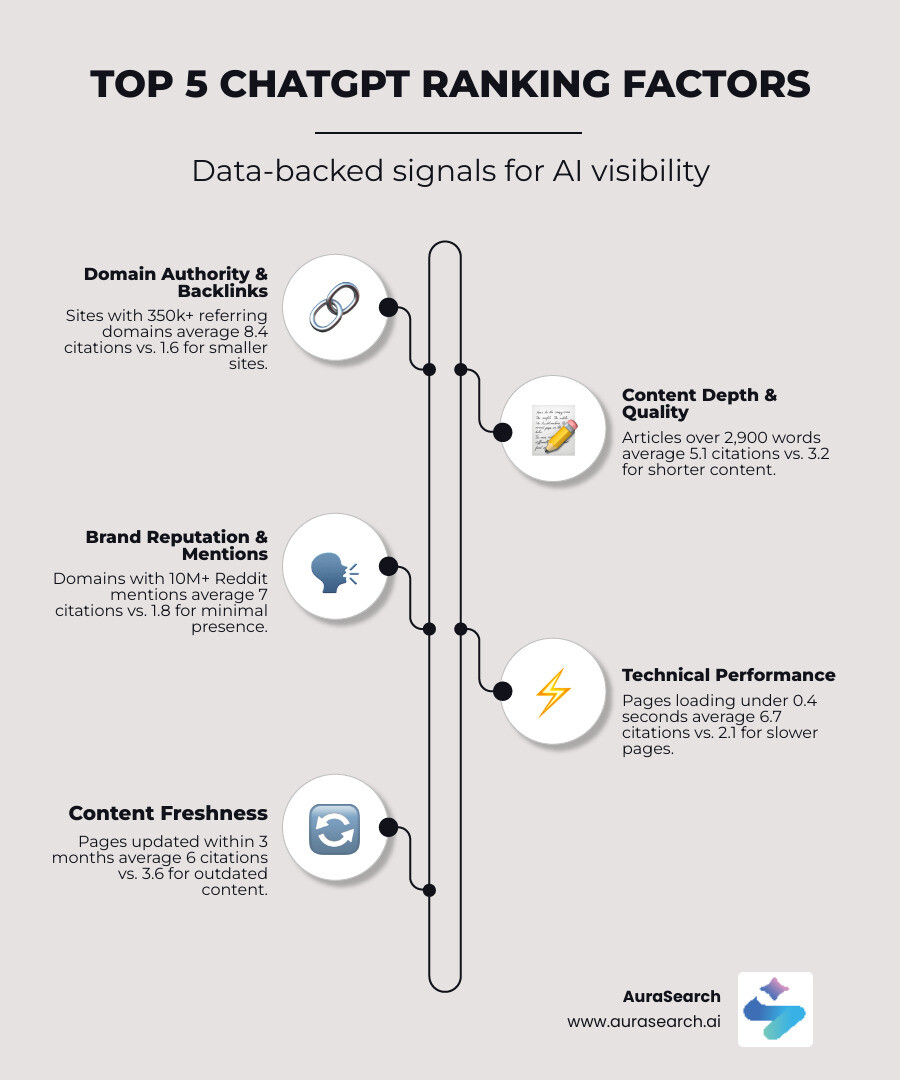
The Top 5 ChatGPT Ranking Factors:
- Domain Authority & Backlinks - Sites with 350,000+ referring domains average 8.4 citations vs. 1.6 for smaller sites
- Content Depth & Quality - Articles over 2,900 words average 5.1 citations vs. 3.2 for shorter content
- Brand Reputation & Mentions - Domains with 10M+ Reddit mentions average 7 citations vs. 1.8 for minimal presence
- Technical Performance - Pages loading under 0.4 seconds average 6.7 citations vs. 2.1 for slower pages
- Content Freshness - Pages updated within 3 months average 6 citations vs. 3.6 for outdated content
The search landscape has shifted. Even if you rank well on Google, your brand could be invisible when users ask ChatGPT for recommendations. This means losing relevance in how people find information.
Unlike Google's ten blue links, ChatGPT synthesizes information and cites a few trusted sources. If you're not one of those sources, you don't exist in the conversation.
The good news is that these factors are measurable. Research on over 200,000 pages reveals clear patterns in what gets cited.
This guide breaks down what ChatGPT looks for and how to position your brand as a trusted source for AI answers.
Must-know ChatGPT ranking factors terms:
The Core Pillars: How ChatGPT Selects and Cites Content
When discussing ChatGPT ranking factors , we're not talking about a traditional search algorithm. We're exploring how a Large Language Model (LLM) processes and recommends content. It's less like a librarian pointing to a shelf and more like a well-read friend giving a summary and their sources.
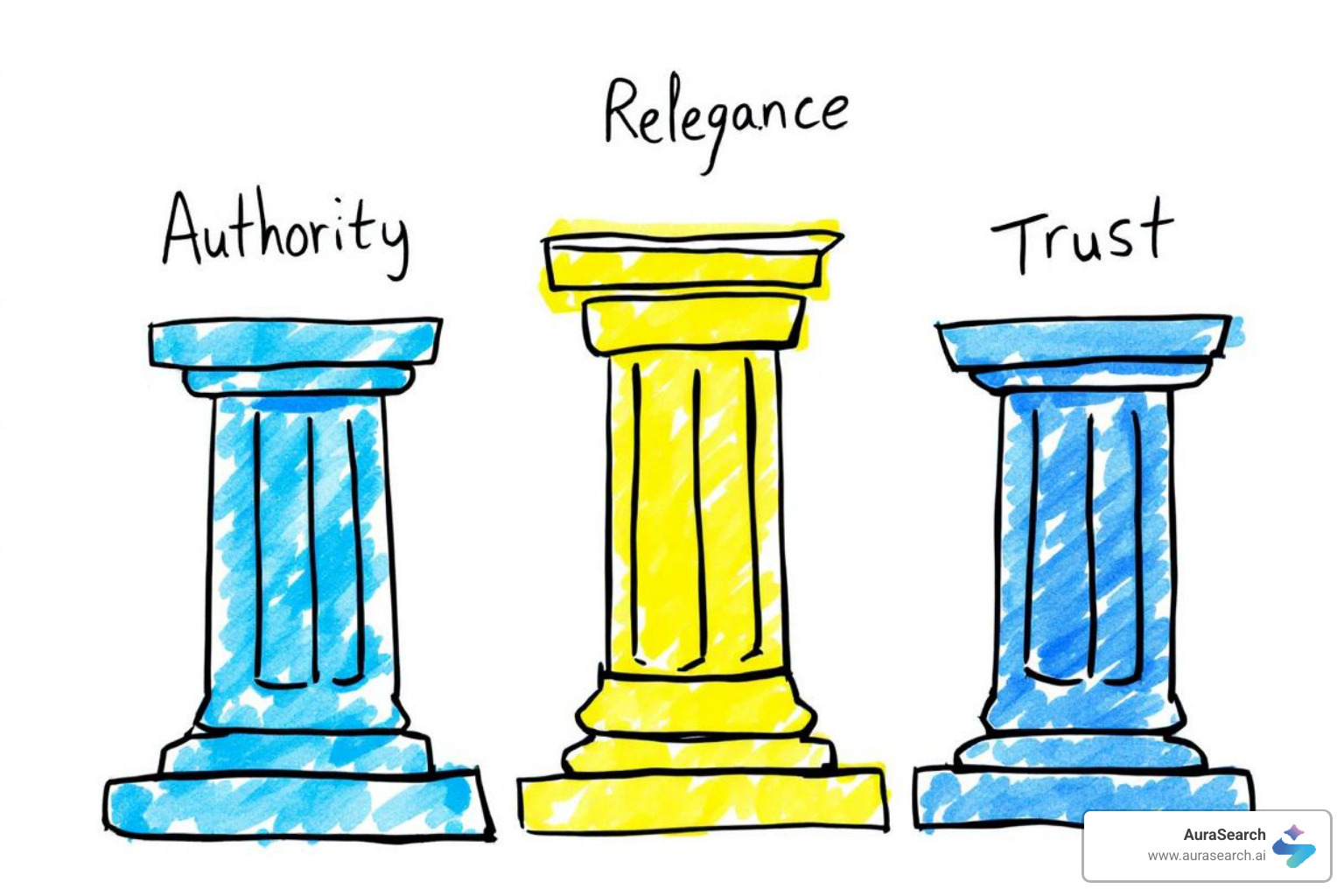
ChatGPT's selection process mirrors Google's E-E-A-T (Experience, Expertise, Authoritativeness, and Trustworthiness) principles. Our research suggests LLMs seek similar signals to gauge value and reliability. This includes training data and how content is corroborated online. A key concept is "consensus"—how often a business is positively mentioned and ranked. This collective endorsement, a strong brand reputation, and positive reviews form the bedrock of ChatGPT's recommendations. For a deeper dive, see our AI in SEO: Your Essential Guide.
Understanding the Primary ChatGPT Ranking Factors
Our analysis points to a few critical areas:
- Authoritative Sources: ChatGPT prioritizes content from reliable sources that demonstrate expertise and a strong reputation.
- Content Relevance and Accuracy: The information must directly answer the user's query and be factually accurate. ChatGPT often cross-references information to ensure reliability.
- User Reviews and Brand Mentions: ChatGPT values what real users and other credible platforms say about a brand. Positive reviews and frequent, favorable mentions are powerful signals.
- Cross-Platform Authority: AI models build confidence in a brand when they find consistent, positive information about it across various online platforms. Inconsistency can break trust.
ChatGPT vs. Traditional Search Engines
This is where things differ from traditional SEO. Google indexes billions of pages and ranks them using an algorithm that considers keywords, backlinks, and user signals, presenting a list of "10 blue links."
ChatGPT, an LLM designed for "next token prediction," doesn't rank pages. It synthesizes information from its training data and web browsing to formulate a conversational answer, citing its sources. The goal shifts from being a link on a page to being the source of the answer. Traditional SEO still matters, as a strong search presence is often a prerequisite for AI citation.
The rise of AI Overviews in search engines highlights this shift, with studies showing a potential 140% decrease in organic visibility for some queries. This is a fundamental change in information consumption.
Here's a quick comparison of how key signals diverge:
| Feature | Traditional Search Engines (e.g., Google) | ChatGPT (and other LLMs) |
|---|---|---|
| Primary Output | List of 10 "blue links" | Conversational, synthesized answer with citations |
| Ranking Concept | Algorithmic position based on many factors | Source selection based on authority, extractability, relevance, consensus |
| Keyword Importance | High: Exact match, keyword density, topical relevance | Moderate: Semantic relevance, answering user intent naturally |
| Backlinks | High: Key signal for authority and trust | High: Proxy for domain authority, trust, and external corroboration |
| Content Format | HTML pages, often long-form for depth | Structured, machine-readable, concise for extraction (e.g., bullet points, tables) |
| Technical SEO | Crawlability, indexing, page speed, mobile-friendliness | Crawlability (AI bots), page speed, schema markup for context |
| User Signals | Click-through rate, bounce rate, time on page | User engagement (in chat), presence on review platforms, social mentions, consensus |
| E-A-T/E-E-A-T | Explicitly evaluated by human raters, signals integrated into algorithm | Implicitly evaluated through source quality, expert quotes, brand reputation, reviews |
The Power of Reputation and Social Proof
When ChatGPT recommends a business, it weighs reputation, not just keywords. This is a critical ChatGPT ranking factor . Our research shows online reputation, reviews, and brand mentions are monumental in its recommendations.
LLMs analyze online sentiment to assess a company's reputation. This means:
- Positive Online Sentiment: A positive online sentiment is crucial. ChatGPT considers negative mentions, expert criticism, and controversies when assessing a company's reputation.
- Community Discussions: Mentions on platforms like Reddit and Quora correlate with citations. Domains with 10M+ Reddit mentions averaged 7 citations, versus 1.8 for those with minimal activity. Genuine engagement builds social proof.
- Expert Opinions and Industry Awards: These heavily contribute to brand authority. Endorsements from experts or recognized bodies are noted by ChatGPT.
- User-Generated Content (UGC): Reviews and ratings on platforms like Trustpilot or G2 are vital. Domains on multiple review platforms averaged 4.6 to 6.3 citations, versus 1.8 for those absent. This external corroboration signals trust to AI.
ChatGPT seeks a consensus of positive signals online. A pervasive, positive brand impact increases citation likelihood. To learn more about how we help businesses achieve this visibility, explore our guide on More on building AI visibility.
The Data-Backed ChatGPT Ranking Factors: What 200k+ Pages Reveal
While the core pillars offer a qualitative view, our proprietary studies provide quantitative insights into the specific ChatGPT ranking factors correlating with higher citation rates. We analyzed over 200,000 pages to find the signals that move the needle.
This data dive reveals that some factors align with traditional SEO, while others have unique nuances for AI search. Backlink volume, content structure, and technical performance all contribute to how AI perceives your content. Our AuraSearch proprietary study highlights these correlations, offering a roadmap for AI-era optimization.
Authority Signals: Backlinks and Website Trust
Backlinks remain a powerhouse for authority, but with an AI twist. Our research shows the number of referring domains is the strongest predictor of ChatGPT citation likelihood. It's about the breadth of a site's external endorsements, not just individual link value.
- Referring Domains: Sites with 350,000+ referring domains averaged 8.4 citations, versus 1.6-1.8 for sites with under 2,500. A threshold exists around 32,000 referring domains, where citations nearly doubled from 2.9 to 5.6, showing a diverse backlink profile is paramount.
- Domain Trust Score: Domain quality matters. Sites with Trust scores of 91–96 averaged 6 citations, while scores of 97–100 averaged 8.4. This shows AI values credible domains. Page Trust was less impactful, suggesting ChatGPT weighs overall site authority more heavily.
- .gov & .edu vs. Commercial: Government and educational domains (3.2 average citations) didn't automatically outperform commercial sites (4.0 average citations). This shows commercial sites with strong authority can compete effectively.
- Website Traffic Correlation: A strong correlation only appeared at very high traffic levels. Sites with under 190,000 monthly visitors averaged 2-2.9 citations, while those with over 10 million visitors averaged 8.5. Homepage traffic also appears to play a role.
- Search Rankings Correlation: A page's average Google rank correlates with ChatGPT citations. Pages ranking 1-45 averaged 5 citations, while those ranking 64-75 averaged 3.1. This suggests AI and search engines evaluate quality with similar principles.
These findings highlight that traditional authority-building strategies, especially acquiring diverse backlinks, are crucial ChatGPT ranking factors .
Content Signals: Depth, Structure, and Freshness
How your content is crafted, organized, and maintained impacts its citation chances. AI models prefer comprehensive, well-structured, and current information.
- Word Count and Depth: Longer content earns more citations. Articles over 2,900 words averaged 5.1 citations, versus 3.2 for articles under 800 words, showing AI values thoroughness.
- Section Length and Structure: Readability matters. Pages with 120-180 words between headings averaged 4.6 citations, while sections under 50 words averaged only 2.7. This shows AI prefers well-organized content.
- Expert Quotes and Statistical Data: External validation adds credibility. Pages with expert quotes averaged 4.1 citations (vs. 2.4 without). Pages with 19+ data points averaged 5.4 citations (vs. 2.8 for minimal data).
- Content Recency and Freshness: Freshness is key. Pages updated within 3 months averaged 6 citations, while outdated content averaged 3.6. Regularly refreshing content is a clear ChatGPT ranking factor .
- FAQ Sections and Heading Styles: Our study found pages with FAQ sections received slightly fewer citations (3.8 vs. 4.1). This may be due to FAQs appearing on simpler pages. Also, question-style headings earned fewer citations than straightforward ones (3.4 vs. 4.3), suggesting direct headings are better for AI extraction.
These insights underscore the importance of crafting high-quality, well-researched, and intelligently structured content. For strategies on how to adapt your content for AI, explore our guide on Optimising Content for the AI Search Era.
Technical Performance as a Key ChatGPT Ranking Factor
Like with traditional SEO, technical health is crucial for AI visibility. A fast, responsive site signals reliability. Our research shows strong correlations between page speed and ChatGPT citations.
- Page Speed (FCP & Speed Index): First Contentful Paint (FCP) is a key indicator. Pages with FCP under 0.4s averaged 6.7 citations, while pages over 1.13s averaged only 2.1. A low Speed Index also correlated with more citations. These metrics impact an AI's perception of quality.
- Interaction to Next Paint (INP): This measures responsiveness. Pages with moderate INP (0.8-1.0s) averaged 4.5 citations. Surprisingly, extremely fast pages (<0.4s) received fewer (1.6 average). This may suggest that overly simple pages, while fast, lack the depth ChatGPT seeks.
- URL & Title Optimization: AI preferences diverge from traditional keyword stuffing. Our research found pages with low semantic relevance between their URL/title and keyword averaged more citations than highly optimized ones. This suggests ChatGPT prefers broad, topic-describing URLs and titles over hyper-focused keywords.
These technical ChatGPT ranking factors emphasize the need for a holistic approach to website optimization. A technically sound website provides a solid foundation for AI visibility. Tools like Google PageSpeed Insights can help you identify and address performance bottlenecks.
Your Playbook for AI Visibility: Optimization and Tracking
Understanding ChatGPT ranking factors is the first step. The next is translating insights into action. We call this Generative Engine Optimization (GEO), our specialty at AuraSearch. GEO ensures your content is visible, digestible, and extractable for AI crawlers and LLMs.
This involves technical configurations for AI bots, content structuring for easy extraction, and robust tracking to measure success.
Optimizing for AI Crawlers and Readability
To be cited by ChatGPT, your content must be accessible to its crawlers. Prepare your site for an intelligent but literal reader.
- Allow OpenAI’s Crawlers:
Ensure your
robots.txtfile allowsChatGPTBotandOAI-SearchBot. Blocking them makes you invisible to ChatGPT's web browsing. - Clean HTML and Structure:
AI parses your site's code. Clean, semantic HTML with a logical structure (
<h1>,<h2>, etc.) helps AI understand your content's hierarchy and meaning. - Schema Markup: This is a game-changer for AI readability. Structured data helps AI understand context and extract information. We use schemas to ensure AI understands our content and expertise.
- Essential Schema Types for AI:
- Organization Schema: Defines your business, name, logo, and contact info.
- Person Schema: Establishes the identity and expertise of authors.
- Article Schema: Details your articles, including publication date and author.
- FAQPage Schema: Helps AI understand Q&A content, despite mixed results on citations.
- HowTo Schema: Breaks down processes into digestible steps for AI.
- QAPage Schema: Delineates questions and answers on your pages.
By implementing these technical optimizations, you make your content machine-readable and increase its chances of being considered a credible source.
Structuring Content for AI Extraction and Summarization
ChatGPT excels at summarizing information. Structure your content to facilitate this process, making it a vital ChatGPT ranking factor .
- Direct Answers First: Start key sections with a clear, direct answer. Think of it as an executive summary for AI.
- Bullet Points and Tables: These formats are AI-friendly. They break down complex info into digestible lists and allow for easy comparison.
- Factual, Data-Rich Writing: Back up claims with data. Our research showed content with 19+ data points averaged more citations, adding credibility.
- Cite Your Sources: Cite credible sources in your content. This builds trust with readers and helps AI verify information.
- Avoid Promotional Language: AI models are objective and often overlook promotional content. Focus on providing value and facts, not sales pitches.
By optimizing your content for extraction, you’re making it easier for ChatGPT to process and cite your valuable information.
How to Track Your Visibility in AI Search
Tracking AI search performance requires a blend of traditional and new methods. With no "ChatGPT Search Console," we use a combination of tools to monitor AI visibility.
- Manual Prompt Checks: Ask relevant questions on AI platforms like ChatGPT. Track how often your brand is mentioned or linked to identify opportunities and understand AI perception.
- Referral Traffic in Google Analytics:
In Google Analytics(GA4), set up custom channel groups to monitor referral traffic from AI tools like
chat.openai.com. This shows if users are clicking through from AI answers. - Google Search Console for AI Overviews: Use Google Search Console to track impressions, clicks, and queries for URLs included in Google's AI Overviews.
- Third-Party Tools: We use specialized AI SEO tools to track mentions and citations across AI platforms, measuring visibility and performance.
By diligently tracking these metrics, you can understand your current AI visibility and refine your strategies. Don't get left behind; explore our guide on AI Search Optimization: Don't Get Left Behind in the Generative Era.
The Evolving Landscape: Future-Proofing for AI Search
The AI search world is dynamic. Future-proofing your strategy means understanding the nuances between AI models and preparing for an era of abundant AI-generated content.
Key Differences in Ranking Factors Across AI Platforms
While overarching ChatGPT ranking factors exist, each AI platform has unique characteristics and data sources, leading to different signal weighting.
- ChatGPT: Relies on its training data and "Browse with Bing" for live queries. This means Bing rankings directly influence citations. It also emphasizes relevance, brand mentions, and online reputation.
- Gemini (Google): As a Google product, Gemini's responses correlate with Google search results. It prioritizes Google's SEO recommendations, a strong backlink profile, and structured data. It also uses Google's Knowledge Graph for AI Overviews.
- Perplexity: This "answer engine" uses its own crawler (PerplexityBot). Its rankings correlate with Google's, suggesting a reliance on traditional SEO signals.
- Microsoft Copilot: Integrated into Bing, Copilot's sources are derived from Bing's search results. Optimizing for Bing SEO is paramount for visibility.
- DuckAssist (DuckDuckGo):
Provides summarized answers with citations. It uniquely scans the web in real-time with its
DuckAssistBotcrawler.
The key takeaway is adaptability. While SEO fundamentals are a common thread, each platform has nuances. Strategies must adapt to evolving standards like real-time web scanning, which makes content freshness vital. The interconnectedness of these systems, like Bing's influence on ChatGPT, is significant.
Differentiating Your Content in an AI-Saturated World
As AI-generated content grows, standing out is key. The answer is leveraging uniquely human strengths, which are also critical ChatGPT ranking factors .
- Original Research and Data: AI synthesizes existing information but can't conduct original research. Invest in studies and unique data to become a primary source that AI will prioritize.
- Expert Insights and Experience: Share genuine human experience and expert insights that AI can't replicate. As our data shows, pages with expert quotes earn more citations. Your unique perspective is invaluable.
- Authentic Brand Voice and Storytelling: AI can mimic tones but lacks an authentic brand voice. Develop a consistent, engaging voice and use storytelling to connect with your audience and differentiate your content.
- Focus on the "Why" and "How": Go beyond superficial answers. Explain the "why" and provide detailed "how-to" guides. Deep understanding and practical application require human expertise.
By prioritizing these differentiating factors, you can create content that meets technical and authority-based ChatGPT ranking factors and also offers unique value. For more strategies on staying ahead, read our guide on Navigating AI Overviews: Your SEO Survival Guide.
Frequently Asked Questions about ChatGPT Ranking Factors
How important are backlinks for appearing in ChatGPT?
Backlinks are extremely important and one of the strongest ChatGPT ranking factors . Our research shows the number of referring domains is the strongest predictor of citation likelihood. For instance, sites with 350,000+ referring domains averaged 8.4 citations. Backlinks act as a crucial trust signal, contributing to the domain authority that AI models weigh heavily. It's about the collective endorsement from diverse, authoritative sites.
How can I track my website's performance in ChatGPT?
Currently, there isn't a dedicated "ChatGPT ranking tool." However, we employ several effective methods:
- Manual Prompts: We regularly conduct manual checks by asking ChatGPT relevant questions about our clients' industries or content to see if and how their websites are being cited.
- Google Analytics 4(GA4) Referral Traffic:
We monitor referral traffic in GA4, looking for spikes from domains like
chat.openai.comor other AI platforms. - Google Search Console (GSC): For visibility within Google's AI Overviews, GSC provides data on impressions, clicks, and queries for URLs that appear in AI snippets.
- Third-Party AI SEO Tools: We use specialized tools that monitor AI mentions and citations across various platforms, helping us track performance in AI-generated search results.
Does using Schema Markup help with ChatGPT citations?
Yes, schema markup generally helps by making your content machine-readable, which is crucial for information extraction. However, our research noted a nuance: pages with FAQ schema received slightly fewer citations (3.8 vs. 4.1), possibly because they appear on simpler pages. More broadly, schemas like Organization and Person are valuable for helping AI recognize your brand's identity and author expertise. While the impact of specific types varies, structured data is foundational for making content AI-readable.
Conclusion: Winning in the New Era of AI Search
The shift to AI-driven search is a fundamental change in how users find information. Adapting to the new ChatGPT ranking factors is imperative for digital visibility.
We've seen that success in this new era hinges on a blend of foundational SEO principles and AI-specific optimizations. Key takeaways include:
- Authority and Trust: Building a strong online reputation through extensive backlinks, positive reviews, and widespread brand mentions is paramount.
- Content Quality and Depth: AI rewards comprehensive, well-structured, data-rich, and expert-backed content that directly answers user queries.
- Technical Performance: A fast, accessible, and logically structured website is essential for AI crawlers to efficiently process your content.
- Proactive Optimization: Regularly updating content, using schema markup, and ensuring your site is crawlable by AI bots are non-negotiable steps.
The future of SEO is Generative Engine Optimization (GEO)—moving beyond keywords to become a trusted source for AI. At AuraSearch, we specialize in helping businesses steer this complex landscape with the expertise to win in the AI search era.
Don't let your brand become invisible in the age of AI. Master your ChatGPT SEO strategy with our expert guidance and ensure your content is the secret sauce ChatGPT decides to show.