
Why the AI Search Experience is Redefining How We Find Information

The AI search experience is fundamentally changing how we interact with search engines, moving from traditional blue links to conversational, AI-powered answers that synthesize information instantly.
What is the AI Search Experience?
- AI Overviews : Quick, synthesized snapshots of information powered by Google's Gemini model, appearing directly in search results with links to sources
- AI Mode : A conversational search environment where you can ask complex questions and explore topics through follow-up prompts
- Key Benefit : Get direct answers without clicking through multiple pages—AI does the research legwork for you
- The Shift : Moving from keyword-based searching to natural language conversations with intelligent systems
If you've noticed your website traffic declining despite strong rankings, you're witnessing this shift firsthand. Users are increasingly getting answers directly from AI-generated summaries rather than clicking through to traditional search results.
Over the past 25 years, Google Search has evolved through many technological shifts. But generative AI represents something different—a complete reimagining of the search experience. Instead of presenting ten blue links and letting you piece together information, AI search engines now synthesize answers from multiple sources and present them conversationally.
The numbers tell the story: AI Overviews have been used billions of times and are rolling out to over a billion people globally. In India, eligible queries saw over a 10% usage lift after adoption. People use Search more and report higher satisfaction with AI-powered results.
This isn't just about Google. Platforms like ChatGPT Search, Perplexity AI, and Microsoft Copilot are reshaping findy across the web. The common thread? Users now expect answers, not links.
For content creators and businesses, this creates both challenge and opportunity. Your content needs to be structured not just for ranking, but for citation—appearing within those AI-generated responses where users actually see it.
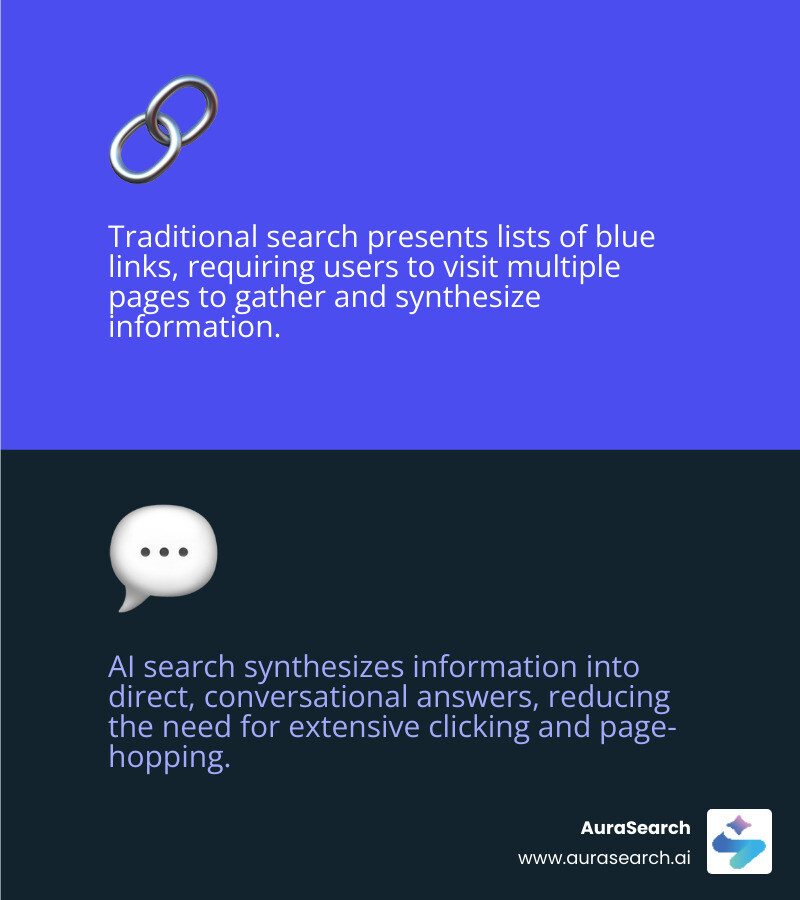
Basic AI search experience vocab:
The Dawn of a New Search Era: From Keywords to Conversations
The way we find information online is undergoing a profound change. What was once a journey through endless pages of blue links is now becoming an intuitive, conversational dialogue with intelligent systems. This shift is driven by the AI search experience , where the goal is to provide direct, synthesized answers rather than just a list of potential sources.
AI-powered findy is reshaping how people find answers online, replacing traditional page-hopping with concise, single-prompt results. We're seeing a significant change in user behavior:
- From Links to Answers : Users are increasingly expecting immediate answers to their queries, often delivered in a summarized format directly within the search interface.
- Conversational Interaction : Instead of typing in precise keywords, we can now ask natural language questions, engaging in a dialogue with the AI to refine our searches and explore topics more deeply. Users can steer AI responses through follow-up prompts instead of repeatedly rephrasing queries.
- Increased Satisfaction and Usage : With AI Overviews, people are using Search more and reporting higher satisfaction with their results. This indicates a positive reception to the new, more efficient search paradigm.
- Multimodal Search : The AI search experience is no longer limited to text. We can now search using images (visual search), voice, or even by circling items on our phone screens, making findy more natural and integrated into our daily lives.
- Emphasis on Trust and Provenance : As AI synthesizes information, the importance of authoritative sources and clear citations becomes paramount. The best AI search experiences blend large language models with authoritative sources and built-in guardrails to deliver trustworthy answers.
This isn't just a minor update; it's a fundamental change in how we interact with information. The AI search experience is designed to do the "legwork" for us, making complex research feel effortless.
What are AI Overviews?
Imagine asking a complex question that traditionally would require opening several tabs, reading through various articles, and piecing together an answer. That's where AI Overviews step in. These are quick, synthesized snapshots of information that appear directly at the top of your search results page. They are designed to do the work for you, gathering and summarizing the information you need.
Powered by advanced AI models, like Google's customized Gemini model, AI Overviews can perform multi-step reasoning and planning. This means they don't just pull a snippet; they understand the nuances of your query, gather relevant information from across the web, and present it in an easy-to-understand summary.
The adoption has been rapid and widespread. AI Overviews have been used billions of times through experiments in Search Labs, and Google is rolling them out to everyone in the U.S., with plans to reach over a billion people globally by the end of the year. The data shows that these AI-powered responses are among the industry's fastest, leading to higher user satisfaction and more frequent searches.
Crucially, AI Overviews don't replace the web. They provide links to the sources they used, allowing us to dive deeper, verify information, and explore different perspectives. This balance of quick answers and source transparency is key to a trustworthy AI search experience .

What is AI Mode?
While AI Overviews provide a quick snapshot, AI Mode takes the AI search experience to the next level, offering a truly conversational research environment. Think of it as having an intelligent assistant dedicated to your query, capable of understanding complex questions and engaging in a continuous dialogue.
AI Mode is Google’s most powerful AI search experience. It allows us to ask anything and receive an AI-powered response, with the unique ability to go deeper through follow-up questions and helpful links. This expands upon what AI Overviews can do, offering more advanced reasoning and interactive ways of exploring information.
How does it achieve this depth? AI Mode employs a sophisticated "query fan-out technique." Instead of treating your question as a single entity, it divides it into subtopics and searches for each one simultaneously across multiple data sources. It then synthesizes these results to provide a comprehensive, easy-to-understand response. This method is particularly useful for:
- Exploring a new concept that might have previously required multiple searches.
- Comparing different options for a product or service, getting a balanced overview.
- Conducting in-depth research where you need to iteratively refine your questions.
With AI Mode, we can easily ask follow-up questions to dig deeper into a topic or even change the direction of our inquiry, making the research process much more fluid and intuitive. For the best experience, enabling Search history (Web & App Activity) allows us to pick up where we left off with previous searches, maintaining context across our explorations.
Learn more about the query fan-out technique and how it powers a more advanced search. To understand how to best position your content for these changes, explore Navigating AI Overviews: Your SEO Survival Guide.
The Engine Behind the Magic: How Gemini Improves Search
At the heart of Google's advanced AI search experience lies the Gemini model, particularly Gemini 3. This frontier model brings significant improvements, changing how search engines process and present information.
Gemini 3's advanced reasoning and multimodal understanding capabilities are a game-changer. It allows Google Search to:
- Understand Intent More Intelligently : Gemini 3 can perform even more searches to uncover relevant web content, understanding our intent with greater nuance. This means it can find new content that might have previously been missed, leading to more credible and highly relevant results.
- Power Generative UI : One of the most exciting advancements is the introduction of Generative UI in AI Mode. Thanks to Gemini 3's multimodal understanding and agentic coding capabilities, the search experience can now feature dynamic visual layouts, interactive tools, and even simulations.
- Create Bespoke Experiences : Imagine asking a complex question and receiving not just text, but an interactive visualization or a custom-generated tool embedded directly within the response to help you understand or complete a task. Gemini 3 can dynamically create these bespoke generative user interfaces on the fly, making information clearer and more actionable. For example, if you're researching a scientific concept, the AI might generate a real-time simulation to illustrate it.
- Improve Real-time Information : The integration of Gemini 3 also means that search can dynamically create ideal visual layouts for responses, incorporating elements like images, tables, and grids for maximum clarity. When an interactive tool is beneficial, Gemini 3 can generate custom simulations or tools in real-time and embed them within the search response.
This continuous evolution of AI models like Gemini is what drives the sophisticated, intuitive, and increasingly interactive nature of the AI search experience , pushing the boundaries of what we expect from a search engine.

The Creator's Crossroads: Navigating the Shift from SEO to GEO
For content creators and businesses, the rise of the AI search experience presents a pivotal moment. The traditional landscape of SEO, focused on ranking high on search engine results pages (SERPs), is undergoing a significant change. With AI Overviews and conversational AI models delivering direct answers, the user journey often bypasses those familiar blue links.
This shift has profound implications for website visibility and business strategy. If users are getting their answers directly from an AI summary, the traditional click-through model changes. Businesses are shifting from solely focusing on SEO to embracing Generative Engine Optimization (GEO) because user behavior is fundamentally changing. Users are increasingly turning to AI-driven platforms that deliver answers directly, often without requiring a click on search results.
Our content needs to be structured not just to rank, but to be cited—to appear within those AI-generated responses where users are now finding their information. This ensures we remain visible and authoritative in the spaces where decisions are increasingly being made. For a deeper dive into this paradigm shift, explore Generative Engine Optimisation.
What is Generative Engine Optimization (GEO)?
Generative Engine Optimization (GEO) is the new frontier in digital marketing. It's the process of optimizing content specifically for AI-driven search engines and conversational AI models. While traditional SEO aims to get your content to rank on a SERP, GEO focuses on getting your content cited, referenced, and recommended within AI-generated answers, summaries, and conversational search results.
The core differences between SEO and GEO are:
- Focus : Traditional SEO targets rankings on a results page. GEO aims to make content findable and quotable by AI systems.
- Goal : SEO seeks clicks to your website. GEO seeks citation and inclusion in AI responses, often leading to brand mentions and authority within the AI answer itself.
- Approach : GEO emphasizes context, user intent, and how generative models interpret, synthesize, and present information. It builds upon SEO principles, particularly E-E-A-T (Experience, Expertise, Authoritativeness, and Trustworthiness), but requires new content structures and a keen understanding of how AI "thinks."
GEO isn't replacing SEO; it's extending it. It's the next evolution, ensuring that our content is chosen in the AI synthesis process by focusing on clarity, structure, and undeniable authority. Well-structured information with clear answers signals reliability to AI, increasing the likelihood of our content being featured. Mastering GEO is crucial for maintaining search visibility and future-proofing our online presence in this evolving landscape. To understand how to leverage this shift, read AI's New Frontier: How to Optimize for Generative Search.
How to Optimize for the AI Search Experience
Adapting to the new AI search experience requires a strategic shift in our content creation and optimization efforts. Here's how we can optimize our content to be findable and quotable by AI:
- Conduct GEO-Focused Keyword Research : Move beyond simple keywords. Focus on question-based, conversational queries that users are likely to ask AI. Analyze AI-generated answers for your target topics to understand the query structure and intent. Long-tail, intent-rich phrases are gold here.
- Structure Content for AI Engines
: AI models need clarity. Our content should be easy for an LLM to parse, extract, and cite.
- Clear Headings : Use H1, H2, H3 tags effectively to guide the AI through your content's structure.
- Direct Answers : Provide concise, factual answers to common questions directly and early in your content.
- Short Paragraphs & Bullet Points : Break down complex information into digestible chunks. Bullet points are excellent for key data.
- FAQ Sections : Create dedicated FAQ sections that directly answer conversational questions. Content that is easy for an LLM to quote verbatim is highly valuable.
- Strengthen Technical SEO for AI Compatibility
: A site that's easy for human users is often easy for AI crawlers.
- Fast Page Load Times : AI prioritizes efficiency. Faster sites are better.
- Mobile Optimization : Most users access information on mobile, and AI models reflect this.
- HTTPS Security : A secure site signals trustworthiness.
- Schema Markup : Implement structured data to give AI explicit context about your content. This helps generative engines understand what your content is and how to use it.
- Add Multimedia and Localized Context
: AI engines process more than just text.
- Infographics and Videos : Use visuals to make complex data easy to understand and provide more context.
- Localized Content : For local searches, include region-specific terms and details to boost relevance.
- Build Authority Through Backlinks and Brand Consistency
: Generative engines pull from sources they trust.
- High-Quality Backlinks : Earn links from credible sites to prove your authority.
- Original Research : Publish unique studies, case studies, or data-rich reports.
- Consistent Brand Data : Ensure your brand information is consistent across all platforms and listings. Positive reviews and mentions strengthen reliability.
- Monitor, Measure, and Iterate
: GEO isn't static.
- Track Citations : Monitor how often your brand or content is mentioned in AI-generated answers.
- Referral Traffic : Track traffic coming from AI engines.
- Continuous Refinement : Adapt your content based on evolving user intent and AI behavior.
By focusing on these strategies, we can ensure our content is not only seen but also cited in the evolving AI search experience . For comprehensive strategies on adapting your content, see Beyond Keywords: Optimising Content for the AI Search Era.
Mastering Your AI Search Experience: Tips, Tricks, and Challenges
The AI search experience offers incredible power, but like any sophisticated tool, mastering it requires understanding its nuances. For us, the users, this means learning how to interact effectively, being aware of its limitations, and understanding the role of our data.
We can now ask questions that might have previously taken multiple traditional searches. AI Mode, for instance, simplifies research by intelligently organizing information with simple breakdowns and helpful links. However, this new frontier also comes with its own set of considerations.
How to Effectively Leverage AI Search Tools
To get the most out of your AI search experience , consider these best practices:
- Ask Detailed and Specific Questions : The more context you provide, the better the AI can understand your intent. Instead of "best laptop," try "best lightweight laptop for video editing under $1500."
- Use Follow-Up Prompts : Don't be afraid to engage in a conversation. If an answer isn't quite right, ask follow-up questions to refine it, explore a different angle, or request more detail. This iterative process is a core strength of AI search.
- Verify with Sources : While AI aims for accuracy, always use the provided source links to verify critical information, especially for important decisions or factual claims. This is crucial for evaluating the reliability of AI-generated information.
- Explore Provided Links : AI Overviews and AI Mode provide helpful web links. Use them to dive deeper into topics, gain additional context, or explore information from a wide range of perspectives.
- Practice Critical Thinking : AI is a tool. Always approach its answers with a critical eye, especially when dealing with complex, subjective, or rapidly changing information. Asking multiple versions of a question can also help you get a more robust understanding.
Navigating Potential Limitations and Inaccuracies
While the AI search experience is rapidly advancing, it's important to acknowledge its current limitations. AI models, despite their sophistication, can sometimes make mistakes or "hallucinate" information.
Google itself states that AI Mode may make mistakes, and that "results are for illustrative purposes and may vary." We are quickly improving and evolving the experience, but as users, it's our responsibility to exercise caution.
Here are key points to remember:
- Potential for Errors : AI responses are generated based on patterns and data, and sometimes these patterns can lead to inaccuracies or fabricated information. This is why always double-checking important information is a best practice.
- Information Verification : For any critical facts, statistics, or advice, always cross-reference the AI's answer with its provided sources and other reputable websites.
- Bias : AI models are trained on vast datasets, which can sometimes reflect existing biases present in the data. This can lead to skewed or incomplete answers. Awareness of this potential bias helps us critically evaluate the information we receive.
As the technology evolves, these limitations are continually being addressed. However, for now, a healthy dose of skepticism and a commitment to verifying information are essential components of a responsible AI search experience . For businesses looking to steer these complexities, Artificial Intelligence SEO Services can help ensure accuracy and trustworthiness in AI-generated content.
Data, Privacy, and Your AI Search Experience
The personalized nature of the AI search experience raises important questions about data and privacy. To deliver custom responses and improve its models, AI search tools often rely on user data.
- Personalized Responses : For the best and most personalized experience, enabling Search history by turning on "Web & App Activity" is recommended. Without this setting, you can still access AI Mode, but you won't be able to pick up where you left off with previous searches. Personalized responses are often based on your previous searches and Search/Maps activity.
- User Data Control : We have control over our data. We can manage our Search personalization settings in our Google Account. If we don’t want future searches to be used to improve the quality of generative AI models, we can turn off Web & App Activity in My Activity. This will stop future Search history from being saved to our Google account.
- Anonymized Data for Training : Google uses user interactions with Search and AI experiences, including search queries and feedback, to develop and improve generative AI models. However, privacy precautions are taken. This includes disconnecting data from user accounts and removing identifying information before it's used for model training. Even searches done while signed out may still be used for AI model improvement, but they are not associated with a specific account.
Understanding these aspects allows us to make informed choices about our privacy while still benefiting from the power of the AI search experience .
The Future is Conversational: What's Next for AI Search?
The current AI search experience is just the beginning. The rapid pace of AI development suggests an even more integrated, intuitive, and proactive future for how we find and interact with information. We can anticipate several key trends:
- Agentic AI : We'll see the rise of "agentic" AI, where intelligent systems don't just answer questions but take action on our behalf. This could involve AI agents in email clients providing personalized daily briefings, or tools that remix browser tabs into custom applications. The concept of "agentic operations" suggests AI will actively assist in achieving business outcomes directly from search.
- Improved Multimodal Search : The ability to search using images (Lens), voice, and even real-world objects (Circle to Search) will become even more sophisticated. We can expect more than 1.5 billion monthly Lens users to continue leveraging visual search, with AI understanding context and relevance from visual input in deeper ways. The future promises multimodal experiences where we can talk to Search about scenes captured through our camera.
- Proactive Assistance : AI search will become less about us asking a question and more about the system anticipating our needs. It could proactively suggest information, tools, or even complete tasks based on our context and past behavior, moving towards truly intelligent agents.
- Deeper Personalization : While privacy remains a concern, personalization will continue to evolve, offering custom experiences that adapt to our individual preferences, learning styles, and contexts.
- Generative UI and Interactive Experiences : With models like Gemini 3 Pro, we can expect even more dynamic visual layouts, interactive tools, and simulations directly within search results. This means search responses won't just be static text but engaging, customizable interfaces that help us explore and understand complex topics in real-time.
The AI search experience is evolving rapidly, promising safer, smarter, and more open systems. The future of information findy is conversational, personalized, and increasingly capable of understanding and fulfilling our needs in ways we are only just beginning to imagine.
Frequently Asked Questions about the AI Search Experience
What is the main difference between AI Overviews and AI Mode?
AI Overviews provide quick, synthesized snapshots for many queries, acting as a starting point. AI Mode is a more powerful, dedicated conversational environment where you can ask complex, multi-step questions, have an extended dialogue, and explore topics in greater depth.
Is traditional SEO dead because of AI search?
SEO is not dead, but it is evolving into Generative Engine Optimization (GEO). While traditional principles like authority and quality content remain crucial, the focus is shifting from simply ranking on a results page to having your content cited and featured within AI-generated answers.
How can I get the best results from AI search?
Be specific and detailed in your initial question. Use natural, conversational language. Don't hesitate to ask follow-up questions to refine the answer or explore a different angle. Always use the provided source links to verify critical information.
Conclusion
The advent of the AI search experience marks a profound paradigm shift in how we find and interact with information. We are moving beyond the era of simple keywords and blue links into a world where conversational AI synthesizes knowledge, offers direct answers, and even helps us complete tasks. This isn't just an incremental improvement; it's a complete reimagining of what search can be.
For businesses and content creators, this change presents both a challenge and an immense opportunity. The landscape of online visibility is changing, demanding that we adapt our strategies from traditional SEO to Generative Engine Optimization (GEO). Our goal is no longer just to rank, but to be cited, referenced, and trusted within the AI-generated responses that users increasingly rely on.
Embracing this new frontier means understanding the nuances of AI Overviews, leveraging the conversational power of AI Mode, and structuring our content to be digestible and quotable by advanced AI models like Gemini. It means prioritizing clarity, authority, and user intent, ensuring our content stands out in a crowded digital space.
At AuraSearch, we understand that navigating this evolving digital landscape can be complex. That's why we provide expert generative AI SEO services, helping businesses like yours optimize their visibility across both traditional search and emerging AI platforms. We are dedicated to helping you adapt and win in this exciting, AI-driven era.
The future of search is here, and it's conversational, intelligent, and transformative. Let's work together to Adapt your strategy for the AI search era and ensure your brand is not just found, but truly understood and cited.