
Why AI SEO Content Matters Now More Than Ever

AI SEO content is text, images, or multimedia created with artificial intelligence tools to improve search engine rankings. It combines machine learning with SEO best practices to produce content faster than traditional methods—but success depends on human oversight to ensure quality, accuracy, and authenticity.
Key things to know about AI SEO content:
- What it is : Content generated or assisted by AI platforms like ChatGPT, Claude, or specialized SEO tools that analyze search data and create optimized drafts
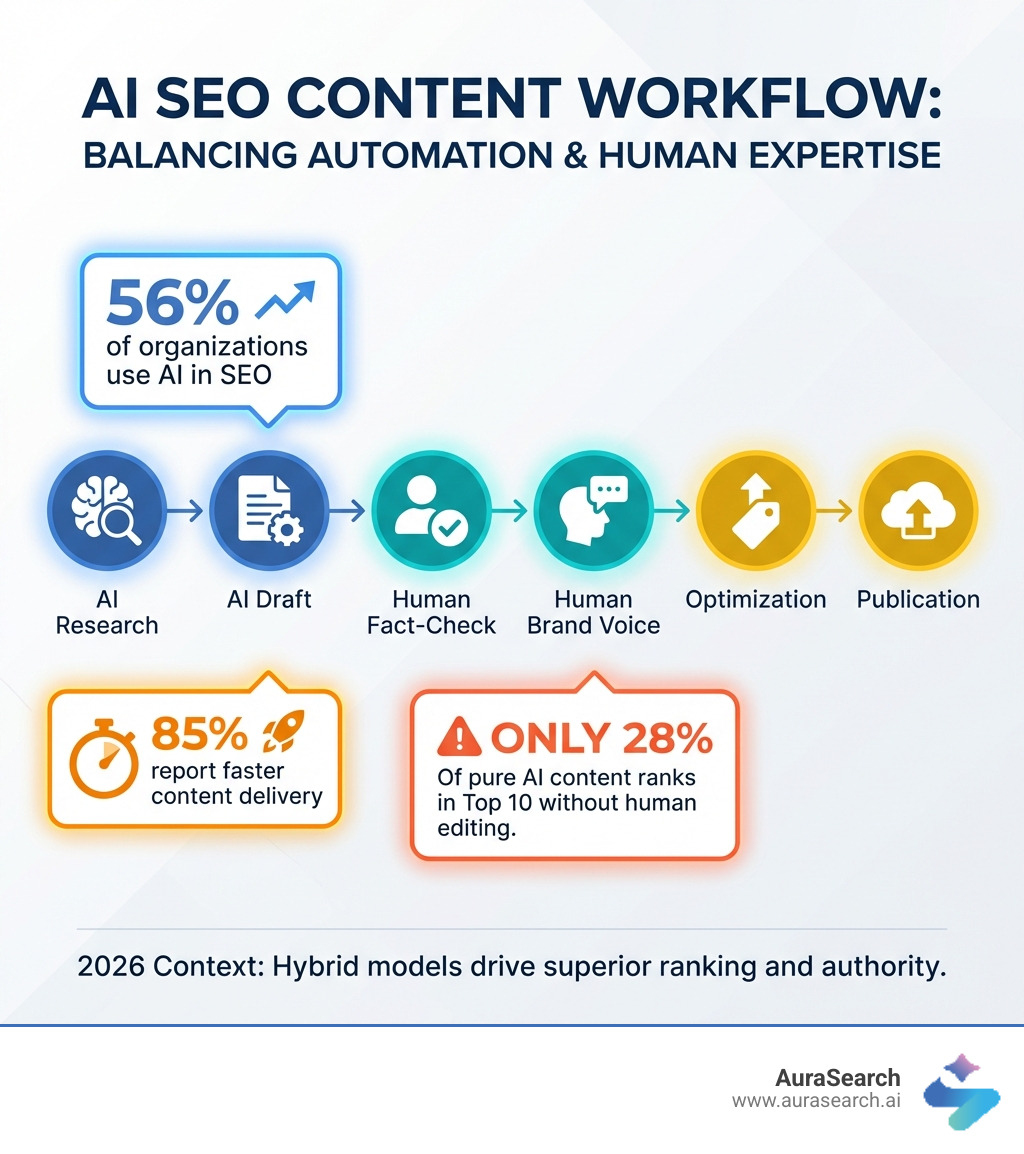
- Why it matters : 56% of organizations now integrate AI into their SEO workflows, and traditional search volume is predicted to drop 25% by 2026 as users shift to AI platforms
- The challenge : AI can write 10x faster, but purely AI-generated pages reach Google's top 10 only 28% of the time—human editing is crucial
- The opportunity : When done right, AI content helps you rank in both traditional search and emerging platforms like ChatGPT, Perplexity, and Google's AI Overviews
If you've noticed your organic traffic declining despite good rankings, you're not alone. The search landscape is changing fast. AI platforms now answer billions of queries without sending users to websites. Brands that don't optimize for AI citation risk becoming invisible.
But here's the good news: AI isn't replacing human content creators . It's changing how we work. The most successful teams use a hybrid model—AI handles research, drafting, and optimization, while humans add expertise, fact-checking, and brand voice. This approach delivers 185% higher authority scores and 240% better pipeline quality, according to recent industry data.
The race isn't about publishing more content faster. It's about creating content that AI systems want to cite and humans want to read. That balance is what this guide will help you achieve.
The New SEO Landscape: AI vs. Traditional Methods
The SEO world is always evolving, but AI has brought a transformative shift. Understanding this is crucial for creating effective AI SEO content .
Traditional SEO relied on manual keyword research, competitive analysis, and a linear content creation process. Experts would identify a primary keyword, analyze top pages, and craft content to outrank them through on-page optimization and backlink building.
AI SEO uses machine learning to automate and improve these processes. It goes beyond single keywords to understand the entire keyword landscape, including related term clusters and search variations. AI maps the customer journey, enabling content strategies that address informational, comparison, and transactional intent for long-term growth.
Google has long integrated AI, like RankBrain, into its algorithms. Its guidance has evolved: quality and helpfulness matter most, regardless of how content is created. This means AI SEO content can rank if it provides value and adheres to Google's E-E-A-T framework (Experience, Expertise, Authoritativeness, and Trustworthiness).
However, Google's policy on scaled content abuse remains critical. Using AI to generate vast quantities of low-quality, unoriginal content to manipulate search rankings will likely be penalized. The key is blending AI's efficiency with human quality control.
Here's a quick look at how traditional SEO stacks up against the AI-driven approach:
| Feature | Traditional SEO | AI SEO |
|---|---|---|
| Keyword Research | Manual, single keyword focus, volume-driven | Automated, cluster-focused, intent-driven, journey mapping |
| Content Creation | Human-led, slower, iterative | AI-assisted drafting, faster, scalable |
| Optimization | On-page, technical, backlinks | Semantic relevance, entity optimization, AI answer engines |
| Competition Analysis | Manual SERP review | AI-driven SERP competitor analysis, content gap identification |
| Measurement | Rankings, organic traffic, conversions | Citations, mentions, share of AI voice, AI-attributed ROI |
| Core Philosophy | Rank web pages in search results | Be part of the answer itself, get cited by AI platforms |
| Content Quality Focus | Unique, relevant, well-written | Helpful, E-E-A-T, original, human-refined |
| Efficiency | Moderate | High, especially for repetitive tasks |
Understanding Google's Helpful Content System
Google's Helpful Content Update, starting in August 2022, prioritizes "people-first content" created to help users, not just to rank. The system rewards content demonstrating E-E-A-T.
The Helpful Content Update was reinforced by the March 2024 core update, which aimed to reduce low-quality, unoriginal content, resulting in a 45% reduction by April 2024. This means any AI SEO content must be genuinely helpful and high-quality to avoid falling afoul of these updates.
The Shift to Generative Engine Optimization (GEO)
The rise of generative AI platforms like ChatGPT, Perplexity, and Google's AI Overviews is a profound change. They transform search into a conversational experience with direct answers, creating a new paradigm: Generative Engine Optimization (GEO).
GEO is about making content "quotable" by AI systems. It's no longer just about ranking #1; it's about being the source an AI chooses to cite. Since AI platforms answer billions of queries daily without sending users to websites, brands not optimizing for citation risk becoming invisible.
For example, Google's AI Overviews appear in over 50% of searches, and ChatGPT processes over 1 billion queries daily. These platforms prioritize useful, clearly structured, and trustworthy content. The goal is to provide undeniable value, making your content a prime candidate for citation. Understanding how to navigate AI Overviews is as critical as traditional keyword optimization, especially as AI-powered searches increased 21.64% from 2023 to 2024.
How to Create High-Performing AI SEO Content
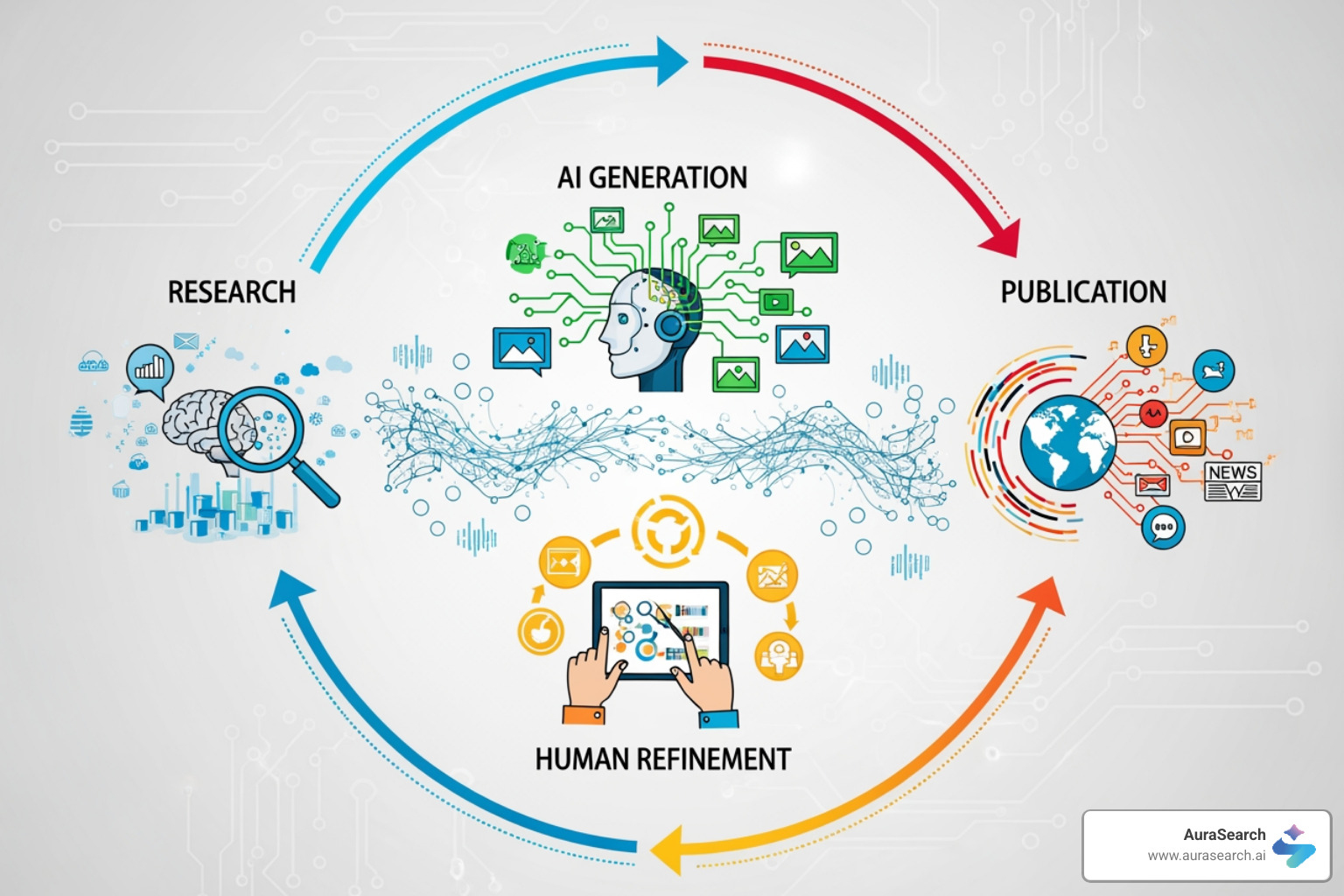
High-performing AI SEO content requires a symbiotic relationship between AI and human expertise. AI offers efficiency, data-driven insights, and scalability, freeing teams to focus on strategy, creativity, and the essential human touch.
Step 1: AI-Powered Research for AI SEO Content
Thorough research is the foundation of great content, and AI revolutionizes this process. Instead of targeting single keywords, AI provides a comprehensive understanding of audience search behavior.
- Beyond single keywords : AI identifies clusters of related terms and search phrases, reflecting real customer behavior for broader visibility and relevance.
- Topic clustering : AI analyzes SERP data to identify topics and subtopics, helping structure content to build topical authority instead of just keyword density.
- Search intent analysis : AI maps the customer's buying journey by analyzing informational, comparison, and transactional queries, allowing for precisely custom content.
- Competitor content gap analysis : AI quickly analyzes competitors to find content gaps, providing invaluable input for our strategy to unleash our edge.
Step 2: Generating and Optimizing the First Draft
After research, AI accelerates the drafting and optimization of AI SEO content .
- Automated SERP analysis : AI tools analyze SERP competitors to extract key topics, questions, and entities needed for optimized content.
- AI-powered content briefs : AI generates detailed content briefs with word counts, keywords, and headings, streamlining the process for writers.
- Drafting with AI writers : LLMs generate initial drafts of various content types, reducing writing time. Specific prompts on keywords, audience, and tone guide the AI.
- On-page optimization : Content optimization tools give real-time NLP feedback, suggesting semantic variations and key phrases to build topical authority. Learn more about how AI transforms content optimization.
- Readability scores : AI analyzes readability and suggests improvements to sentence structure and vocabulary to make content more accessible.
- Internal linking suggestions : AI tools can suggest internal links to improve site architecture and distribute link equity.
Step 3: The Crucial Role of Human Oversight in AI SEO Content
AI is a powerful assistant, but the human element is what lifts AI SEO content . The "human-in-the-loop" model infuses authenticity, accuracy, and brand voice.
- Fact-checking statistics : AI can "hallucinate" or use outdated data. Human oversight is critical to verify all facts and figures, ensuring accuracy and credibility.
- Adding unique experience and anecdotes : AI lacks genuine experience. Layer in unique insights, stories, and expert commentary to add value, relatability, and build E-E-A-T.
- Aligning with brand voice : Unedited AI content can sound generic. Refine the output to match your specific brand tone and style for authenticity.
- Editing for flow and clarity : AI text can lack a natural flow. Human editing ensures the content is cohesive, readable, and compelling.
- Avoiding repetitive phrasing : AI can overuse certain phrases. Editors should remove redundancy to make the content sound more natural.
Here are some human-touch elements to add to AI drafts:
- Personal stories or examples : Share how the topic impacted you or clients.
- Unique opinions or perspectives : State your stance on a key aspect.
- Recent, verifiable statistics : Use updated data from authoritative sources.
- Quotes from industry experts : Add credibility with diverse viewpoints.
- Specific calls to action : Tailor them to your audience and goals.
- Nuance and empathy : Address complex topics with sensitivity.
- Creative analogies or metaphors : Simplify complex ideas.
This hybrid approach harnesses AI's speed and power while preserving the human qualities that resonate with users and search engines.
Navigating the AI SEO Toolkit
The market is flooded with AI tools for AI SEO content . Choosing the right one can be overwhelming, but understanding their categories, strengths, and weaknesses is key. The best tools integrate into workflows, speed up tasks, and free up your team for strategy.

Common Features and Pricing Models
The AI SEO toolkit broadly falls into several categories:
- AI Writers/Generators : These tools (LLMs, writing assistants) generate text like blog posts and ad copy. Strengths: rapid generation and scale. Weaknesses: generic output, potential inaccuracies, and lack of unique voice without human editing.
- SEO Content Optimizers : These tools analyze content against top-ranking pages, recommending keywords, entities, and structure to align with search intent. Strength: data-driven optimization. Weakness: may stifle originality by focusing on what already ranks.
- AI-powered Keyword Research Tools : These tools identify topic clusters, analyze search intent, and uncover long-tail opportunities, helping you understand the full keyword landscape.
- Technical AI SEO : These tools use AI for tasks like automated structured data generation, crawl budget optimization, and site audits.
- Workflow Automation Tools : These platforms help integrate various AI tools into a seamless content pipeline from ideation to publication.
Pricing models vary from free trials to enterprise subscriptions. Solo plans might be around $15/month, while team plans can exceed $100. AI writers often start at $16-$49/month, with comprehensive suites costing $200+ per month. Pay-as-you-go models are also common. When evaluating, prioritize data accuracy, integration, and ROI. Look for affordable AI SEO tools for growing businesses that fit your needs.
Advanced Applications: Local, Multilingual, and Voice Search
AI's capabilities extend beyond general content, offering powerful solutions for specialized SEO.
- AI for local content generation : AI can generate locally optimized AI SEO content with location-specific keywords to boost local rankings. Our Trades and Services AI SEO solutions use AI for hyper-local content strategies.
- Translating and localizing at scale : For a global audience, AI efficiently translates and localizes content, adapting it culturally for different regions. This expands reach without the high cost of manual translation.
- Optimizing for conversational queries : The rise of voice search and AI chatbots means users ask questions in natural language. AI tools help identify these queries and structure AI SEO content to provide direct answers, which is vital for AI Overviews and voice search.
- Voice search trends : With smart speaker usage growing 2.5% from 2024, optimizing for voice is crucial. AI helps understand spoken language nuances and structure content in a Q&A format for voice assistants. This is why we focus on AI-powered voice search optimization to ensure content is heard.
Ethical Considerations and the Future of Search
As we accept the power of AI in our SEO content strategies, it's crucial to address the ethical considerations and understand the long-term implications for the future of search. This requires balancing technological advancements with responsibility and integrity.
One significant concern is content authenticity . With the potential for up to 90% of internet content to be created or touched by AI by next year (according to a Europol study), distinguishing human-generated from AI-generated content can become challenging. This raises questions about trust and credibility. While Google states it doesn't penalize AI content per se , it prioritizes helpful, high-quality, original content that demonstrates E-E-A-T. Content that is unhelpful, low-quality, generic, or plagiarized, whether human-generated or AI-generated, risks being impacted by updates like Google's Helpful Content Update.
Another ethical consideration is the potential for bias in LLMs . AI models are trained on vast datasets, and if these datasets contain biases (e.g., gender, racial, or cultural), the AI's output can reflect and perpetuate them. This means we must be vigilant in reviewing AI-generated content for fairness and inclusivity, ensuring it aligns with our values and avoids unintended prejudice.
Data privacy is also paramount. When using AI tools, we often input sensitive information about our business, customers, or content strategy. We must carefully consider the data privacy policies and security measures of any AI tool we use, protecting sensitive information and adhering to relevant regulations.
Finally, the sheer volume of AI-generated content can become an SEO liability if not managed strategically. While AI enables rapid content production, simply churning out thousands of low-quality pages can lead to content inflation, making it harder for truly valuable content to stand out. Google's March 2024 core update specifically targeted this issue, aiming to reduce low-quality, unoriginal content. The future isn't about more content; it's about more impactful content.
The Future Outlook for SEO and Content Marketing
The trajectory of AI in SEO and content marketing points towards even more sophisticated applications and a continued evolution of how users find information.
- Predictive search intent : AI will increasingly anticipate user queries before they are even typed. This means our AI SEO content strategies will need to optimize for forward-looking user needs, creating content that addresses questions before they're explicitly asked.
- Hyper-personalization : AI-powered search results are becoming highly personalized, custom to individual user history, location, and preferences. This makes traditional "rankings" less universal and emphasizes the need for content that can adapt to diverse user contexts.
- Ethical AI governance : As AI becomes more pervasive, strict frameworks will be essential for ensuring AI-generated content is responsible, transparent, and unbiased. This includes establishing clear internal policies for AI usage and potentially disclosing AI assistance to build audience trust.
- The evolving role of the SEO professional : Gartner predicts that traditional search volume will drop 25% by 2026, replaced by traffic from generative engines. This doesn't mean SEO is dead; it means the role of the SEO professional is evolving. We will move from primarily keyword-focused tactics to becoming strategists who integrate AI, manage complex content workflows, ensure E-E-A-T, and optimize for AI citation and emerging search interfaces. Our expertise in prompt engineering, fact-checking, and infusing human insight will be more valuable than ever.
Frequently Asked Questions about AI SEO Content
Can AI-generated content really rank on Google?
Yes, absolutely! AI SEO content can rank on Google, and it does so frequently, especially when blended with human oversight. Google's stance is pragmatic: it doesn't penalize content simply because AI wrote it. What truly matters is whether the content is high-quality, helpful, original, and demonstrates E-E-A-T (Experience, Expertise, Authoritativeness, Trustworthiness). This often requires significant human involvement for fact-checking, refining, adding unique insights, and aligning with brand voice. Purely AI-generated pages without human editing tend to perform less effectively, with studies showing they reach the top 10 search results only 28% of the time, and the top 3 just 6%.
What are the biggest mistakes to avoid with AI content?
The biggest mistakes we see with AI SEO content often stem from over-reliance on the technology without sufficient human intervention:
- Relying on unedited drafts : Publishing AI-generated content directly without review almost always leads to generic, inaccurate, or unengaging output.
- Failing to fact-check : AI models can "hallucinate" or provide outdated information. Not verifying facts can severely damage credibility and lead to Google penalties.
- Creating content at scale without a quality focus : Churning out thousands of low-quality pages purely for SEO manipulation is a direct violation of Google's spam policies and will likely result in demotion or penalization.
- Ignoring brand voice : AI content, left unedited, often lacks personality and can dilute a brand's unique tone and style.
- Lack of E-E-A-T : Without human input, AI struggles to convey genuine experience, expertise, or trustworthiness. Content missing these elements will struggle to rank, especially for YMYL (Your Money Your Life) topics.
Should I disclose that my content is AI-assisted?
While Google does not currently mandate disclosure for AI SEO content , transparency can be a powerful tool for building trust with your audience. Many publishers are now adding small disclaimers when AI tools contribute to research or drafting. However, it's worth noting that some studies have shown that disclosing AI assistance can affect audience perception, with some users trusting AI-generated content less than human-generated content. The decision depends on your brand's values and your target audience. For expert-driven topics where trust is paramount, disclosure, combined with robust fact-checking and human refinement, can reinforce credibility.
Conclusion: Balancing Automation with Authenticity
The journey through AI SEO content reveals a landscape transformed by technology, yet still deeply rooted in human values. We've seen that AI is not merely a trend but a fundamental shift, offering unprecedented efficiency, scalability, and data-driven insights. It helps us streamline keyword research, generate content drafts, optimize for emerging AI answer engines, and even automate tasks like local content generation and multilingual translation.
However, the true power of AI is open uped not when it replaces human effort, but when it augments it. The hybrid model—where AI acts as a powerful assistant, handling the heavy lifting of data analysis and initial drafting, while humans provide the indispensable elements of experience, expertise, authenticity, and creativity—is the winning strategy. This balance ensures our AI SEO content is not only optimized for search engines but also resonates deeply with our audience.
The future of SEO and content marketing belongs to those who can master this balance, adapting to predictive search intent, navigating hyper-personalization, and upholding ethical AI governance. The enduring value lies in strategic thinking, creative storytelling, and the unique human touch that AI, for all its brilliance, cannot replicate.
At AuraSearch, we understand this evolving landscape. We are the only platform offering expert generative AI SEO services, helping businesses like yours adapt and win in this AI-driven search era. Our approach focuses on combining the power of AI with strategic human oversight, ensuring your content achieves definitive authority and visibility in both traditional and emerging search environments.
To learn more about our approach to Artificial Intelligence SEO and how we can help your business thrive, we invite you to explore our services.