
The Search Landscape Has Fundamentally Changed

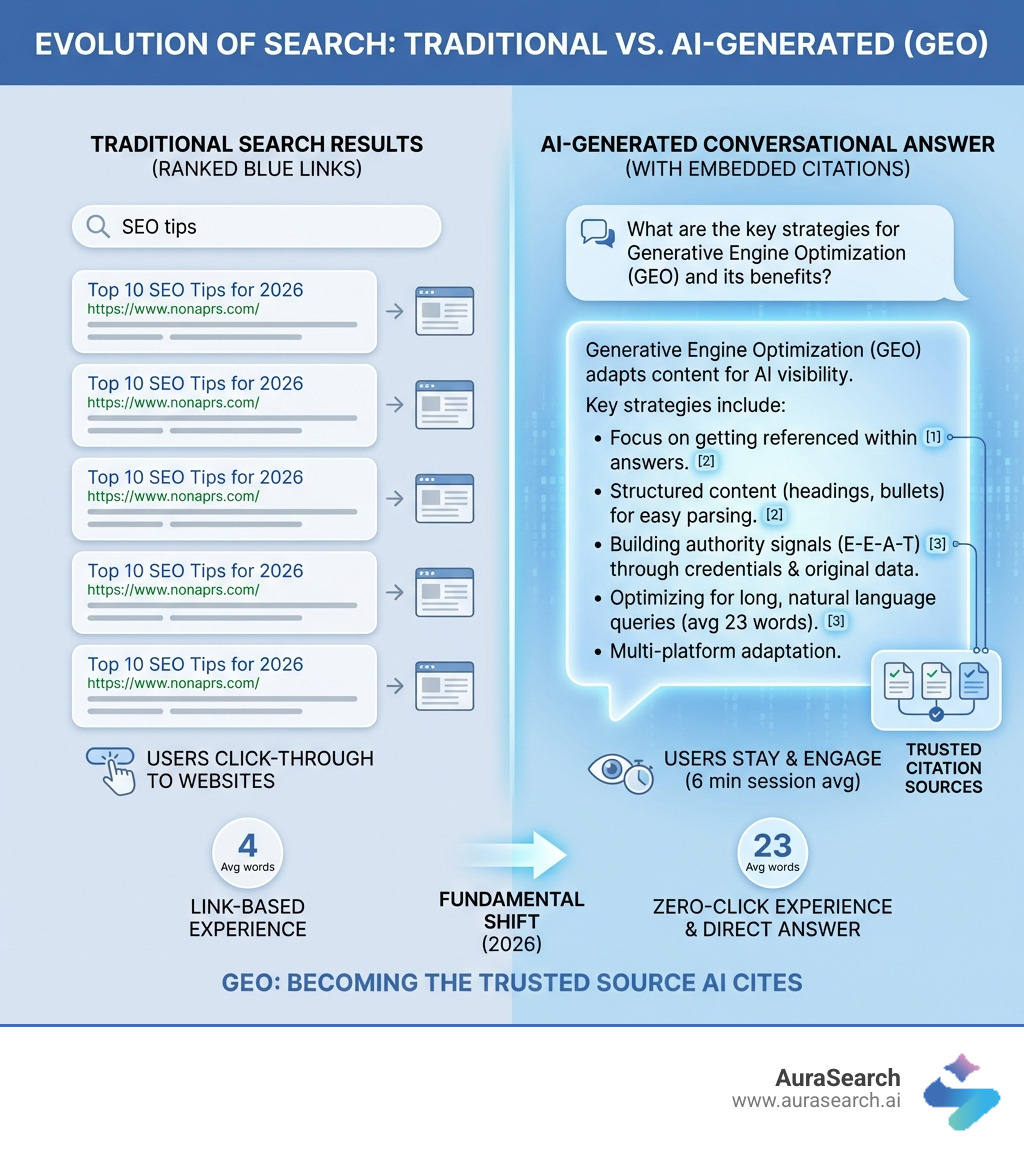
Generative engine optimisation is the practice of adapting digital content to improve visibility and citation within AI-powered search engines like ChatGPT, Google AI Overviews, Perplexity, and Claude—platforms that generate direct, conversational answers rather than traditional link-based search results.
Key elements of GEO:
- Focus on citations - Getting referenced within AI-generated answers, not just ranking in traditional results
- Structured content - Clear headings, bullet points, and scannable formats that AI can easily parse
- Authority signals - E-E-A-T (Experience, Expertise, Authoritativeness, Trustworthiness) demonstrated through credentials, citations, and original data
- Conversational queries - Optimizing for longer, natural language questions (averaging 23 words vs. Google's 4-word standard)
- Multi-platform strategy - Adapting content for different AI engines, each with unique preferences
If you've noticed your organic traffic declining despite maintaining good rankings, you're witnessing a fundamental shift in how people find information. Users are increasingly turning to AI search platforms that deliver synthesized answers directly—often without clicking through to websites.
This isn't the death of search visibility. It's an evolution.
The $80+ billion SEO industry is experiencing its most profound change since PageRank. ChatGPT alone serves over 800 million weekly users, while AI-driven search queries have grown 858% year-over-year on platforms like Perplexity. Gartner predicts a 25% drop in traditional search volume by 2026.
But here's the opportunity: users arriving from AI-generated responses demonstrate stronger purchase intent and spend an average of 6 minutes per session , compared to seconds on traditional search results. Early adopters implementing GEO strategies report visibility increases of 40% or more in AI-cited sources.
The competition has shifted from ranking on page one to becoming the source AI engines trust and cite.
What is Generative Engine Optimization (GEO)?
Generative engine optimisation (GEO) is a strategic approach to digital marketing that focuses on optimizing content for AI-powered search engines and answer engines. Unlike traditional search engines, which present a list of blue links, these new generative engines use large language models (LLMs) to deliver conversational, context-rich results directly to the user. This means our content needs to be not just findable, but understandable, synthesizable, and citable by AI.
The concept of GEO emerged from a 2023 academic paper by a team of prominent AI researchers, highlighting a fundamental disruption to the established SEO industry. This shift is rooted in the adoption of Retrieval-Augmented Generation (RAG) architectures by generative search systems. Essentially, RAG allows AI to retrieve relevant information from vast data stores, process it, and then generate a coherent, human-like answer, often citing its sources.
This change means we're no longer just optimizing for algorithms that rank discrete documents. Instead, we're ensuring our content's entities, schema, and topical authority are legible to systems that reason across documents, synthesizing information. The goal is to be included and attributed within these generative responses, which are becoming the new metrics of online visibility.
The $80+ billion SEO industry is certainly experiencing a shake-up. As one observer put it in a now-famous headline, " SEO Is Dead. Say Hello to GEO" — a bold statement reflecting the magnitude of this change.
Here's a quick comparison of how GEO stacks up against traditional SEO:
| Feature | Traditional SEO | Generative Engine Optimisation (GEO) |
|---|---|---|
| Query Length | Short (avg. 4 words) | Longer, conversational (avg. 23 words) |
| Goal | Rank high on SERPs, drive clicks | Be cited/included in AI answers, build brand authority |
| Key Metric | Organic rankings, Click-Through Rate (CTR) | Citation Rate, Share of Answer, Brand Mentions |
| Core Focus | Keywords, backlinks, technical crawlability | Content structure, E-E-A-T, factual accuracy, AI-parsability |
Why GEO is Crucial for Modern Digital Marketing
The rise of generative AI isn't just a tech trend; it's a profound shift in consumer behavior that makes GEO indispensable for modern digital marketing. This holiday season, for instance, retailers could see up to a 520 percent increase in traffic from chatbots and AI search engines compared to 2024. This signals a massive market share growth opportunity.
Consider these compelling reasons why GEO is becoming increasingly important:
- Massive User Base: ChatGPT alone serves over 800 million weekly users. With such a vast audience turning to AI for information, optimizing for these platforms is no longer optional; it's essential for reach.
- Higher User Intent: Users arriving from AI-generated responses often demonstrate stronger purchase intent. Industry experts report that "conversions, by percentage, from LLMs are higher. People chat with AI and see the software more as a friend, which is one reason why conversions from GEO are higher." This means fewer, but higher-quality, leads.
- Increased Session Duration: AI search users spend an average of 6 minutes per session, compared to mere seconds on traditional Google results. This deeper engagement offers more opportunities to convey value and build trust.
- Future-Proofing Visibility: As Apple integrates AI-native search engines into Safari and Google's distribution monopoly faces its first real challenge, optimizing for AI now positions us for the inevitable shift in search behavior. We can't afford to be left behind in this generative era.
As we noted in our guide, AI Search Optimization: Don't Get Left Behind in the Generative Era, adapting now means capturing market share while competitors are still playing catch-up.
The Technology Driving the Shift: How LLMs Changed Search
At the heart of this change are Large Language Models (LLMs). These sophisticated AI models have fundamentally changed how search engines operate and how users interact with information.
- Conversational Queries: LLMs excel at understanding natural language. This means users can ask longer, more complex, and conversational questions (averaging 23 words compared to Google's 4-word standard) and expect meaningful answers. Our content needs to reflect this conversational style.
- Contextual Understanding: LLMs don't just match keywords; they infer user intent and understand the context of a query. This allows them to synthesize information from various sources to provide a comprehensive response.
- Information Synthesis: Instead of merely listing documents, LLMs combine facts and insights from multiple web pages to generate a concise, direct answer. This means our content must be easily extractable, quotable, and combinable with other information.
- Direct Answers & Bypassing Blue Links: The ability of LLMs to provide direct answers means users often don't need to click through to a website. This can lead to a significant drop in click-through rates (CTR) for traditional blue links. For instance, early data shows AI Overviews now appear in ≈ 11% of Google queries and have driven a 30% CTR drop to blue links since mid-2024. This necessitates a shift in our optimization strategy from driving clicks to securing citations.
For a deeper dive into the academic origins and technical underpinnings of this shift, we recommend exploring the research paper " GEO: Generative Engine Optimization."
The Core Principles of Generative Engine Optimisation

To succeed in the era of GEO, we need to accept a new set of principles that go beyond traditional keyword stuffing and link building. Our focus shifts to making our content a trusted, synthesizable source for AI. As we discuss in Beyond Keywords: Optimising Content for the AI Search Era, it's about making our content not just visible, but valuable to AI.
The core principles of Generative engine optimisation include:
- Content Structure: AI thrives on organized information. Clear, logical content structures enable AI models to efficiently parse, extract, and synthesize information.
- User Intent: Understanding and directly addressing the nuanced, conversational queries of users is paramount. Content should anticipate questions and provide comprehensive answers.
- Authority Signals: AI needs to trust its sources. We must actively build and showcase our content's credibility through verifiable expertise and robust evidence.
- Factual Accuracy: Hallucinations are a known issue for AI. Providing precise, accurate, and up-to-date information is crucial for our content to be chosen and cited reliably.
The Role of E-E-A-T in Generative Engine Optimisation
Google's E-E-A-T framework (Experience, Expertise, Authoritativeness, Trustworthiness) has always been important for traditional SEO, but it takes on an even more critical role in Generative engine optimisation . AI models are designed to surface the most reliable information, making content that demonstrates these qualities far more likely to be favored.
- Experience: Does the content creator have direct, first-hand experience with the topic? We should highlight practical insights and real-world application.
- Expertise: Is the content created by someone with specialized knowledge? We must clearly present author bios, credentials, and qualifications. LLMs map these author bios, credentials, and citation density into trust vectors.
- Authoritativeness: Is the content recognized as a leading source on the topic? This involves earning high-quality backlinks and being cited by other reputable sources.
- Trustworthiness: Is the content accurate, transparent, and safe? We need to provide verifiable claims, cite sources, and maintain a high standard of ethical content creation.
Building trust with AI means proving our content is a credible source. Thin or anonymous content often fails policy checks within generative engines.
Creating AI-Parsable and Human-Readable Content
For our content to be effectively used by AI, it must be both easily parsable by algorithms and engaging for human readers. AI engines prefer content that is "well-organized, easy-to-parse, and dense with meaning."
Here are some best practices:
- Clear Headings (H1-H4): Use a logical heading hierarchy to break down complex topics. This helps AI understand the structure and relationships between different sections of our content. Industry testing has found success using structured headings and bullet points with generative search engines.
- Bullet Points and Numbered Lists: AI models love lists! They are easily extractable and present information concisely. Recent studies show that comparative listicles, in particular, are one of the most common cited asset types by LLMs.
- Short Paragraphs: Break down complex information into digestible chunks. Each paragraph should ideally be self-contained and resolve a specific intent, making it easier for AI to extract relevant passages.
- Conversational Tone: Since user queries are becoming more conversational, our content should mirror this style. Write in a natural, approachable voice while maintaining professional authority.
Here's a list of scannable content formats favored by AI, which we should prioritize:
- Q&A Sections/FAQ Pages: Directly answer common questions.
- Definition Boxes: Provide concise definitions for key terms.
- Step-by-Step Guides: Detail processes clearly.
- Comparison Tables: Present features, pros, and cons side-by-side.
- Summaries: Offer quick overviews of complex topics.
- Comparative Listicles: As mentioned, these are highly citable.
The Power of Citations, Statistics, and Structured Data
In GEO, proving our claims is paramount. AI models are constantly seeking verifiable information, and they value content that backs up its assertions.
- Source Credibility: AI models often check for corroboration patterns and source diversity. By citing reputable external sources, we demonstrate trustworthiness and reinforce the factual accuracy of our content.
- 40% Visibility Boost: Research shows that including citations, quotations from relevant sources, and statistics notably boosted source visibility by over 40% across various queries in generative engine responses. This is a significant gain for our content's reach.
- Expert Quotes: Integrating quotes from recognized experts adds a layer of authority and helps build E-E-A-T. AI systems can identify and attribute these insights, making our content more valuable.
- Data-Backed Claims: Statistics, figures, and research findings lend weight to our arguments. Presenting these clearly, with their sources, makes our content more appealing for AI synthesis.
- Schema Markup (FAQPage, HowTo):
Structured data is like a direct line to AI. By implementing schema markup (e.g.,
FAQPagefor Q&A sections,HowTofor instructional content), we explicitly tell AI what our content is about and how it's organized. This significantly improves the probability of correct extraction and attribution.
As we emphasize in What is Content Optimization and How AI Transforms It, structured data doesn't just help traditional search engines; it's a foundational element for GEO success.
Optimizing for a Multi-Engine World
The AI search landscape is not monolithic. Different AI search platforms, powered by various LLMs, have their own nuances, preferences, and user bases. Our GEO strategy must be adaptable and multi-faceted to succeed across this diverse ecosystem.
- Platform Nuances: Each AI engine might prioritize different signals. For example, some might favor recency, others academic sources, and some might even have a bias towards their own ecosystem.
- Model Differences: The underlying LLMs (e.g., GPT-4, Claude, Gemini) have varying capabilities in understanding context, generating responses, and discerning source quality.
- User Base Variations: The types of queries users pose to ChatGPT might differ from those on Perplexity or Google AI Overviews, reflecting different intents and expectations.
Optimizing for Google AI Overviews
Google's AI Overviews represent a significant change within the most dominant search engine. They synthesize information directly into the search results page, often pulling from existing web content.
- Featured Snippet Synergy: There's a strong correlation between content that appears in traditional featured snippets and content cited in AI Overviews. If our content is already optimized for featured snippets (concise, direct answers to questions), we're ahead of the game. Sixty percent of cited sources in AI Overviews already ranked in positions 1–5 for related queries.
- E-E-A-T Integration: Google continues to heavily emphasize E-E-A-T. For AI Overviews, this means content from highly authoritative and trustworthy sources with clear author credentials is more likely to be selected.
- Traditional Ranking Factors: While AI Overviews introduce a new layer, they still integrate with traditional ranking factors. Technical SEO, site speed, mobile-friendliness, and overall site authority remain important.
For more in-depth strategies on adapting to this feature, check out our guide on AI Overview Optimisation.
Optimizing for Conversational Engines (ChatGPT, Perplexity)
Conversational AI platforms like ChatGPT and Perplexity operate differently from Google's integrated approach. They often prioritize direct, comprehensive answers and leverage a wider array of sources.
- Direct Question Answering: These platforms thrive on content that directly and thoroughly answers user questions. Our content should be structured to address specific queries in a clear, concise, and complete manner.
- Citation-Worthiness: For platforms like Perplexity, being cited is the ultimate goal. This requires content that is factual, well-supported, and easily extractable. Perplexity also weights content published within 90 days heavily, so freshness is key. A recommended practice is to check Perplexity first to see how often content shows up in citations for target keywords.
- Community-Sourced Data (Reddit): Interestingly, a recent study revealed that Reddit was the top sourced URL across millions of citations. This highlights the importance of user-generated content and being present in community discussions, as these platforms can be influential data sources for LLMs.
- Comparative Listicles: As previously mentioned, comparative listicles are the most common cited asset by LLMs. Creating well-researched, balanced comparisons can be a highly effective strategy for these engines.
Measuring Success and Avoiding Pitfalls
In the brave new world of GEO, what gets measured gets managed. Traditional SEO metrics like organic traffic and keyword rankings still have their place, but we need new dashboards and analytics to truly understand our performance in the AI-driven landscape. GEO is an iterative process of performance tracking and continuous improvement.
Key Metrics for Generative Engine Optimisation
Measuring GEO success requires looking beyond clicks, as AI often provides answers directly. Here are some key metrics we track:
- Citation Rate: How often our content, brand, or specific information is cited or referenced within AI-generated answers. This is a direct measure of our content's utility to AI.
- Share of Answer: This metric gauges the prominence and comprehensiveness of our content within an AI's response. Are we a primary source, or just a brief mention?
- Brand Mention Sentiment: When our brand is mentioned by AI, is the sentiment positive, neutral, or negative? This helps us manage our brand narrative within AI outputs.
- Referral Traffic Quality: While overall click volume might decrease, the quality of traffic from AI sources tends to be higher, with stronger user intent and longer session durations. We track conversion rates and engagement metrics for these referrals.
- Conversion Rates: As noted earlier, higher conversion rates from LLM-referred users indicate stronger intent. We must analyze these conversions to understand GEO's bottom-line impact.
- Branded Search Lift: If our content is consistently cited by AI, we should see an increase in branded searches, even if users don't click through directly from the AI answer. This indicates increased brand awareness and recall.
Common Mistakes to Avoid in Your GEO Strategy
As with any evolving field, there are pitfalls to navigating Generative engine optimisation . Avoiding these common mistakes can save us time and resources:
- Keyword Stuffing: AI models are sophisticated. Keyword stuffing, which was already a poor SEO practice, is even more detrimental in GEO. AI penalizes over-optimization and unnatural language.
- Thin Content: Content lacking depth, expertise, or originality will not be trusted by AI. We must avoid creating "thin" content without clear expertise signals.
- Neglecting E-E-A-T: Ignoring the Experience, Expertise, Authoritativeness, and Trustworthiness of our content is a critical error. AI prioritizes reliable sources, and content without strong E-E-A-T signals will struggle to gain traction.
- Poor Content Structure: Content that is disorganized, lacks clear headings, or has overly long paragraphs will be difficult for AI to parse and extract. This can lead to our content being overlooked.
- Ignoring Platform Differences: A one-size-fits-all approach won't work. Each AI engine has its quirks. Optimizing only for Google AI Overviews and ignoring platforms like Perplexity or ChatGPT, for example, means missing significant opportunities.
- Forgetting Traditional SEO: GEO is an extension of SEO, not a replacement. Neglecting fundamental technical SEO, backlink building, and overall site health will undermine even the best GEO efforts. Both strategies must work in tandem.
Frequently Asked Questions about Generative Engine Optimization
We understand that Generative engine optimisation can feel like a complex new frontier. Here are answers to some common questions that help clarify this evolving field.
Will GEO completely replace traditional SEO?
No, GEO will not completely replace traditional SEO; it's an evolution and an extension. Think of it as a logical next layer of search visibility. While the landscape is shifting rapidly, traditional search engines still handle a massive volume of traffic, and many users still prefer to click through to websites.
Core SEO principles like technical crawlability, site speed, and strong backlinks still feed into the "authority embeddings" that AI models use to evaluate sources. The key is a combined strategy: maintaining robust traditional SEO while integrating GEO tactics to capture visibility within AI-generated answers. Content optimized for traditional search often performs well in AI engines, too, especially if it adheres to E-E-A-T principles and is well-structured.
How long does it take to see results from GEO?
The timeline for seeing results from Generative engine optimisation can vary, but early adopter sites have reported seeing a lift in AI-Overview impressions within 4-8 weeks after republishing optimized pages. However, this is an average, and several factors can influence the speed of results:
- Content Quality: High-quality, authoritative, and well-structured content will likely see quicker adoption by AI.
- Domain Authority: Websites with higher existing authority and trust signals may be recognized faster.
- Competition: The competitive landscape for specific keywords and topics will also play a role.
- Iteration: GEO is not a one-and-done task. Continuous monitoring, testing, and refining of strategies are essential.
GEO is a long-term strategy focused on building enduring authority and trust with AI systems, rather than a quick fix for traffic spikes.
What is the single most important factor for GEO?
The single most important factor for Generative engine optimisation is creating authoritative, well-structured, and genuinely helpful content that directly addresses user intent.
While many elements contribute to GEO success, the foundation lies in demonstrating E-E-A-T (Experience, Expertise, Authoritativeness, Trustworthiness). AI prioritizes trustworthy sources to provide reliable answers and avoid "hallucinations." If our content clearly showcases these qualities, is factually accurate, and is organized in a way that AI can easily parse and synthesize (e.g., clear headings, bullet points, statistics, citations), it stands the best chance of being selected and cited. Without high-quality, trustworthy content, other GEO efforts will be less effective.
Conclusion: Embracing the Future of Search
The digital landscape is undergoing a monumental shift, and Generative engine optimisation isn't just a new buzzword—it's the strategic imperative for businesses aiming to thrive in an AI-first world. We've seen how the rise of AI-powered search engines and large language models has fundamentally altered user behavior, moving the goalpost from merely ranking high on a search results page to being directly cited within AI-generated answers.
This paradigm shift, from driving clicks to earning citations, presents both challenges and immense opportunities. While traditional SEO remains vital, GEO extends our reach, allowing us to capture the attention of high-intent users on platforms like ChatGPT, Perplexity, and Google AI Overviews. By focusing on creating authoritative, well-structured, and human-readable content, demonstrating E-E-A-T, and leveraging the power of citations and structured data, we can become the trusted source for AI.
The future of search is conversational, synthesized, and deeply integrated with AI. Early adopters who accept Generative engine optimisation now will not only future-proof their online visibility but also gain a significant competitive advantage.
At AuraSearch, we specialize in navigating this evolving landscape. Our expertise in AI SEO services helps businesses adapt and win in this new era of findy.
Ready to take the next step in your Generative engine optimisation journey? We invite you to explore how AuraSearch can empower your content to be seen, understood, and trusted by the AI-driven search engines of today and tomorrow.
Take the next step in your Generative Engine Optimisation journey