Why Your Google Traffic is Ghosting You and How to Win It Back
Why Google Organic Traffic Decreases Happen and What to Do
Key Takeaways
- Organic search traffic declined 2.5% year-over-year across the top 40,000 U.S. websites as of early 2026, with mid-sized sites experiencing the sharpest drops.
- AI Overviews now appear in approximately 30% of search results and reduce click-through rates by 35% when present.
- 92% of established companies in a 200-company study attributed their traffic decline at least partly to AI Overviews, making it the single leading cause.
- Sites can lose 20% to 40% of organic traffic without any ranking change, meaning stable positions no longer guarantee stable clicks.
- Regaining visibility in an AI-dominated search environment requires structured authority signals and citation eligibility, the core capability AuraSearch delivers.
Google organic traffic decrease is affecting businesses of all sizes in 2026, and the causes are more varied than most marketers realise. Here is a quick summary of why it happens and what to do:
Most common causes of Google organic traffic decrease:
- AI Overviews appearing in \~30% of searches, reducing click-through rates by 35%
- Core algorithm updates penalising thin, off-topic, or low-E-E-A-T content
- SERP crowding from ads, rich results, and AI features pushing organic links lower
- Increased competition from better-resourced competitors improving their content
- Content decay where older pages lose relevance and ranking power over time
Quick action steps:
- Open Google Search Console and compare clicks vs. impressions over the past 90 days
- If impressions are stable but clicks are falling, AI Overviews are likely the cause
- If both impressions and clicks are falling, investigate rankings, content quality, or technical issues
- Cross-reference your traffic drop date with Google's published update history
One moment you have steady traffic. The next, the graph bends the wrong way and nobody can explain it clearly.
Across the top 40,000 websites, organic search traffic fell 2.5% year-over-year between early 2024 and early 2026. That aggregate figure sounds modest. For mid-sized sites ranked between 100 and 10,000 in visibility, the reality is far harsher. Some have lost 20% to 40% of their organic traffic without any change in their rankings at all.
The search landscape did not break. It transformed. Google AI Overviews now answer informational queries directly on the results page, meaning users get what they need without ever clicking through. Zero-click searches already represented 58.5% of U.S. Google searches in 2024, and that figure has continued to climb. For publishers in lifestyle, health, and finance verticals, the impact has been severe.
The critical insight most diagnostics miss: a traffic drop does not always signal an SEO failure. It can signal a fundamental shift in how search delivers value to users, and that requires a different kind of response.
I am Amber Brazda, an SEO strategist at AuraSearch with over a decade of experience in navigating complex algorithm shifts and generative search evolution. I have worked directly with organisations experiencing organic traffic decrease caused by both traditional ranking factors and the accelerating influence of AI-driven search features. The sections below walk through exactly how to diagnose what is happening to your traffic and what practical steps will move the needle.
Terms related to organic traffic decrease:
Navigating a Google Organic Traffic Decrease in 2026
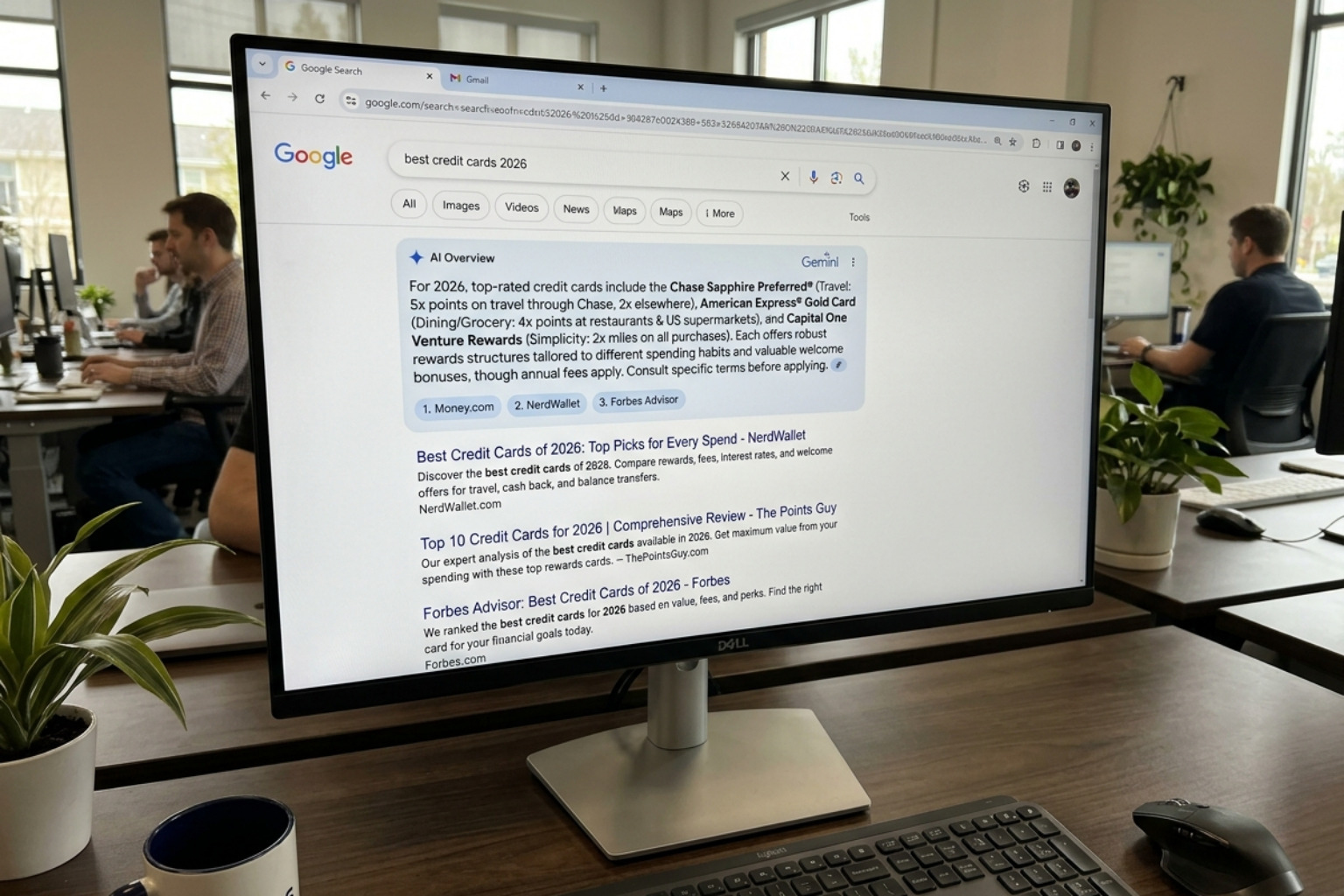
Organic search is undergoing a fundamental disruption that alters how users interact with the results page. In 2026, a Google organic traffic decrease often stems from the rise of AI Overviews and the expansion of zero-click searches. These features provide immediate answers, effectively satisfying user intent before they ever reach the traditional "blue links" below.
Data from 2025 indicates that global publisher search traffic declined by a third, with U.S. publishers seeing a 38% year-over-year drop. This shift is particularly visible in informational queries. When Google provides a comprehensive summary at the top of the page, the incentive for a user to click an external link vanishes. This trend is not limited to simple definitions. AI Overviews now appear for 18.57% of commercial queries and 13.94% of transactional queries, moving the impact further down the sales funnel.
The competition for clicks has moved from a battle for the top spot to a battle for citation eligibility. Traditional SEO focuses on ranking first, but the new landscape rewards sites that provide the data source for the AI's summary. Even if your traffic volume decreases, the quality of the remaining visitors often improves. Some consultancies report a 40% drop in raw organic traffic while seeing a slight increase in monthly conversions. This suggests that AI features filter out low-intent researchers, leaving high-intent buyers to click through to the source.
Identifying a Google Organic Traffic Decrease via Search Console
Google Search Console remains the most reliable tool for diagnosing traffic decrease. The performance report allows you to isolate whether the issue is a loss of visibility or a loss of interest. You should compare your current 90-day window to the previous year to account for seasonality.
A stable impression count paired with falling clicks is the hallmark of the "AI Overview Effect." This pattern confirms that your pages still appear in search results, but users are finding their answers in the AI-generated summary at the top. If both impressions and clicks fall sharply on a specific date, the cause is more likely a core algorithm update or a technical site error.
Technical debt is another factor to investigate. Slow page speeds and broken redirects contribute to 13% of traffic drops in mature companies. Google systems require weeks or months to recrawl and re-index a site after major changes. You can use the Crawl Stats and Page Indexing reports to check for spikes in errors that might be suppressing your visibility. If a site takes longer than three seconds to load, users and search crawlers alike may abandon the page.
Reversing a Google Organic Traffic Decrease through E-E-A-T
Experience, Expertise, Authoritativeness, and Trustworthiness (E-E-A-T) are the primary metrics Google uses to evaluate content quality in 2026. A Google organic traffic decrease often occurs when a site publishes generic, AI-generated content that lacks original insight. Google prioritises content that demonstrates first-hand experience and clear author credentials.
Content pruning is a powerful recovery strategy. Some industry leaders have recovered traffic by removing up to 60% of their thin or off-topic content. This refocuses the site's authority on its core niche. If a marketing blog starts ranking for "office chair reviews" to capture high-volume keywords, it dilutes its topical authority. Removing these tangential pages helps Google's algorithm recognise the site as a trusted expert in its primary field.
Author transparency is equally critical. Every informational page should feature a clear author bio that links to professional profiles and lists relevant credentials. Citations and data-backed insights prove to Google that the content is reliable. In an era where AI can generate endless "consensus content," original data and proprietary frameworks are the only ways to remain relevant and earn citations in AI Overviews.
Algorithmic Updates and Content Decay
Google releases core updates regularly to improve the helpfulness of search results. These updates often result in a significant Google organic traffic decrease for sites that rely on outdated SEO tactics. The December update, for instance, heavily penalised sites with poor user experience and low-quality affiliate content.
Content decay happens when your best-performing pages lose their edge. Competitors may publish more recent data, or search intent for a keyword might shift from informational to commercial. Approximately 61% of companies cite content decay as a major reason for traffic loss. You should regularly refresh your top 20% of pages to ensure they remain the most helpful resource available for their target queries.
Algorithm updates do not just change who ranks; they change how the page looks. More ads and more AI features push organic results further down the page. This SERP crowding accounts for 61% of traffic declines. To combat this, you must optimise for rich features like FAQ schema and structured data. These technical additions make your content more eligible for featured snippets and AI citations, helping you capture visibility even when traditional clicks are down.
Strategic Lessons from HubSpot and Forbes
Major websites provide clear examples of how a Google organic traffic decrease can occur at scale. HubSpot experienced a 55% decline in organic traffic between late 2024 and early 2025. Their blog traffic share fell significantly because they had expanded into too many off-topic areas, such as "cover letter examples," which diluted their authority as a CRM provider. Despite this metric drop, their revenue grew, proving that high-intent traffic is more valuable than raw volume.
Forbes Advisor faced a similar challenge, losing 60% to 80% of its organic search visibility in certain verticals. This was largely attributed to site reputation abuse, where a high-authority domain is used to host low-quality affiliate content. Google's systems now better identify when a site is leveraging its brand name to rank for unrelated, low-value keywords.
The lesson for businesses is clear: stay in your lane. Building deep topical authority in a specific niche is more resilient than trying to capture every high-volume keyword in existence. Site reputation and brand trust are harder to build than traffic, but they are the only sustainable defences against algorithm shifts. Maintaining a clean link profile and avoiding aggressive affiliate tactics are essential for long-term stability.
The Strategic Advantage of AuraSearch
AuraSearch provides the technical and strategic framework needed to navigate the complexities of modern search. As the search landscape shifts from traditional rankings to Generative Engine Optimisation (GEO), businesses need a partner that understands how AI models synthesise and cite information. We specialise in helping brands adapt to these changes by focusing on entity optimisation and citation eligibility.
Our approach goes beyond traditional SEO. We help you restructure your content so it is easily parsed by AI Overviews and other generative platforms like ChatGPT. This ensures that even if traditional traffic declines, your brand remains the primary source of truth in the AI layer of search. Our data-driven methodology identifies exactly where your traffic is going and implements a recovery plan focused on high-conversion visibility.
By partnering with AuraSearch, you gain access to expert generative AI SEO services that are designed for the 2026 search environment. We help you move from a defensive posture of "fixing drops" to a proactive strategy of "dominating visibility." Our goal is to ensure your business remains visible, authoritative, and profitable, regardless of how Google changes its results page.
FAQs
Why is my organic traffic dropping but rankings are stable?
Stable rankings paired with declining traffic often indicate the presence of AI Overviews or other zero-click SERP features. These features provide direct answers to users, satisfying their intent without requiring a click to your website. You can confirm this by checking if your impressions remain steady while your click-through rate (CTR) falls in Google Search Console.
How do AI Overviews affect click-through rates?
AI Overviews significantly reduce click-through rates by approximately 35% for informational queries. Because the AI provides a comprehensive summary at the top of the page, users frequently find the information they need without scrolling to traditional organic links. This shift necessitates a move toward optimising for AI citations rather than just traditional blue-link rankings.
Can a website recover from a Google core update?
Recovery from a Google core update is possible but typically requires three to six months of consistent quality improvements. You must conduct a comprehensive content audit to remove thin or unhelpful pages and strengthen your E-E-A-T signals. Google's systems need time to recrawl and re-evaluate your site to confirm it now meets their updated helpfulness standards.
What is the difference between zero-click and AI search?
Zero-click search refers to any result where the user gets an answer on the SERP, such as a featured snippet or knowledge panel. AI search specifically refers to generative responses from systems like Google AI Overviews or ChatGPT that synthesise information from multiple sources. Both trends reduce traditional traffic, but AI search requires specific optimisation for citation eligibility.
How does technical debt contribute to traffic loss?
Technical debt, including slow page speeds, broken redirects, and poor mobile responsiveness, can quietly suppress your search visibility. While only 13% of mature companies cite it as a primary cause of traffic drops, it often exacerbates the impact of algorithm updates. Ensuring your site loads in under three seconds is a critical baseline for maintaining organic performance in 2026.
Should I focus on traffic volume or conversion quality?
Marketers should prioritise conversion quality and high-intent traffic over raw session volume as search becomes more fragmented. Many sites report a 40% decrease in organic traffic while maintaining or even increasing their total conversions. This paradox occurs because AI Overviews filter out low-intent browsers, leaving more qualified leads to click through to your site.
How do I detect seasonality in my traffic data?
You can detect seasonality by comparing your current performance to the same period in the previous year using the 16-month date range in Google Search Console. Tools like Google Trends also help distinguish between a site-specific issue and a broader decline in industry-wide search interest. If impressions are falling across your entire niche, the cause is likely a shift in consumer demand rather than an SEO failure.
What are the main reasons for organic traffic drops beyond AI?
Beyond AI Overviews, the primary causes of traffic decline include core algorithm updates, increased competition, and content decay. Algorithm updates account for 69% of reported drops, while SERP crowding from ads and rich features impacts 61% of sites. Regularly refreshing your top-performing content is essential to prevent competitors from eroding your established positions.
Recent Posts